





The 20th edition of WAVES Film Bazaar brought together 2,288 delegates from 54 countries, including 471 buyers, reaffirming its role as a platform for connecting filmmakers, nurturing talent and strengthening collaborations between Indian and international cinema. Organised by the National Film Development Corporation (NFDC) alongside the 57th International Film Festival of India (IFFI), the five-day marketplace facilitated around 220 scheduled business-to-business (B2B) meetings at its Co-Production Market. Two letters of intent for India-Chile co-productions were signed, while 14 MoUs and agreements are nearing finalisation following business interactions.
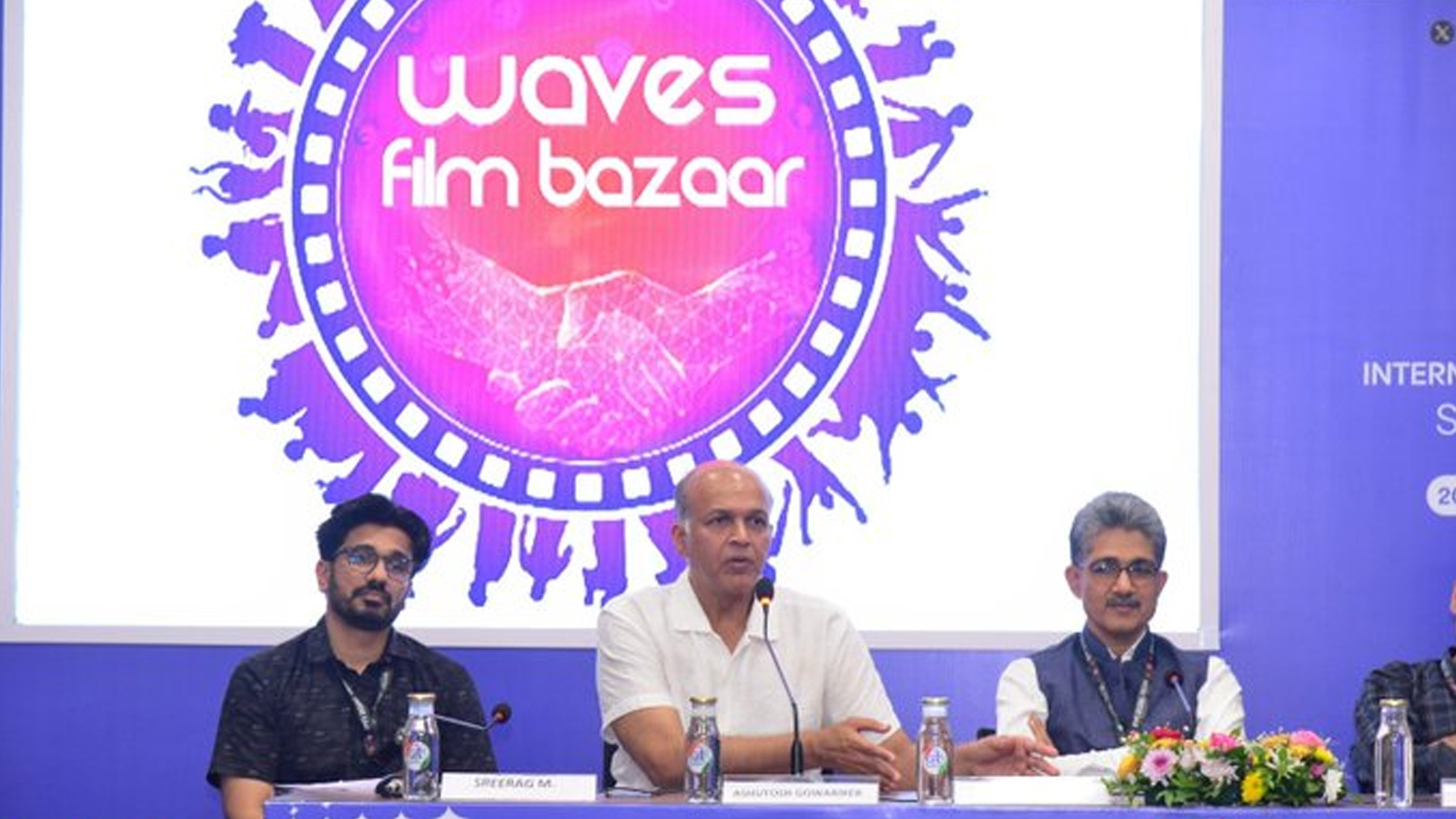
Sharing the outcomes at a press conference organised by the Press Information Bureau (PIB), Additional Secretary, Ministry of Information and Broadcasting, Prabhat, said the Co-Production Market had facilitated around 220 scheduled one-to-one meetings.
IFFI Festival Director Ashutosh Gowariker, NFDC Managing Director Dhiraj Singh and WAVES Film Bazaar Officer on Special Duty Sreerag M also participated in the interaction.
Co-Production Market and Project Development
The Co-Production Market featured 25 projects representing eight countries and 16 languages, including 13 Indian languages. Alongside the scheduled meetings, additional business interactions helped projects connect with potential partners and investors. Production house Khan & Kumar Media came on board as a producer for Hurda (That Tight Green Top), one of the selected feature projects.
WAVES Film Bazaar also supported projects at different stages of development through its Co-Production Market, Screenwriters’ Lab, Work-in-Progress Lab and Viewing Room.
The Viewing Room recorded 170 project entries, with 155 films viewed by 608 visitors over nearly 100 hours. The projects represented 11 countries and a wide range of languages. The Bengaluru International Short Film Festival will select four short films from the Viewing Room for consideration in its festival programme. Panorama Studios is also considering projects for theatrical distribution, in-flight entertainment and non-theatrical rights.
Five projects were selected from 53 submissions to the Work-in-Progress Lab. Each selected project received three feedback sessions from industry mentors.
The Screenwriters’ Lab also secured industry collaboration for selected projects. Filmmaker Santosh Singh and Super Zero Films came on board as director and co-producer, alongside Travelin Bone Entertainment, for The Japanese Wife, a project by Sanchita Sinha.
Financial Grants and Professional Support
WAVES Film Bazaar extended financial and professional support to projects through cash grants, distribution opportunities, fellowships, casting services and post-production assistance.
Under the NFDC Cash Grants, USD 10,000 was awarded to Nose Bone, directed by Garima Pura, while USD 5,000 each went to Goodbye Mr D’Mello, directed by Ridham Janve, and Fireflowers, directed by Sreemoyee Singh.
The Reborn India Film Cash Grant of ₹1 lakh was awarded to And on That Day…, directed by Kushal Kishore and Kushagra Kishore. Goodbye Mr D’Mello also received the Mukesh Chhabra Casting Award, which provides free casting services.
The Prasad Corporation Post-Production Award went to Nadhi, directed by Aditya Vempaty, while the Mica Creative Fellowship was awarded to Aattumali (By the River), directed by Ajith Velayudhan. The Moviebuff Post-Production Awards went to Aaram Nagar, Kaareng and Chakachaundh.
The Reborn India Film Distribution Award was presented to Bhai Band (One Two Three Mic Check), directed by Manish Saini.
The Work-in-Progress Lab also recognised projects through several awards. The Prasad Corporation Post-Production Award and the IICT Work-in-Progress Lab Award went to The Garden of Us. Special mentions were given to Family Matter, Saja (The Blackstone Ratio) and Where Has the River Gone under the Prasad Corporation award. The Nube Studio Post-Production Award went to Aattumali (By the River).
International Participation, Technology and Startups
The marketplace hosted 12 State Pavilions and four Country Pavilions, with Russia participating as the Partner Country. It also featured 22 market stalls, providing opportunities for industry representatives to showcase projects and explore collaborations.
The technology segment included companies such as Netflix and Dolphin AI, which launched its AI Studio at the marketplace. The WaveX Startup Showcase brought together 10 startups working across media, entertainment and emerging technologies.
According to post-event feedback, participating startups reported more than 299 meetings and 14 deals and agreements across six startups, including one MoU.
Knowledge Series Focuses on Emerging Industry Trends
Held from November 21 to 24, the four-day Knowledge Series featured 25 panel sessions with around 127 panellists and 17 moderators from India and abroad. Leading industry representatives from organisations including Netflix India, Prime Video and Amazon MGM Studios participated in the discussions.
The sessions covered the evolution of Indian stories into global intellectual property, streaming trends, the changing entertainment landscape, independent cinema, international co-productions, film financing and regional filmmaking ecosystems. Discussions also focused on animation, visual effects, gaming and comics (AVGC-XR), artificial intelligence, emerging technologies and future creative skills in the media and entertainment sector.
The sessions brought together filmmakers, actors, producers, OTT executives, festival programmers, distributors, policymakers, investors and technology professionals.
Industry Leaders Highlight Long-Term Impact and Role of Technology
Observing that the impact of the marketplace would unfold over time, Prabhat said, “These interactions, so many B2B meetings, and animated discussions would show result maybe next year, next to next year, or coming three-four years.”
Ashutosh Gowariker emphasised the need to embrace emerging technologies while retaining the centrality of human creativity and emotion. He described artificial intelligence as a tool that could assist filmmakers but could not replace human intervention. He added that technological advancements would expand the possibilities of cinematic expression without diminishing the importance of content-driven films.
Sreerag M highlighted WAVES Film Bazaar’s contribution to independent Indian cinema, citing films such as Aattam, Boom and Angh as examples of projects supported by the platform that subsequently received national and international recognition.
The press conference was moderated by Sayyid Rabeehashmi.
(PIB)


