






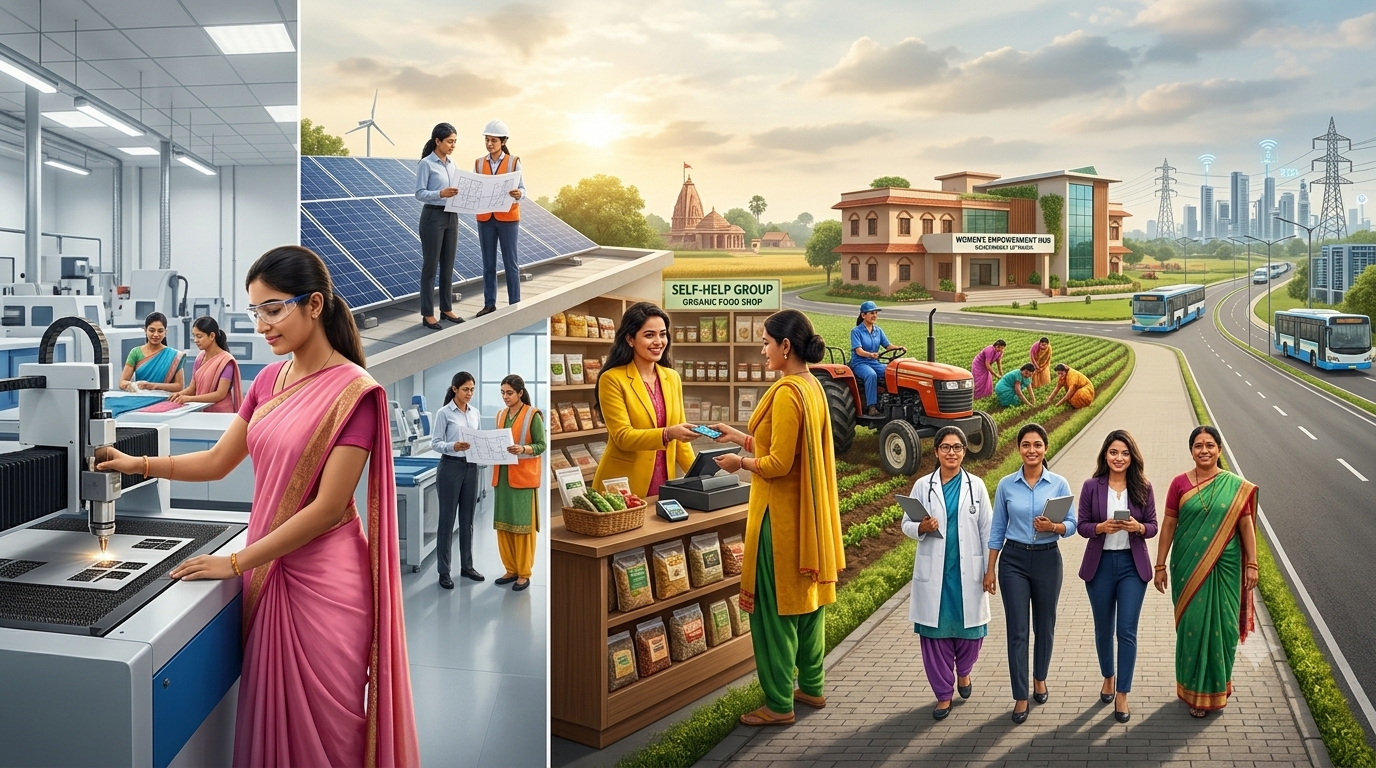
Women’s empowerment has emerged as an important pillar of India’s development journey, with greater emphasis on ensuring that women are not merely beneficiaries of government welfare programmes but active participants in the country’s economic, social and political progress.
Under the leadership of Prime Minister Narendra Modi, the central government has undertaken several initiatives aimed at expanding opportunities for women, strengthening their financial independence and encouraging their participation in entrepreneurship, education, innovation and leadership.
The vision of a developed India or Viksit Bharat, places women at the centre of national transformation. Recognising their contribution to society and the economy, the government has increasingly focused on creating an environment in which women can pursue their ambitions, develop their skills and become decision-makers in their own lives.
From women’s development to women-led development
One of the significant aspects of the government’s approach has been its emphasis on women-led development. Rather than limiting empowerment to welfare and financial assistance, the focus has expanded towards enabling women to become entrepreneurs, professionals, innovators and community leaders.
Initiatives such as Beti Bachao Beti Padhao have helped strengthen awareness about the importance of the girl child, education and gender equality. Similarly, the Pradhan Mantri Ujjwala Yojana has provided LPG connections to women from economically weaker households, improving access to cleaner cooking fuel and reducing the burden of traditional cooking practices.
Financial inclusion has also played a significant role. Through the Pradhan Mantri Jan Dhan Yojana, millions of women have gained access to formal banking services, while the Pradhan Mantri Mudra Yojana has enabled aspiring women entrepreneurs to access financial support for starting and expanding small businesses.
Empowering women through entrepreneurship
The growing participation of women in entrepreneurship is an important indicator of India’s changing economic landscape. Government initiatives such as Stand-Up India and the Lakhpati Didi programme have sought to encourage women to establish enterprises, strengthen self-help groups and build sustainable sources of income.
The Lakhpati Didi initiative, in particular, reflects the government’s effort to transform rural women from participants in community-based activities into financially independent entrepreneurs.
Through skill development, financial assistance, market access and institutional support, women associated with self-help groups are exploring opportunities in agriculture, food processing, handicrafts, dairy and other sectors.
The emergence of women-led enterprises is not only improving household incomes but also contributing to employment generation and economic development at the grassroots level.
Expanding opportunities in education and leadership
Women’s empowerment also depends on access to quality education, skills and opportunities. Through initiatives such as Beti Bachao Beti Padhao, the government has sought to encourage families to invest in girls’ education and challenge traditional barriers. Greater emphasis on STEM education, vocational training and digital literacy is opening new pathways for young women to participate in emerging sectors.
The 106th Constitutional Amendment, providing for reservation of one-third of seats for women in the Lok Sabha and State Legislative Assemblies, represents another significant step towards strengthening women’s political representation. It reflects the government’s recognition that women’s participation in decision-making is essential for inclusive governance.
Nari Shakti as a driving force of Viksit Bharat
The growing presence of women in diverse fields, from science and technology to sports, defence, administration and business, reflects the changing aspirations of Indian society. Government initiatives can provide institutional support, but the determination, talent and hard work of women remain the real drivers of this transformation.
Prime Minister Modi’s emphasis on Nari Shakti reflects an approach that views women’s empowerment as central to national development rather than merely a social welfare objective. The journey towards Viksit Bharat 2047 will depend significantly on creating equal opportunities, ensuring safety, improving access to education and finance, and encouraging women to occupy leadership positions.
Ultimately, an empowered woman contributes not only to her family’s prosperity but also to the strength of her community and the nation’s economy. As India moves towards a more inclusive and developed future, the vision of women-led development offers an important pathway to progress.
The rise of Nari Shakti is not simply a story of changing opportunities, it is a story of a changing India, where women are increasingly shaping the country’s future as equal partners in nation-building.


