







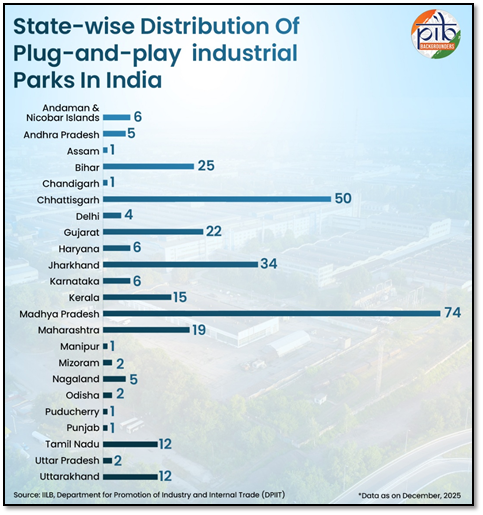
Industrial parks are increasingly emerging as a central pillar of India’s industrial and innovation strategy, facilitating smarter infrastructure, sustainable development and stronger industrial growth, according to official data released on Tuesday.
India currently has more than 4,500 industrial parks mapped on the India Industrial Land Bank (IILB), covering a total area of about 7.70 lakh hectares, with nearly 1.35 lakh hectares still available for industrial development. The country also has 306 plug-and-play industrial parks and 20 parks and smart cities being developed under the National Industrial Corridor Development Corporation (NICDC).
Industrial parks are playing a critical role in strengthening India’s manufacturing base by attracting investment, generating employment and promoting environmentally responsible industrialisation. Developed in partnership with state governments and the private sector, these parks provide shared infrastructure, streamlined approvals and a predictable regulatory environment for industries.
An industrial park is defined as a planned and demarcated area developed for industrial use, supported by common facilities such as utilities, internal roads, waste management systems, laboratories, logistics services, training centres and security infrastructure. Dedicated park management authorities oversee compliance, firm entry and long-term development.
Beyond economic growth, industrial parks are also being positioned as models of sustainable and inclusive development. Park authorities ensure adherence to environmental norms, promote resource efficiency, monitor emissions and safeguard biodiversity. Social infrastructure, worker safety, gender-sensitive facilities and community engagement are also integral to park planning and operations.
To support faster industrial expansion, the government has prioritised plug-and-play industrial parks that offer ready-to-use infrastructure tailored to industry needs. In the Union Budget 2025–26, an allocation of Rs. 2,500 crore was made for the development of such parks. Of the 20 NICDC-led projects, four have been completed, four are under construction, while others are at various stages of bidding and tendering.
The India Industrial Land Bank, developed by the Department for Promotion of Industry and Internal Trade (DPIIT), serves as a GIS-enabled, one-stop platform providing real-time information on industrial land availability across states and Union Territories. As of December 23, 2025, the IILB has mapped 4,523 industrial parks comprising over 6.45 lakh plots, of which more than 1.25 lakh plots remain vacant, offering significant opportunities for new investments.
To benchmark quality and performance, the government has institutionalised the Industrial Park Rating System (IPRS). Under IPRS 2.0, 41 parks have been classified as ‘Leaders’, 90 as ‘Challengers’ and 185 as ‘Aspirers’, based on infrastructure quality, operational efficiency and industrial activity. In September 2025, IPRS 3.0 was launched with expanded parameters, including sustainability, green infrastructure, logistics connectivity, digitalisation, skill linkages and tenant feedback.
Industrial parks are also playing a vital role in attracting foreign direct investment. According to UNCTAD’s World Investment Report 2025, India ranks among the top five global destinations for Greenfield project investments. During April–August 2025–26, provisional FDI inflows stood at USD 43.76 billion, up from USD 37.03 billion in the same period last year.
Ease-of-doing-business reforms, including single-window systems, GST implementation, Startup India incentives and compliance reduction measures, have further enhanced the attractiveness of industrial parks for domestic and foreign investors.
With planned design, shared infrastructure and coordinated governance, industrial parks are expected to remain at the forefront of India’s industrial transformation. The government said continued focus on digital land access, sustainability benchmarks and global best practices will help industrial parks emerge as long-term engines of economic growth, employment generation and global manufacturing competitiveness.


