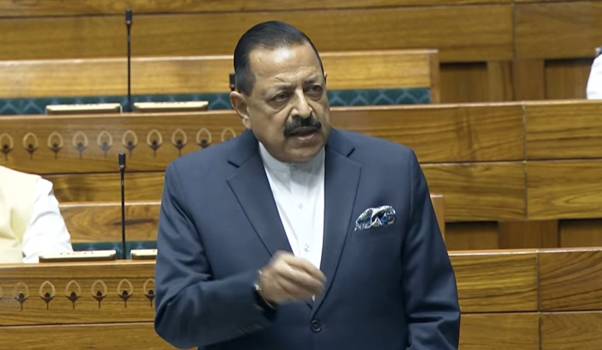
Union Minister of State for Science and Technology and Department of Space, Dr. Jitendra Singh, informed the Lok Sabha that ISRO has successfully conducted the Integrated Main Parachute Airdrop Test (IMAT), marking a major step in India’s preparations for the Gaganyaan mission. The Minister said the test strengthens the qualification campaign for the Crew Module’s parachute-based deceleration system, a core human-rating requirement for the country’s maiden human spaceflight.
The latest IMAT simulated one of the toughest descent conditions by introducing a deliberate delay in the disreefing sequence between two main parachutes. Dr. Singh explained that the scenario created asymmetric forces to test the system under extreme stress. The structure and load-bearing performance were validated, supporting progress toward the first crewed mission targeted for the first quarter of 2027.
Responding to questions on oversight mechanisms, the Minister said ISRO’s Crew Module parachute system undergoes continuous independent reviews. Bodies such as the Design Review Team, the Independent Assessment Committee, and the National Advisory Panel for Human Rating and Certification evaluate all test results to ensure thorough scrutiny of safety-related systems.
On transparency, Dr. Singh said ISRO has been sharing major test outcomes, including the recent IMAT results, and will continue to keep the public informed as the mission moves forward.
The Minister highlighted that crew safety remains the top priority for Gaganyaan. He noted that astronaut training includes detailed simulations of emergency conditions, survival procedures for off-nominal landings, operation of emergency survival kits and ongoing psychological support. Each qualification test contributes to improving systems, refining crew training and strengthening recovery preparations.
Dr. Jitendra Singh told Parliament that ISRO has put in place a comprehensive risk assessment and mitigation framework aligned with global standards. Oversight by the Human Rating Certification Board and the National Advisory Panel helps ensure mission risks remain within permissible limits.
He said the successful IMAT is not just a technical achievement but a milestone that enhances the mission’s overall preparedness as India moves toward its first human spaceflight.