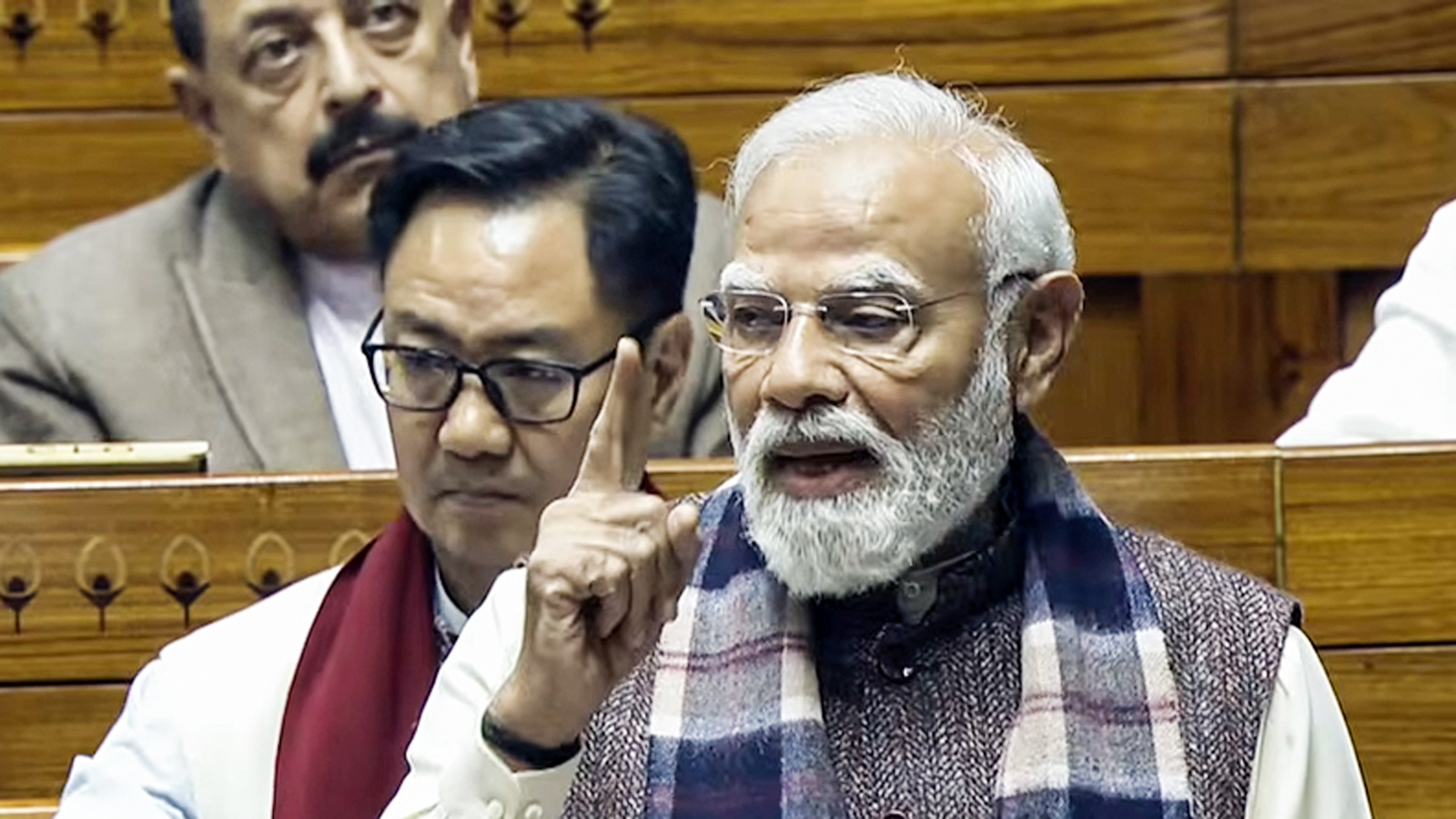
Prime Minister Narendra Modi on Monday addressed a special discussion in the Lok Sabha marking 150 years of Vande Mataram, calling the national song the “mantra that energised and guided India’s freedom movement” and a timeless symbol of the country’s cultural and spiritual unity.
PM Modi thanked all Members of Parliament for participating in the discussion, describing the occasion as a collective tribute to the spirit that shaped India’s independence struggle. “It is a matter of pride for all of us that we are witnessing 150 years of Vande Mataram,” he said.
Tracing the origins of Vande Mataram, the Prime Minister said Bankim Chandra Chattopadhyay composed it in 1875 at a time when India was under intense colonial pressure. The song, he noted, awakened a civilizational consciousness that had flourished in India for thousands of years.
“Vande Mataram revived the thought deeply ingrained in India’s soul – that this land is our mother,” PM Modi said. He described the song as an expression of India’s cultural values, combining the imagery of knowledge, prosperity and valour.
PM Modi recalled how the song became the rallying cry of freedom fighters from Bengal to Punjab. He noted that during the partition of Bengal in 1905, Vande Mataram emerged as the unifying call of the Swadeshi movement, prompting British authorities to ban its singing, printing and public recitation.
The Prime Minister narrated instances of children and women being punished for invoking the song, citing examples from Barisal, Nagpur and other centres of resistance. He paid homage to revolutionaries including Khudiram Bose, Ashfaqulla Khan, Ram Prasad Bismil and Masterda Surya Sen, who chanted Vande Mataram until their final moments.
“No other poem or song in world history inspired millions for generations in the way Vande Mataram did,” PM Modi said.
Quoting Mahatma Gandhi’s 1905 writings, PM Modi said Gandhi had regarded Vande Mataram as “almost the national anthem” and praised its purity and patriotism.
He emphasized that, unfortunately, on October 26, 1937, the Congress compromised on Vande Mataram, fragmenting it through its decision. He noted that this move was presented under the guise of promoting social harmony, but history clearly shows that the Congress bowed before the Muslim League and adopted a politics of appeasement.
Addressing the House, the Prime Minister remarked that under the weight of appeasement politics, the Congress first bent on Vande Mataram – and eventually had to bend on the partition of India. He asserted that the party had outsourced its decision-making and, regrettably, its approach has remained unchanged. The Prime Minister also criticized the opposition and its allies for continuing to indulge in appeasement politics and repeatedly attempting to create controversies surrounding Vande Mataram.
PM Modi said the spirit of Vande Mataram continued to guide India after independence – during food crises, wars, the Emergency, and more recently, the COVID-19 pandemic. “Whenever India faced challenges, the nation advanced with the spirit of Vande Mataram,” he said.
The Prime Minister called the 150-year milestone an opportunity to renew national resolve for the future. “Just as the spirit of Vande Mataram nurtured the dream of freedom, it will nurture the dream of prosperity,” he asserted, urging the nation to work together toward building a developed India by 2047.
PM Modi concluded by saying that Vande Mataram is not just a song but a stream of consciousness that unites the nation. “It is a mantra of sacrifice, strength, purity and dedication,” he said, expressing confidence that the discussion in the Lok Sabha would inspire the younger generation and strengthen the country’s resolve.