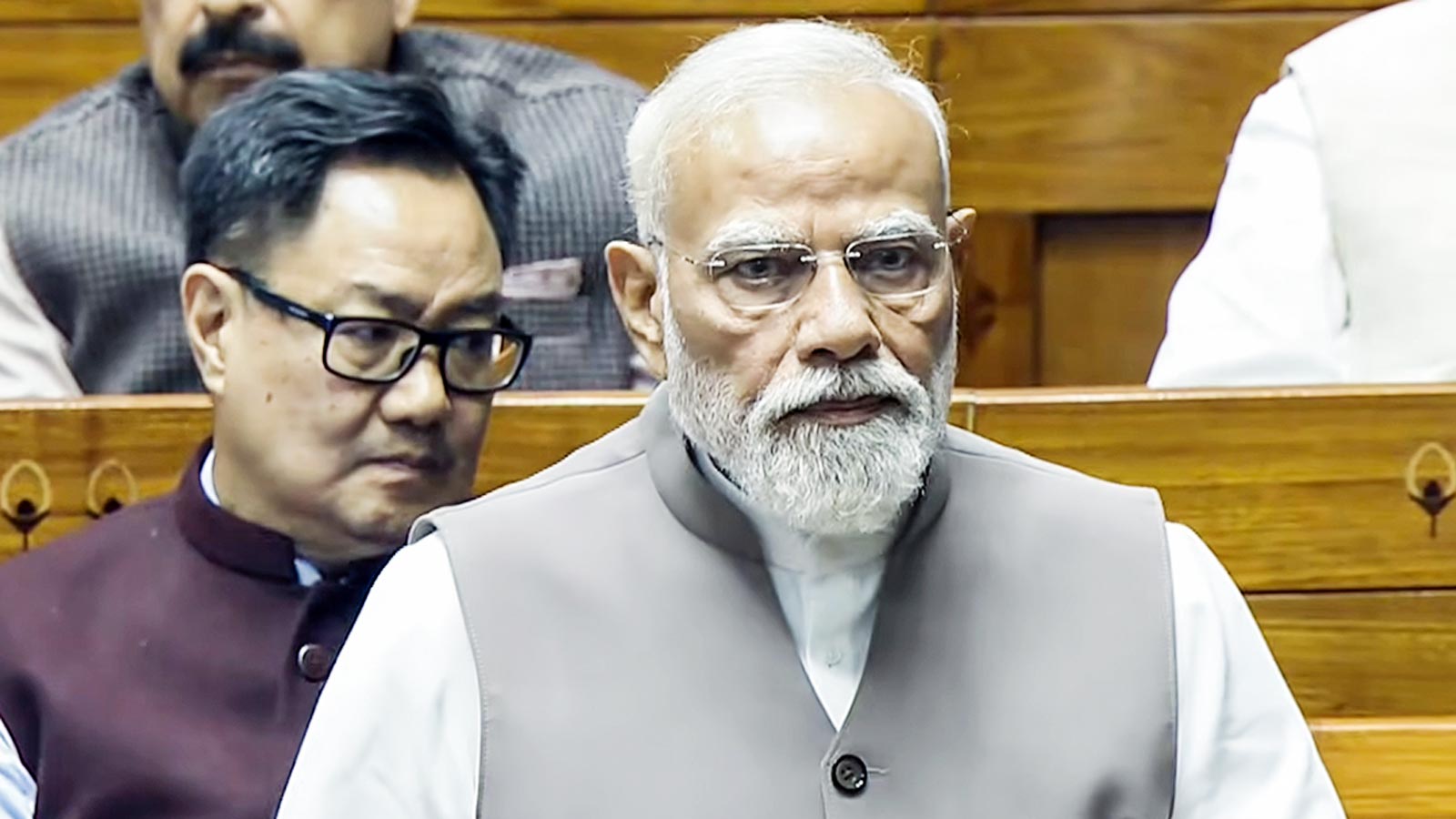
Prime Minister Narendra Modi on Monday addressed the Lok Sabha on the ongoing conflict in West Asia, highlighting its wide-ranging impact on India’s economy, energy security, and citizens abroad, while calling for unity and a peaceful resolution to the crisis.
Describing the situation as serious, the Prime Minister said, “The situation in West Asia is concerning at this time… This crisis has been going on now for more than three weeks. It is having a very adverse impact on the global economy and on people’s lives.” He added, “The whole world is urging all parties for the earliest resolution of this crisis.”
Referring to earlier briefings to Parliament by External Affairs Minister Subrahmanyam Jaishankar and Petroleum Minister Hardeep Singh Puri, PM Modi said the government has been keeping the House informed about developments over the past weeks.
Highlighting India’s strong stakes in the region, the Prime Minister noted, “This region is important to us… as nearly one crore Indians live and work in the Gulf countries,” and added that “among the commercial ships that sail in these seas, the number of Indian crew members is also very high.” Stressing the need for political unity, he said, “India’s concerns are naturally high… it is essential that a unanimous and united voice from India’s Parliament on this crisis reaches the world.”
The Prime Minister underlined the economic and trade implications of the conflict, stating, “India has extensive trade relations with countries at war and affected by war… the region where the war is taking place is also an important route for our trade with other countries of the world.” He specifically pointed to the strategic importance of the Strait of Hormuz, saying, “A large quantity of essential items such as crude oil, gas, and fertilizers come to India through the Strait of Hormuz… since the war began, the movement of ships… has become highly challenging.”
Despite these disruptions, PM Modi assured that the government is working to minimise the impact on citizens. “Our government has been trying to ensure that the supply of petrol, diesel and gas is not affected much and common families… face minimum inconvenience,” he said.
Detailing India’s response to safeguard its nationals abroad, the Prime Minister said that all necessary assistance is being provided. He noted that Indian missions are actively supporting citizens, issuing advisories, and operating round-the-clock helplines. Over 3,75,000 Indians have returned home since the conflict began, including many students from Iran.
On energy security, PM Modi highlighted the government’s long-term preparedness. He said India has diversified its energy imports from 27 to 41 countries and built significant reserves. “In today’s circumstances, the steps taken over the past decade regarding energy security have become even more relevant,” he remarked, adding that India has a Strategic Petroleum Reserve of over 53 lakh metric tonnes with additional capacity under development.
The Prime Minister also pointed to efforts to secure supply chains and maritime routes. “We are in continuous dialogue with global partners to keep our maritime corridors secure,” he said, noting that several ships previously stranded in the Strait of Hormuz have now reached India.
Highlighting domestic energy reforms, PM Modi said India’s ethanol blending has increased significantly. “A decade ago, ethanol blending was only about 1-1.5%; today, we are nearing 20%,” he said, adding that initiatives like railway electrification, metro expansion, and electric mobility are reducing dependence on fossil fuels.
On agriculture, the Prime Minister reassured farmers, stating, “Our farmers have filled our granaries, so India has sufficient food grains.” He added that the government has ensured fertilizer availability despite global price spikes, recalling, “In the past too, our government did not allow the burden of global crises to fall on the farmers.”
Addressing power supply concerns amid rising summer demand, PM Modi said India has sufficient coal stocks and a growing renewable energy base. He noted that renewable sources now account for nearly half of installed power capacity, with solar energy witnessing significant growth in the past decade.
On diplomacy, the Prime Minister reiterated India’s consistent stance. “India has always stood for peace in the interest of humanity. Dialogue and diplomacy are the only solutions to this problem,” he said. He further emphasized, “Putting anyone’s life at risk in this war is not in the interest of humanity… India’s efforts are to encourage all parties to reach a peaceful resolution as soon as possible.”
The Prime Minister also warned against internal security risks during such crises, stating that all agencies are on high alert across coastal, border, cyber, and strategic domains.
He also noted that the CBSE has cancelled the scheduled Class 10th and 12th examinations in Indian schools in the Gulf countries and is taking steps to ensure continuity of education.
Stressing that the government’s focus has been on protecting ordinary families from hardship, and noting measures such as prioritizing domestic use of LPG and boosting its domestic production, PM Modi remarked, “Continuous work has been done to ensure that the supply of petrol and diesel continues smoothly across the entire country.”
He informed the House that India today possesses a Strategic Petroleum Reserve of more than 53 lakh metric tonnes, with work underway to build reserves exceeding 65 lakh metric tonnes, in addition to the separate reserves held by oil companies.
Recalling how, even during the COVID-19 pandemic and associated global supply chain disruptions, when urea prices soared to Rs 3,000 per bag in international markets ,the government ensured that Indian farmers received the same bag at less than Rs 300, PM Modi declared, “In the past too, our government did not allow the burden of global crises to fall on the farmers.”
Detailing the structural steps taken to insulate Indian agriculture from external shocks, the Prime Minister noted that six new urea plants have been commissioned in the last decade, adding over 76 lakh metric tonnes of annual production capacity, while domestic output of DAP and NPKS fertilizers has been increased by approximately 50 lakh metric tonnes and fertilizer import sources have been diversified. Underscoring the breadth of these efforts, PM Modi said, “Just as we have diversified oil and gas imports, we have also expanded our options for the import of DAP and NPKS.”
Concluding his address, the Prime Minister remarked that the difficult global conditions caused by this war are likely to persist for a long time and called upon the nation to remain prepared and united, just as it had stood together during the COVID-19 pandemic.