







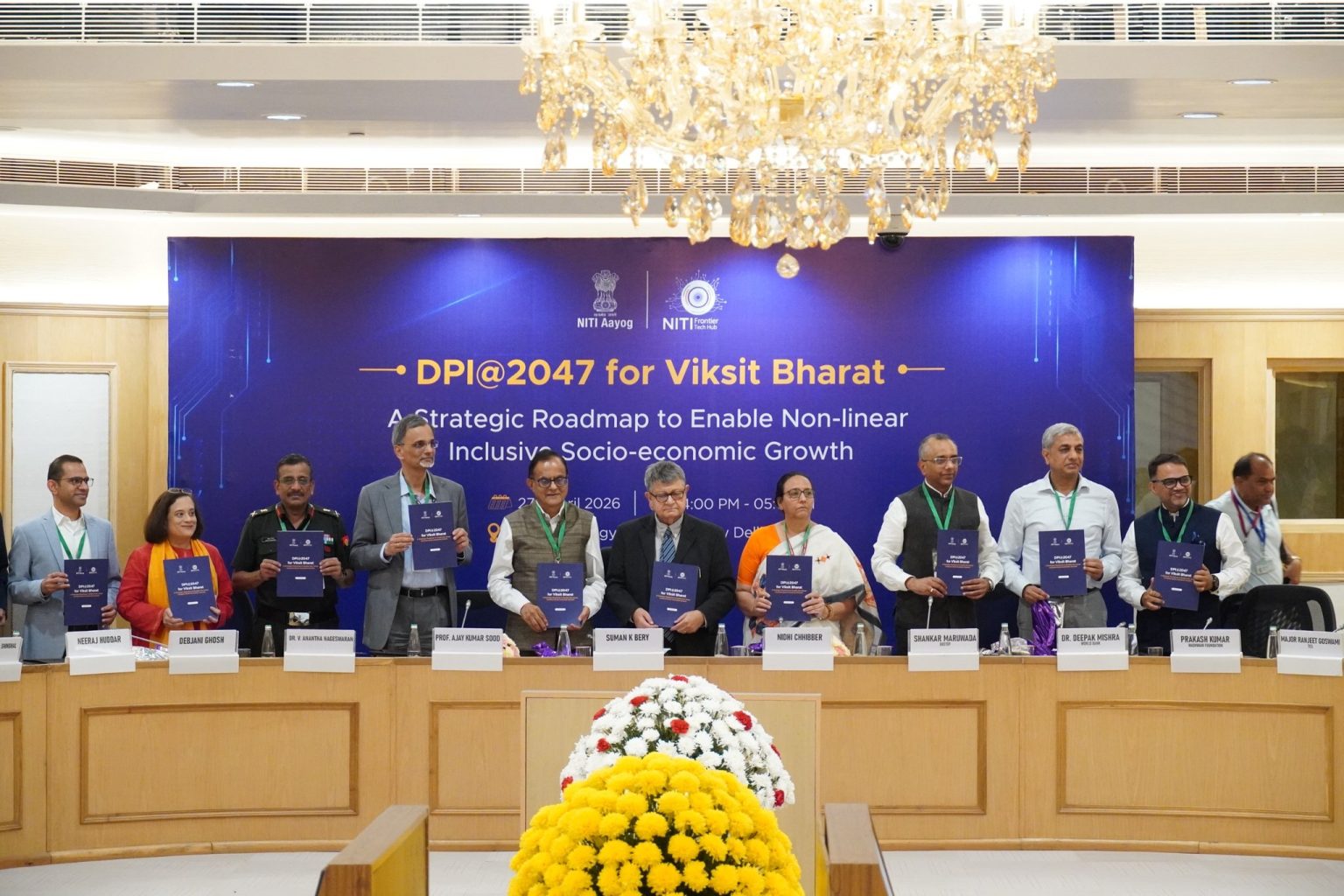
NITI Aayog has unveiled the DPI@2047 roadmap, outlining the next phase of India’s Digital Public Infrastructure (DPI) to drive inclusive and productivity-led economic growth.
The roadmap was launched by Suman Bery and Ajay Kumar Sood in the presence of senior policymakers, industry leaders and technology experts. Developed in collaboration with EkStep Foundation and Deloitte, the strategy lays out a long-term digital transformation pathway for India.
Two-Phase Strategy for Viksit Bharat
The roadmap proposes a two-phase approach—DPI 2.0 (2025–2035) focused on livelihood-led growth, followed by DPI 3.0 (2035–2047) aimed at enabling broad-based prosperity.
DPI 2.0 identifies eight sectoral transformations across MSMEs, agriculture, education, healthcare, credit, energy and social protection. It also outlines execution priorities such as district-level implementation, scaling technology entrepreneurship, leveraging artificial intelligence, and strengthening data-driven systems.
The initiative marks a shift from the first phase of DPI—built on platforms like Aadhaar and UPI—which focused on inclusion and welfare delivery, to a new model centred on productivity, livelihoods and market access.
Focus on Productivity and AI-Led Growth
Speaking at the launch, Suman Bery said the focus of economic policy is increasingly shifting towards productivity, noting that higher incomes and better living standards depend on sustained gains in efficiency.
Ajay Kumar Sood highlighted that the next phase of technological leadership will depend on the ability to translate innovation into scalable public outcomes, supported by open and interoperable systems.
Officials also stressed the role of artificial intelligence in enabling large-scale economic transformation, particularly through local language applications and wider access to digital tools.
CEA Flags Role of DPI in Managing Energy Risks
Chief Economic Advisor V Anantha Nageswaran said DPI 2.0 can help India mitigate the economic impact of global energy price shocks, particularly those arising from disruptions in West Asia.
He noted that India’s reliance on imported fossil fuels, coupled with volatile global energy markets, creates fiscal and inflationary pressures that affect vulnerable sections of society.
“We are navigating a period of acute energy market volatility… productivity and competitiveness gains through DPI 2.0 will be crucial for policymakers,” he said.
Nageswaran described DPI 2.0 as a “total factor productivity engine” designed to strengthen economic resilience, reduce transaction costs, and expand access to markets through interoperable digital networks.
Execution and Long-Term Vision
The roadmap proposes a state-led, district-level implementation model, with pilot projects expected to begin in MSMEs and agriculture in 2026–27.
It also emphasises the need for strong institutional capacity and sustained execution to translate strategy into outcomes.
The DPI@2047 roadmap is aligned with India’s long-term goal of becoming a USD 30 trillion economy by 2047, positioning digital infrastructure as a core driver of growth, resilience and global competitiveness.


