







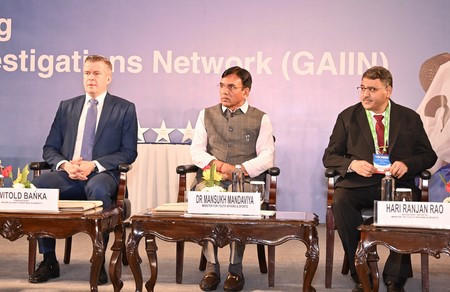
Union Minister for Youth Affairs and Sports Mansukh Mandaviya on Thursday said the government is working to introduce criminal provisions against individuals involved in administering or trafficking prohibited substances.
Speaking at the opening of the final conference of the World Anti-Doping Agency’s Global Anti-Doping Intelligence and Investigations Network (GAIIN), Mandaviya emphasised India’s commitment to fair play and international collaboration in the fight against doping.
He underlined the need for global cooperation, stating that such a network can significantly enhance intelligence-sharing and investigative capabilities. The conference, he said, brings together key stakeholders in the global fight against doping.
Highlighting reforms, Mandaviya said India has undertaken proactive measures “not just for compliance, but with a genuine commitment to the integrity of sports.” He cited the National Anti-Doping Act, 2022, and the proposed amendments aimed at aligning regulations with international standards.
The minister noted that anti-doping efforts have evolved from a focus on testing and athlete compliance to tackling organised, transnational networks involved in doping.
Witold Bańka said WADA’s intelligence and investigations model has evolved to strengthen cooperation between national anti-doping organisations and law enforcement agencies, with support from partners such as INTERPOL and Europol.
Mandaviya said hosting international engagements, including WADA workshops and the current conference, has strengthened India’s investigative capacity and anti-doping ecosystem. He added that India is emerging as a global sporting power.
He also highlighted initiatives such as the Khelo India and the Fit India Movement, noting their role in promoting sports and fitness across the country.
Emphasising ethics, the minister said “athlete values must remain at the core of sporting excellence,” adding that awareness and education are key to preventing both intentional and inadvertent doping violations.
He said the National Anti-Doping Agency follows a multi-layered strategy to raise awareness through workshops, seminars, and digital campaigns, including specialised modules for athletes with disabilities.
Hari Ranjan Rao, Secretary (Sports), said the government has strengthened institutional and investigative capacity, including coordination with enforcement agencies and improved information-sharing. He highlighted partnerships with the Food Safety and Standards Authority of India and the Central Drugs Standard Control Organisation to address risks from contaminated or unregulated substances.
Mandaviya also highlighted technological initiatives such as the “Know Your Medicine” mobile app, which helps athletes verify medicines for banned substances.
He said India has increased anti-doping tests from about 4,000 in 2019 to around 8,000 last year, while adverse findings have declined from 5.6 per cent to below 2 per cent.
Anant Kumar, Director General of NADA India, said testing has expanded alongside a shift towards risk-based and intelligence-driven approaches.
Mandaviya added that India is working to establish new drug-testing laboratories compliant with WADA standards to meet rising demand.
Reaffirming India’s commitment, he said tackling doping requires strong partnerships among governments, regulators and sporting bodies.
IANS


