







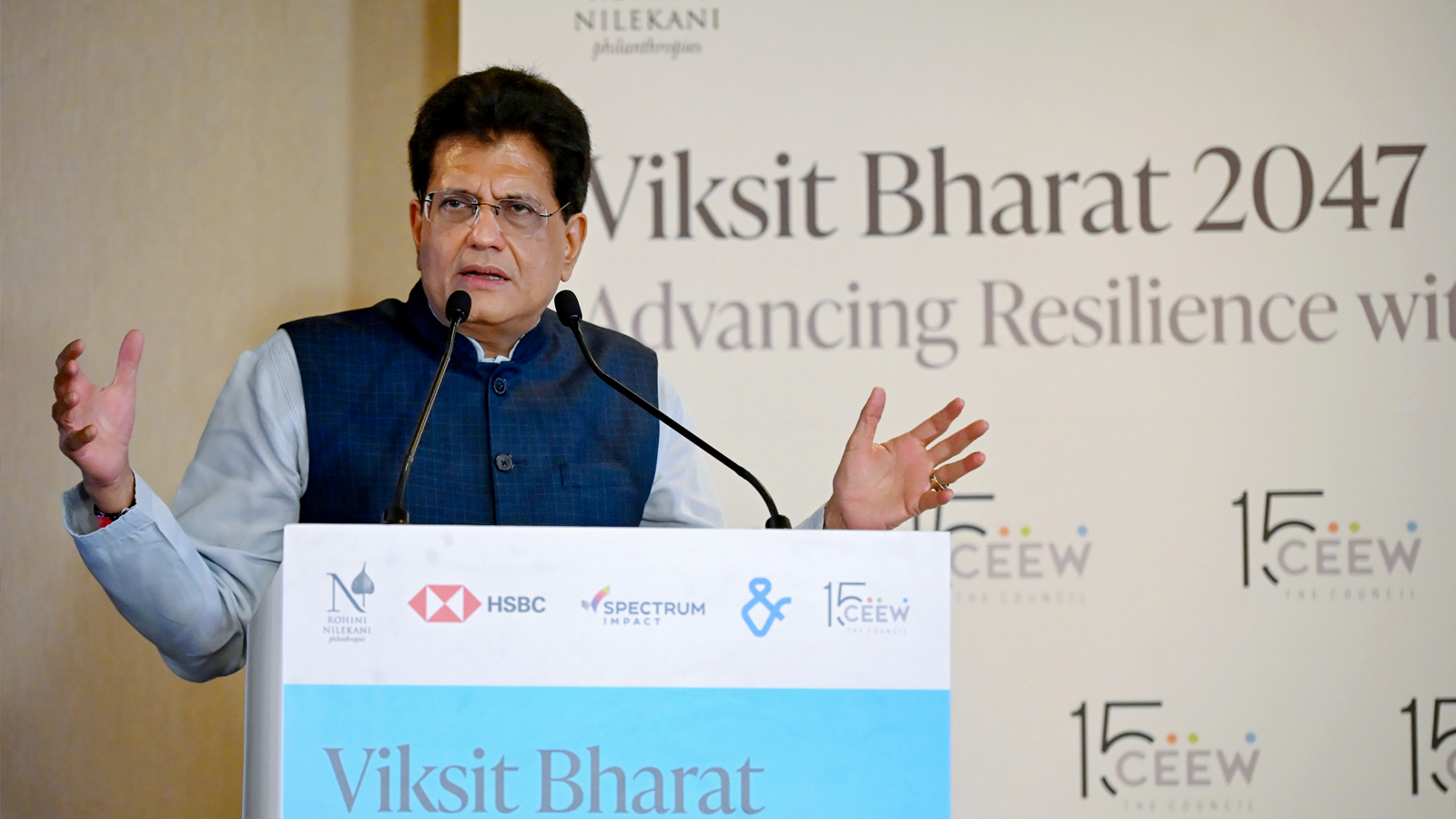
Union Commerce and Industry Minister Piyush Goyal on Wednesday highlighted India’s growing stature as a global leader in climate action, renewable energy expansion, and international economic engagement, asserting that the country is among the top performers in meeting its climate commitments.
Delivering the keynote address at a dialogue on “Advancing Resilience with Climate Change” in New Delhi, Goyal said India has consistently ranked among the top countries in the G20 in achieving its Intended Nationally Determined Contributions (INDCs). He noted that India has already achieved 260 gigawatts of renewable energy capacity, meeting its earlier targets eight years ahead of schedule.
The minister recalled that when the government led by Narendra Modi came to power in 2014, the solar energy target stood at 20 gigawatts over nearly a decade, which was later scaled up to 100 gigawatts and achieved within the stipulated timeframe. “India has now set an ambitious goal of reaching 500 gigawatts of clean energy capacity by 2030,” he said.
Highlighting India’s role in global climate negotiations, Goyal pointed to the country’s leadership during the Paris COP21, where it helped bridge differences between developed and developing nations to achieve a consensus-based outcome. He said India has transitioned from being perceived as a hesitant participant to a proactive global leader in climate action.
On the economic front, Goyal emphasized that India is actively engaging with over a dozen countries and regions to strengthen trade and investment partnerships. These include nations across Latin America, the Middle East, Africa, and Eurasia. “Global confidence in India’s growth story is rising, and the world recognizes India as a key partner in expanding economic opportunities,” he said.
The minister also highlighted structural reforms in the power sector, particularly the implementation of the “One Nation, One Grid” initiative, which integrated regional grids into a unified national network. This, he said, has significantly improved power distribution efficiency and reduced costs across the country.
Goyal underscored that climate action in India has evolved from being seen as an obligation to becoming an economically viable opportunity. He pointed to the rapid adoption of LED lighting, achieved within just three years, as a key example of how policy, innovation, and behavioural change can drive large-scale transformation.
Stressing the importance of collective responsibility, the minister called for greater participation from individuals, industries, and governments in achieving sustainability goals. He highlighted simple behavioural changes such as conserving energy and water as critical to long-term climate success.
Concluding his address, Goyal invoked the principle of trusteeship, urging stakeholders to act responsibly for future generations. He reaffirmed the government’s commitment to supporting climate action initiatives and called for a unified effort to build a sustainable and resilient future.


