







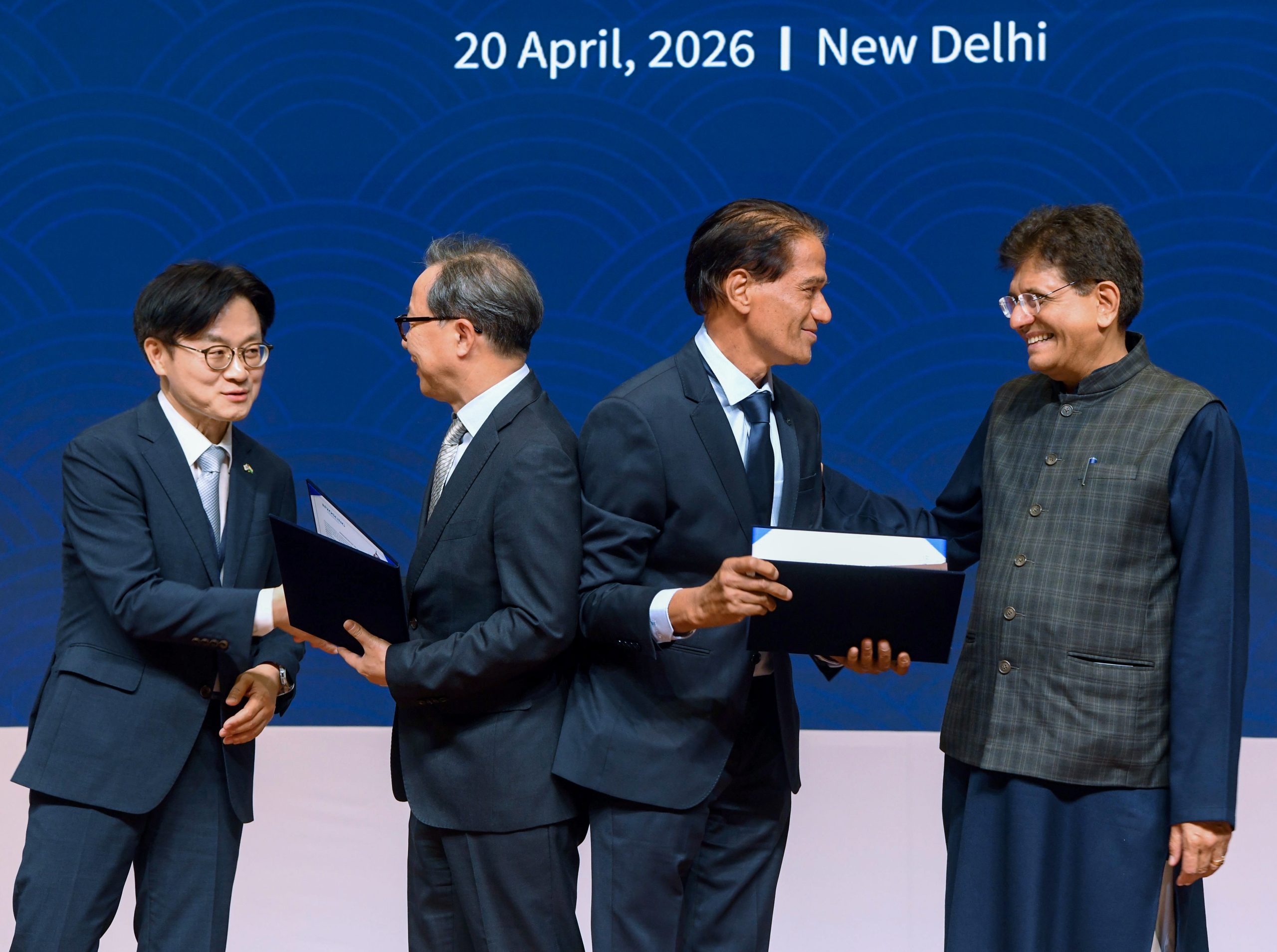
India and the Republic of Korea have set an ambitious target to double bilateral trade to USD 54 billion by 2030, as both countries look to unlock the next phase of economic cooperation, the Ministry of Commerce and Industry said on Monday.
Addressing the India–Korea Business Forum in New Delhi, President of the Republic of Korea Lee Jae Myung described India as a key driver of the global economy.
“India, as the world’s fourth-largest economy and home to 1.4 billion people, stands as a key pillar of the global economy,” he said, adding that bilateral trade has significant potential for expansion.
He noted that ongoing negotiations to upgrade the Comprehensive Economic Partnership Agreement (CEPA) are expected to further boost trade between the two nations. The President also stressed the need for collaboration in high-technology sectors, including artificial intelligence and advanced manufacturing, and called for strengthening cooperation in the shipping sector.
Union Minister of Commerce and Industry Piyush Goyal highlighted that a Memorandum of Understanding on the India–Korea Industrial Cooperation Committee was signed as a major step towards enhancing economic engagement. The committee will comprise four working groups focusing on trade, industry, strategic resources, and clean energy.
A total of 16 MoUs were signed during the forum, aimed at boosting bilateral cooperation across sectors.
The Minister said that both countries have been tasked by their leadership to double bilateral trade from the current USD 27 billion to USD 54 billion by 2030, requiring an annual growth rate of around 18 per cent.
Shri Goyal also informed that discussions were held on establishing a dedicated Korea-specific industrial enclave in India with plug-and-play infrastructure to encourage investments and facilitate the entry of Korean companies.
He noted that such an initiative would allow Korean firms to leverage India’s large domestic market as well as its preferential access to a significant portion of the global economy through multiple free trade agreements.
The Minister said both countries have agreed to adopt a fast-track approach to upgrade the CEPA, focusing on easing non-tariff barriers, improving market access, and enhancing ease of doing business.
Highlighting areas of cooperation, he said sectors such as semiconductors, electronics, e-mobility, green energy, shipbuilding, and digital trade offer strong complementarities between the two economies.
“India and Korea can collaborate through co-production, co-design, co-creation, co-innovation, and jointly serve global markets,” he said.
Underscoring India’s growth potential, Shri Goyal said the country is on track to expand from a USD 4 trillion economy to USD 30 trillion by 2047, driven by a young population, rising incomes, and continued economic reforms.
He added that despite global uncertainties, India remains an “oasis of stability,” supported by infrastructure development and policy reforms.
President of FICCI Anant Goenka also highlighted the scope for collaboration, stating that India’s scale and Korea’s innovation strengths can together build a resilient and future-ready economic corridor.
The Ministry said the developments mark a new phase in India–Korea relations, with both sides committed to strengthening economic ties and fostering long-term partnership.


