







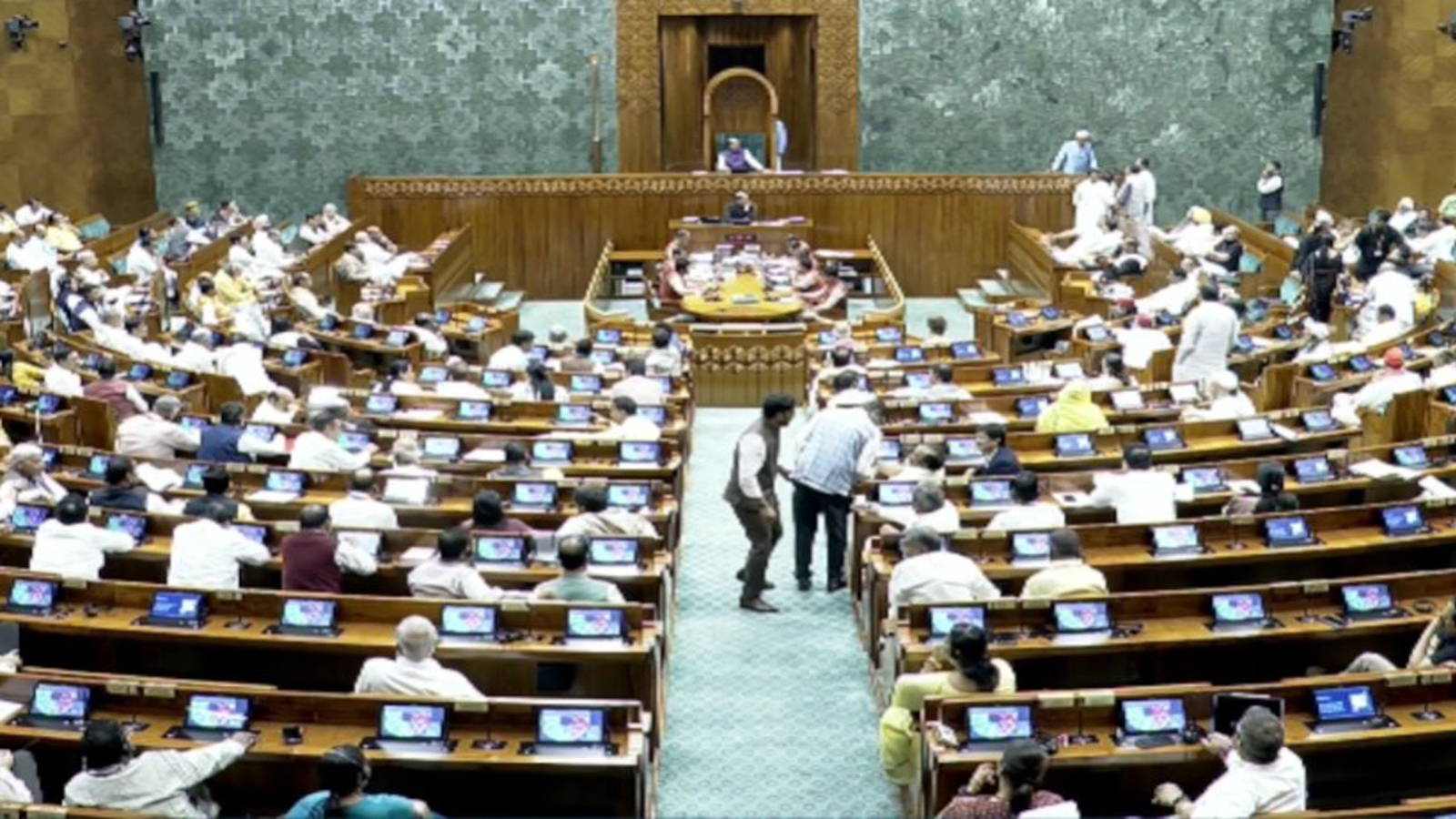
The Constitution (One Hundred and Thirty-First Amendment) Bill, 2026, the Delimitation Bill, 2026 and the Union Territories Laws (Amendment) Bill, 2026, were introduced in the Lok Sabha on Thursday following a division of votes demanded by the Opposition.
The motion to introduce the Constitution Amendment Bill was carried after 251 Members of Parliament voted in favour and 185 against, out of a total of 333 votes cast. No abstentions were recorded. The division was initiated by Lok Sabha Speaker Om Birla after Opposition members challenged the voice vote and sought a recorded vote.
Union Law Minister Arjun Ram Meghwal formally introduced the Bill in the House. The three Bills are aimed at enabling women’s reservation and facilitating delimitation, alongside amendments related to Union Territories.
The Lok Sabha typically passes motions through voice vote, but a “division” is conducted when the result is contested. In this case, members first used the Automatic Vote Recorder system to register votes under “Ayes” and “Noes.” Subsequently, vote slips were also utilised, with all 333 members participating in the process.
Lok Sabha Secretary General Utpal Kumar Singh had earlier briefed members on the voting procedure, explaining how to record “Ayes”, “Noes”, or “Abstain” votes and the conditions under which votes are counted.
The development comes amid a special sitting of Parliament convened from April 16 to 18 to consider amendments linked to the Nari Shakti Vandan Adhiniyam.
Earlier, Prime Minister Narendra Modi had urged political parties to support the legislation, stating that fulfilling women’s reservation reflects the aspirations of “every sister and daughter of this country.”
(With agency inputs)


