







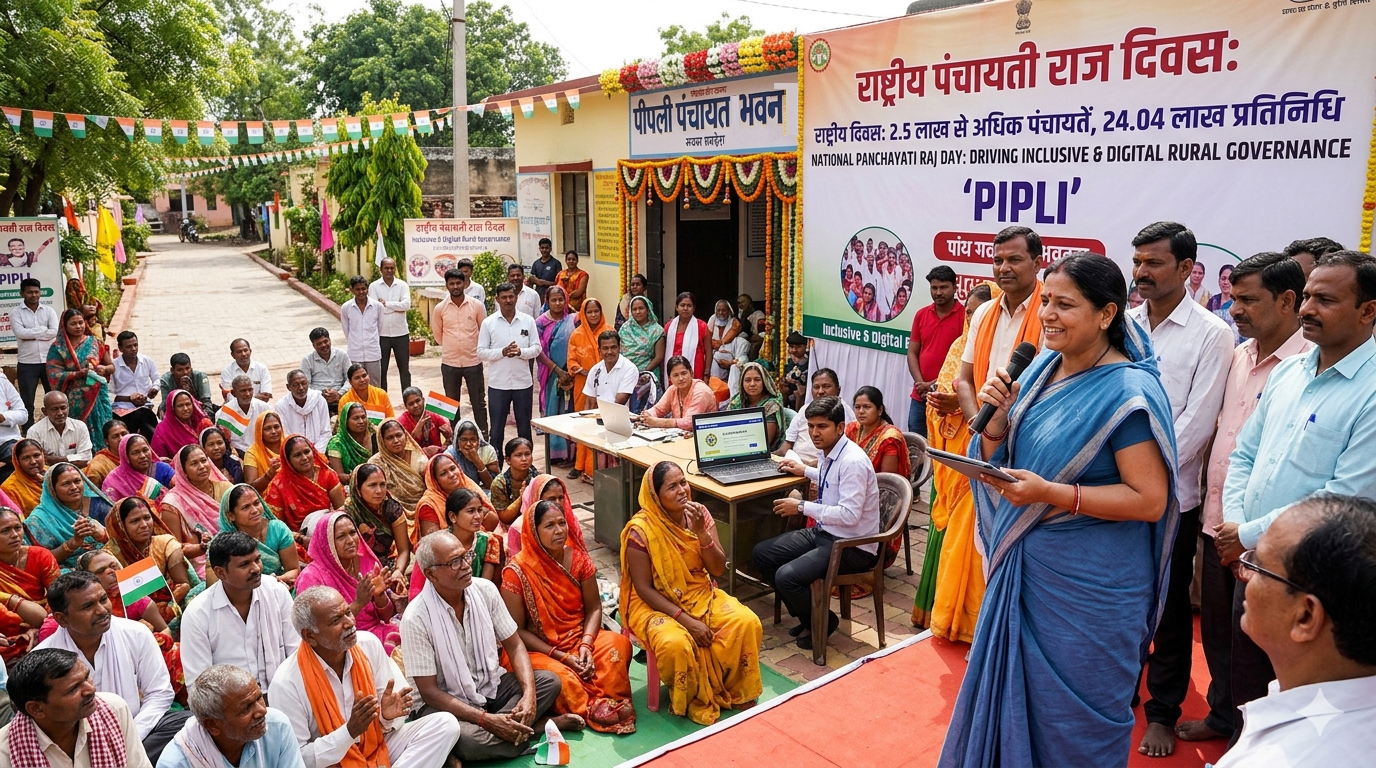
National Panchayati Raj Day, observed annually on April 24, highlights the growing strength of grassroots democracy in India, with Panchayati Raj Institutions (PRIs) continuing to play a central role in local governance, inclusion, and rural development.
The day commemorates the implementation of the 73rd Constitutional Amendment Act, which came into force in 1993 and granted constitutional status to Panchayats under Part IX of the Constitution. Over the past three decades, the system has expanded significantly, with over 2.5 lakh Panchayats and around 24.04 lakh elected representatives, of whom nearly 49.75% are women – a major milestone in inclusive governance.
Democracy at the grassroots
The Panchayati Raj system has deep historical roots in India’s village self-governance traditions, dating back to ancient sabhas and samitis. After independence, the push for decentralisation gained momentum with the Balwant Rai Mehta Committee (1957), leading to the adoption of a three-tier structure – Gram Panchayat, Block Panchayat, and District Panchayat – first implemented in Rajasthan in 1959.
Today, this structure ensures that governance is decentralised and responsive to local needs. At its core is the Gram Sabha, comprising all registered voters in a village, which plays a critical role in approving development plans, monitoring expenditure, and ensuring transparency.
The impact of decentralisation is visible in everyday life, where local bodies can now address issues such as water supply, sanitation, and infrastructure more efficiently without prolonged bureaucratic delays.
National celebrations and new initiatives
This year’s national celebrations at Vigyan Bhawan will feature the launch of the Panchayat Advancement Index (PAI)-2.0, along with three illustrated publications under the Panchayat Dharohar Initiative, including monographs on rural heritage in Tripura, Tirupati, and “Uttarkashi: Saumya Kashi – The Soul of Himalayan Heritage.”
Digital transformation reshaping governance
A major shift in recent years has been the rapid digitisation of Panchayati Raj Institutions. Platforms such as eGramSwaraj are enabling real-time planning, financial management, and transparency.
Key figures highlight the scale of adoption – over 2.55 lakh Gram Panchayats have uploaded development plans; more than 2.59 lakh Panchayats are integrated with the Public Financial Management System (PFMS); transactions worth ₹53,342 crore have been processed through the platform; over 2.50 lakh Panchayati Raj Institutions are making online payments; and more than 1.6 crore vendors are registered.
Connectivity has also improved significantly, with over 95% of villages now covered by 3G/4G networks. Around 2.18 lakh Gram Panchayats are service-ready, with nearly 2.14 lakh already connected, while more than 6.5 lakh Common Service Centres operated by Village Level Entrepreneurs are providing digital services at the grassroots.
Technology-led empowerment
The SVAMITVA Scheme is playing a crucial role in rural empowerment by using drone and GIS technology to map inhabited areas and issue property cards.
As of March 11, 2026, drone surveys have been completed in 3.29 lakh villages out of a target of 3.44 lakh; 3.10 crore property cards have been prepared across 1.87 lakh villages; and 2.65 crore cards have already been distributed.
Similarly, SabhaSaar – an AI-based tool for documenting Gram Sabha meetings – has been adopted by over 1 lakh Gram Panchayats and supports 23 regional languages, improving transparency and record-keeping.
The Gram Urja Swaraj dashboard is also tracking renewable energy adoption at the village level, covering 2,080 Gram Panchayats. Among them, 2,020 use solar energy, 60 hydel power, 69 wind energy, and 106 biogas systems, reflecting a growing push towards sustainable development.
Strengthening participation and capacity
Government initiatives like the Rashtriya Gram Swaraj Abhiyan continue to enhance capacity building, participatory planning, and institutional strengthening of Panchayats. Mobile platforms such as “Meri Panchayat” are further improving citizen engagement, accountability, and access to services.
A pillar of Viksit Bharat
With millions of elected representatives and increasing digital integration, Panchayati Raj Institutions are playing a central role in strengthening democracy, improving service delivery, and promoting inclusive growth.
As India advances towards the vision of a “Viksit Bharat,” the Panchayati Raj system stands as a cornerstone of democratic decentralisation – ensuring that governance is not only accessible but also accountable, participatory, and responsive to the needs of every citizen.


