







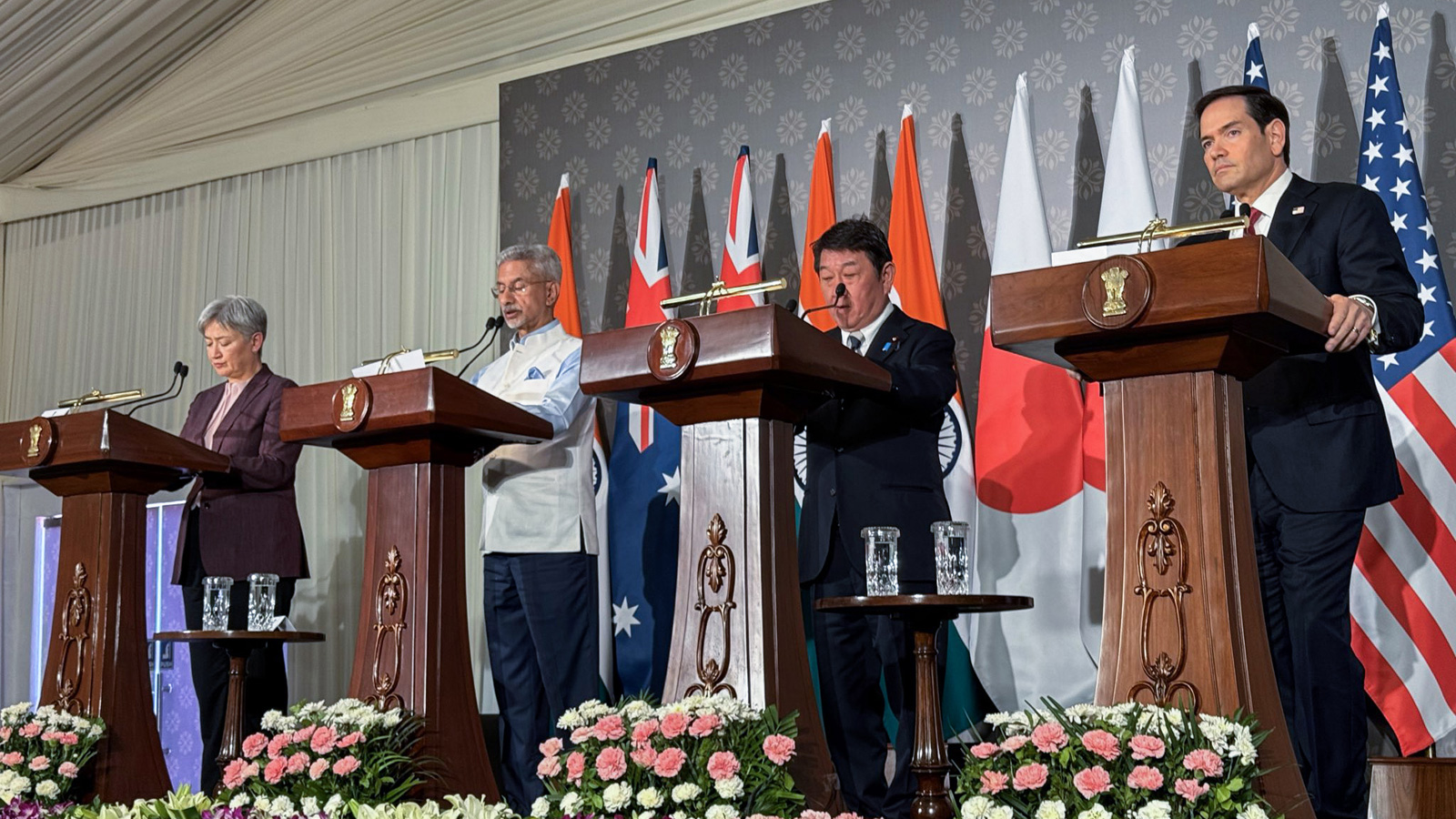
The Quad nations – India, Australia, Japan and the United States – on Tuesday announced a series of major initiatives aimed at strengthening maritime security, critical mineral supply chains, digital connectivity, energy resilience and emerging technologies across the Indo-Pacific region.
The announcements were made during the 11th Quad Foreign Ministers’ Meeting held in New Delhi, attended by External Affairs Minister S. Jaishankar, Australian Foreign Minister Penny Wong, Japanese Foreign Minister Toshimitsu Motegi and US Secretary of State Marco Rubio.
In a significant move to boost maritime cooperation, the Quad partners launched the first-ever Indo-Pacific Maritime Surveillance Collaboration (IPMSC) initiative. The programme aims to enhance maritime domain awareness and information sharing in the Indo-Pacific, with an initial focus on the Indian Ocean Region through surveillance cooperation, expert exchanges and tabletop exercises.
The four nations also expanded the Indo-Pacific Partnership for Maritime Domain Awareness (IPMDA) initiative and announced plans to develop a comprehensive Common Operating Picture (COP) to improve real-time maritime information sharing across the region.
India will host the next edition of the Quad-at-Sea Ship Observer Mission to strengthen interoperability and coordination in addressing unlawful maritime activities.
On counter-terrorism cooperation, the Quad countries announced that Australia will host a Quad Counterterrorism Tabletop Exercise in June 2026 focusing on state-sponsored terrorism threats and the misuse of unmanned aerial vehicles and emerging technologies.
The ministers also unveiled the Quad Critical Minerals Initiative Framework aimed at strengthening resilient and diversified supply chains for critical minerals through coordinated investments, mining, processing and recycling cooperation.
To strengthen regional energy resilience, the Quad partners launched the Quad Initiative on Indo-Pacific Energy Security, which will focus on cooperation in energy technology, policy, market analysis and emergency response exercises.
As part of infrastructure cooperation, the Quad announced plans to work with the Government of Fiji on port infrastructure development following discussions under the Quad Ports of the Future Partnership initiative.
The countries also reiterated their commitment to expanding secure digital connectivity in the Indo-Pacific through undersea cable projects. The Quad partners stated that all Pacific Islands Forum countries are expected to be connected through undersea cable networks by 2026.
In the technology sector, the Quad welcomed progress under the Open Radio Access Networks (Open RAN) cooperation project with Palau, aimed at enhancing secure 4G and 5G connectivity and digital supply chain resilience.
The four countries also agreed to collaborate on next-generation telecommunications standards, including 6G technologies, and announced a Workshop on Digital Identity Standards to improve cross-border interoperability.
Under the AI-ENGAGE initiative, the Quad partners announced more than USD 6 million in funding for six international research projects focused on improving crop yields, pest management and food security using artificial intelligence, robotics and sensing technologies.
In the humanitarian and health sector, the Quad nations said they are collectively providing over USD 50 million worth of support for training health professionals and strengthening public health emergency response capabilities across the Indo-Pacific.
The meeting also reviewed progress on disaster response cooperation, including the successful tabletop exercise and strategic working group meeting held in Honolulu in 2025, which enhanced the Quad’s emergency response preparedness in the region.


