







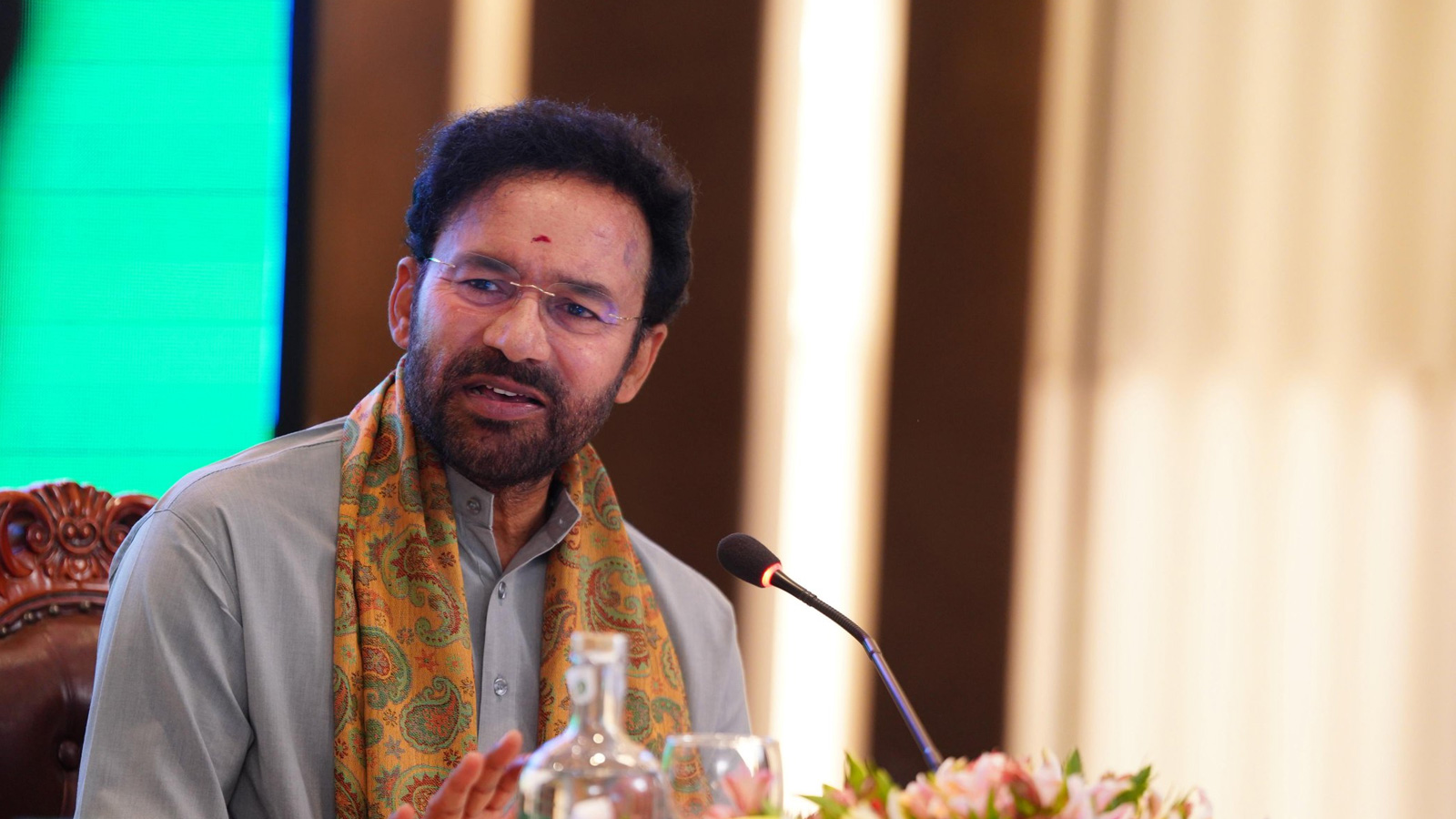
Union Coal and Mines Minister G. Kishan Reddy on Sunday directed key mining and exploration agencies under the Ministry of Mines to fast-track pending projects and adopt a mission-mode approach to strengthen India’s mineral security and strategic growth objectives.
The Minister issued the directive while chairing a series of high-level review meetings in Bengaluru with senior officials of the Geological Survey of India (GSI), National Institute of Rock Mechanics (NIRM), Indian Bureau of Mines (IBM), and the Remote Sensing & Aerial Survey (RSAS) division.
Addressing officials during the meetings, Reddy stressed the need for speed, accountability, transparency, and efficiency in the mining and exploration sector.
“All organisations must fast-track pending projects and ensure that technology, transparency and efficiency become the foundation of every institutional process,” he said, adding that the sector has a crucial role in supporting India’s long-term industrial growth and strategic mineral security under the vision of Viksit Bharat 2047.
The review meetings focused on accelerating mineral exploration, promoting sustainable mining practices, strengthening scientific capabilities, and expanding the use of advanced technologies such as Artificial Intelligence, remote sensing, and integrated geoscience analytics.
The Minister reviewed exploration activities related to critical and strategic minerals including Rare Earth Elements, lithium, nickel, cobalt, tungsten, vanadium, and platinum group elements.
GSI presented updates on exploration projects in Karnataka and Goa, highlighting the identification of gold, copper, nickel, cobalt, and platinum group element-bearing zones. The agency also outlined a five-year roadmap involving AI and machine learning-enabled mineral targeting and advanced-stage exploration across nearly 48,000 square kilometres.
NIRM showcased its work in infrastructure and mining safety projects, including hydropower, metro rail systems, tunnel engineering, seismic monitoring, and controlled blasting operations near sensitive infrastructure.
IBM reviewed progress on sustainable mining practices, scientific mine closure, mineral beneficiation, and the operationalisation of auctioned mineral blocks. It also highlighted efforts under the National Critical Mineral Mission to enhance recovery of critical minerals from existing mining ecosystems.
Meanwhile, RSAS division presented progress under the National Aerogeophysical Mapping Programme, stating that more than 6.5 lakh square kilometres had already been covered through airborne geophysical surveys and hyperspectral remote sensing. Officials said the initiative had generated over 200 exploration projects using aero-geophysical datasets.


