







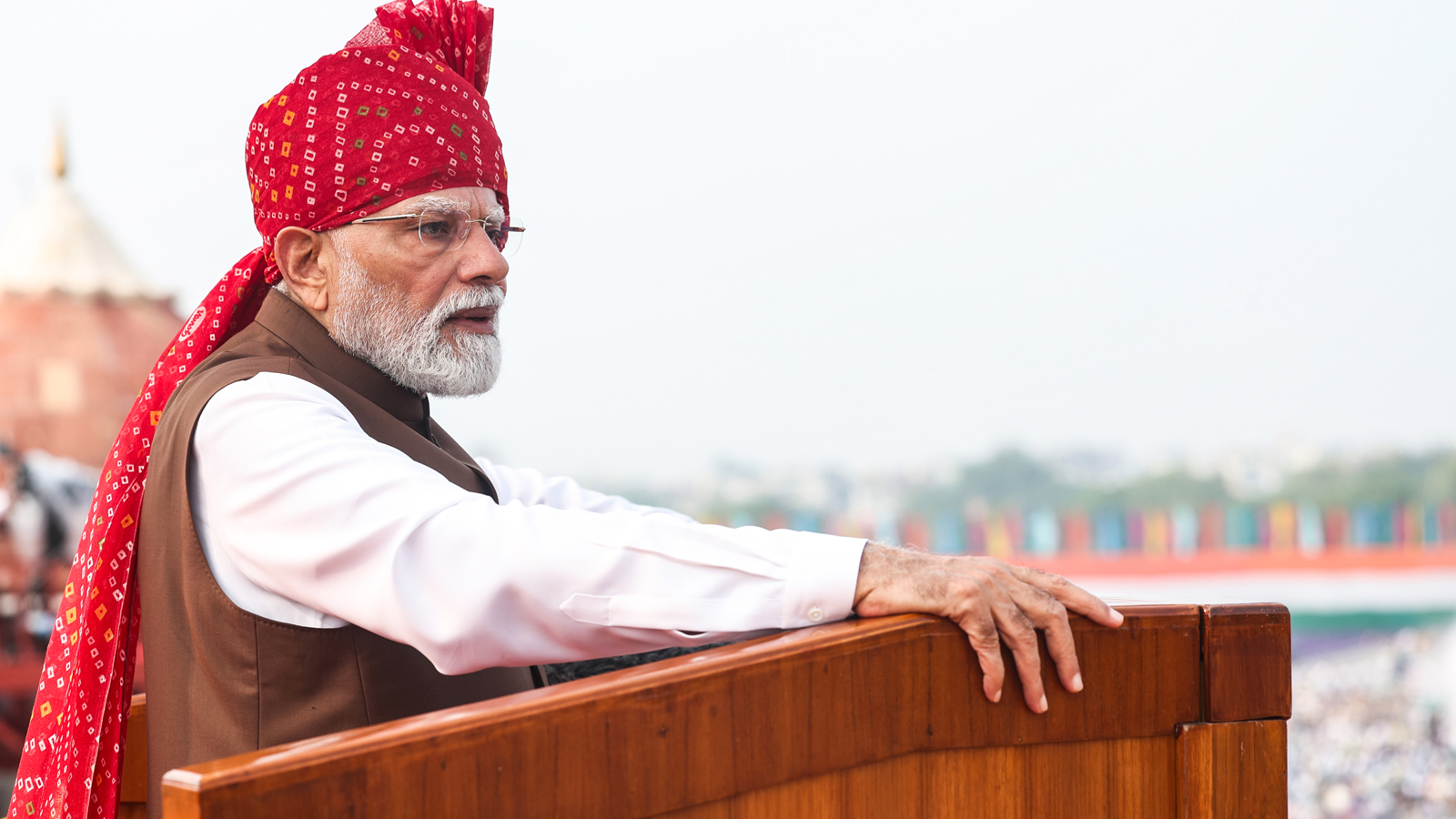
Prime Minister Narendra Modi on Saturday laid out an ambitious roadmap for building a “Viksit Bharat” by 2047, calling for greater self-reliance in manufacturing, defence, technology, energy, agriculture and other strategic sectors while announcing several new initiatives for the country’s youth.
Addressing the nation from the ramparts of the Red Fort on the occasion of India’s 80th Independence Day, PM Modi said the goal of transforming India into a developed nation would have to be achieved through the collective hard work and determination of 140 crore citizens.
He said India’s aspirations must be matched by strong resolve and capabilities, adding that the country had made significant progress over the past 12 years.
“Today, Bharat too has envisioned a very big dream… when the country completes 100 years of Independence, we will build a ‘Viksit Bharat’ in 2047,” PM Modi said.
The Prime Minister began his address by paying tribute to freedom fighters and noted that, for the first time since Independence, ‘Vande Mataram’ was being heard from the Red Fort on August 15 as the nation marks 150 years of the iconic national song.
He also expressed solidarity with families affected by recent floods and landslides in several parts of the country, assuring them that the government and the nation stood firmly with them.
India’s economic and developmental gains
Highlighting the achievements of the past decade, PM Modi said 25 crore people had moved out of poverty, while India had transformed from being counted among the “Fragile Five” economies to becoming the fastest-growing major economy.
He said defence production had increased nearly fourfold, Khadi and village industries production nearly fivefold and electronics manufacturing nearly sevenfold. Production of modern railway coaches has risen 21-fold and mobile phone production 35-fold, he said.
The Prime Minister also highlighted a nearly fourfold increase in internet users and patents granted, while digital transactions have risen 100-fold.
He said the government had also accelerated the provision of basic amenities, including tap-water connections, cooking gas connections, toilets and houses for the poor.
PM Modi said thousands of compliance requirements had been eliminated and hundreds of outdated laws repealed as part of governance reforms.
‘Sapt Dhara’ to drive India’s development
The Prime Minister outlined a seven-pronged development vision, or ‘Sapt Dhara’, covering manufacturing, agriculture and food production, technology and innovation, infrastructure and connectivity, defence, the green and blue economy, and India’s soft power.
On manufacturing, PM Modi called for India to develop the entire value chain, from components and design to finished products, and emerge as a trusted global manufacturing hub.
He urged manufacturers and MSMEs to focus on quality and reliability, stressing that “Quality, Quality, Quality” should become the foundation of India’s global brand value.
He said India had signed free trade agreements with nearly 40 countries since 2014 and urged MSMEs to use the opportunities created by these agreements to expand into global markets.
Focus on agriculture and exports
Agriculture and food production would form another key pillar of the development strategy, PM Modi said, calling for greater emphasis on food processing and exports.
He said Indian farmers should increasingly adopt chemical-free farming as global demand for such products was expected to rise.
Referring to fertiliser prices, PM Modi said the government was providing urea and DAP to farmers at substantially subsidised prices despite the much higher rates prevailing in international markets.
He urged farmers to meet global quality standards and move from the farm directly to international markets.
India to become a technology and innovation hub
Technology and innovation, the third stream of the ‘Sapt Dhara’, would be critical to India’s future, PM Modi said, pointing to artificial intelligence, quantum technology, space, robotics, semiconductors and data centres as emerging areas.
He said three semiconductor plants had already been initiated and that another five to eight plants were expected to be established in the coming seven to eight years.
PM Modi said India should not merely become a market for global technology but should emerge as a global hub of innovation.
He also set the goal of taking Made-in-India 6G technology to the world and expanding India’s Digital Public Infrastructure globally.
Energy security and nuclear power
The Prime Minister stressed that energy security would be crucial in an era of AI, semiconductors and data centres.
He announced that India was working towards 100 GW of nuclear power capacity by 2047, following the passage of the SHANTI Act. The country is also working towards commissioning five new nuclear reactors during the current decade, he said.
PM Modi highlighted India’s growth in solar power, saying capacity had increased from just 2 GW in 2014 to 160 GW.
He said more than 50 lakh households had adopted solar energy under the PM Surya Ghar Muft Bijli Yojana, with many households also earning by selling surplus electricity.
He also called for global leadership in green hydrogen, renewable energy, energy storage, green mobility and green manufacturing.
Defence self-reliance and civil defence network
Defence power, another key element of the development vision, would require India to become self-reliant in next-generation defence technologies, PM Modi said.
He called for greater capabilities in drones, counter-drone systems, hypersonic defence and cybersecurity, and said India should emerge as a global defence supplier.
PM Modi said India’s defence exports have increased nearly 50-fold and Indian weapons and defence equipment are now reaching around 100 countries.
He also announced plans to build a vibrant civil defence network, equipped with modern systems and technologies, to prepare citizens and civil defence personnel for changing forms of warfare and emerging security challenges.
On left-wing extremism, PM Modi said armed Naxalism had been defeated in many areas but warned that the “Naxal mindset” remained a challenge. He called for young people to be connected with the mainstream path of nation-building.
Infrastructure and connectivity
PM Modi identified Gati Shakti as another major area of focus, calling for seamless and faster connectivity through high-speed rail, modern highways, inland waterways, airports and multimodal logistics networks.
He highlighted the rapid electrification of the railway network, saying around 70 per cent of the network had been electrified in the last decade after only about 30 per cent had been electrified in the 90 years after electrification began.
He also highlighted the production of modern railway coaches and India’s progress in hydrogen-powered trains.
Blue economy and tourism
The Prime Minister called for port-led development and greater exploitation of opportunities in the blue economy, including fisheries, coastal tourism and ocean technology.
He said free trade agreements were opening new markets for Indian seafood, particularly shrimp.
PM Modi also said India needed to better leverage its wildlife, culture and heritage to attract international tourists. He called for greater infrastructure to host global sporting events and international artists, noting the growing “concert economy”.
Soft power and creative industries
India’s soft power was identified as the seventh stream of the ‘Sapt Dhara’.
PM Modi highlighted yoga, Ayurveda, holistic healthcare, handicrafts, films, animation, visual effects, gaming and digital content as areas where India could strengthen its global presence.
He said the WAVES Summit was helping showcase India’s creative and entertainment capabilities to the world.
Youth at the centre of Viksit Bharat
The Prime Minister placed the youth at the heart of his development vision, saying they would be both the principal drivers and beneficiaries of a developed India.
He said India now had more than 2.5 lakh registered startups and announced that the government would train one crore young people in AI skills over the next year.
He also highlighted the government’s ₹1 lakh crore innovation fund and urged young innovators to bring forward their ideas, assuring them that resources would not be a constraint.
PM Modi said India’s bioeconomy had grown from ₹60,000 crore before 2014 to ₹20 lakh crore, while the country’s startup ecosystem, space sector and digital infrastructure were creating new opportunities.
Push for sports and talent identification
With India aspiring to host the 2036 Olympics, PM Modi called for a nationwide talent hunt to identify sporting talent among children aged five to 15.
The campaign, he said, would cover villages, cities and schools, with selected youngsters receiving specialised training to prepare them for international competition.
He also highlighted India’s preparations to host the Commonwealth Games in 2030 and called for a collective effort to build a drug-free India.
Women’s empowerment
PM Modi said women were playing an increasingly important role in nation-building, including in fighter aviation and civil aviation.
He said the target of creating three crore ‘Lakhpati Didis’ had already been surpassed and that the government was now working towards creating six crore Lakhpati Didis.
From the Red Fort, he also appealed to political parties to ensure 33 per cent representation for women in state Legislative Assemblies and the Lok Sabha at the earliest.
Education, healthcare and social security
The Prime Minister highlighted the expansion of higher education and healthcare infrastructure, saying nearly 650 universities had been added over the past decade, taking the country closer to the milestone of 1,000 universities.
He also pointed to the expansion of medical education, the entry of foreign universities into India and the establishment of more than 10,000 Atal Tinkering Labs.
In healthcare, PM Modi said India had expanded social security coverage to 100 crore citizens within a decade and that people aged 70 and above were now covered for free treatment of up to ₹5 lakh under Ayushman Bharat.
India as a global economic and corporate power
PM Modi called for greater global ambitions for Indian companies and said the country should aim to have 50 Indian companies among the Fortune 500 within the next decade.
He also said at least one Indian bank should feature among the world’s top five banks and called for Indian pharmaceutical, consulting, accounting and technology companies to become global leaders.
“Why shouldn’t we envision and set a goal that within the coming decade, 50 of these Fortune 500 companies are from India?” he said.
Census and governance reforms
PM Modi urged young people to actively participate in the ongoing Census process, stressing that accurate demographic data was essential for effective policymaking and planning.
He also called upon state governments and local bodies to accelerate reforms and develop policies suited to the aspirations of 2047 rather than relying on outdated systems.
Concluding his address, the Prime Minister called for the national interest to remain above individual interests and urged citizens to turn dreams into resolve, resolve into strength and strength into success.
“Let us together build a developed India,” PM Modi said.


