







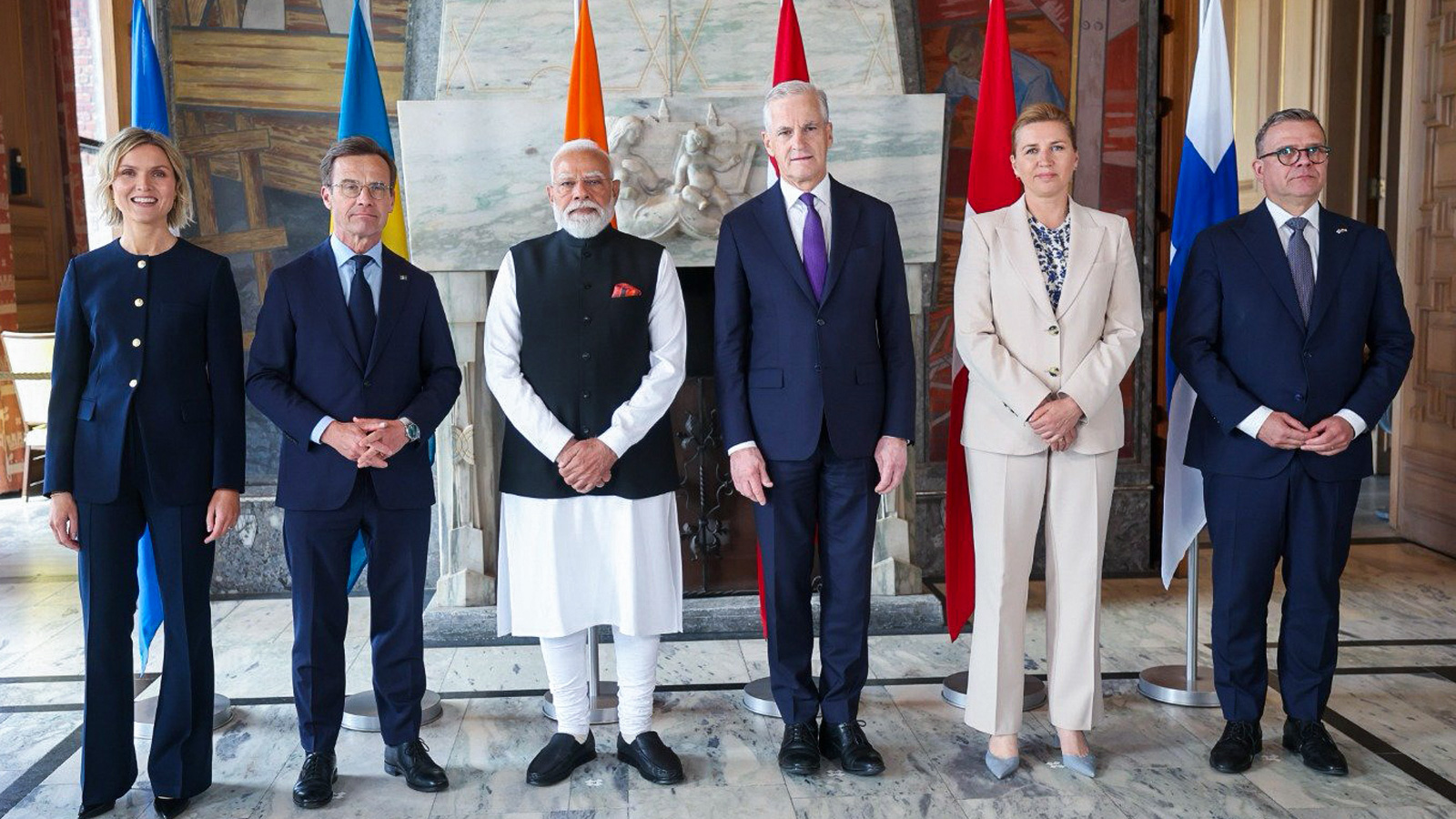
India and the Nordic countries have reaffirmed their commitment to building a future-oriented strategic partnership focused on green technology, innovation, sustainable development, digital transformation and resilient economic growth during the Third India-Nordic Summit held in Oslo on May 19.
The summit marked another significant step in the evolving relationship between India and the Nordic region, with both sides agreeing to elevate ties into a Green Technology and Innovation Strategic Partnership. Leaders from India, Denmark, Finland, Iceland, Norway and Sweden discussed expanding cooperation across clean energy, climate action, maritime security, Arctic research, digital infrastructure, emerging technologies, blue economy initiatives and defence collaboration.
The India-Nordic partnership, first launched during the inaugural summit in 2018, has gradually transformed into a multidimensional collaboration driven by shared priorities in sustainability, innovation and inclusive growth. Nordic countries bring advanced technological expertise and strong sustainability models, while India offers a large market, manufacturing capabilities, skilled workforce and expanding digital infrastructure.
Focus on Green Technology and Innovation
A major outcome of the summit was the decision to strengthen cooperation in renewable energy, green hydrogen, sustainable manufacturing, climate technologies and digital innovation. Both sides agreed that collaboration in green technologies would support sustainable economic growth, improve resource efficiency and accelerate climate change mitigation efforts.
The proposed Green Technology and Innovation Strategic Partnership is expected to create new opportunities in clean energy transitions, water management, waste recycling, smart infrastructure and green jobs while enhancing trade and investment linkages between India and Nordic economies.
The summit also highlighted the growing importance of technology-driven governance and digital infrastructure in ensuring efficient public service delivery and economic resilience.
Arctic Cooperation Gains Strategic Importance
India’s growing engagement with Nordic countries is closely linked to its Arctic policy, particularly amid rising global concerns over climate change and melting Arctic ice. India and the Nordic nations reaffirmed cooperation in Arctic and polar research, recognising its long-term implications for climate systems, environmental sustainability and global weather patterns.
India’s Arctic policy, titled India and the Arctic: Building a Partnership for Sustainable Development, is structured around six pillars, including scientific research, climate protection, transportation, governance and international cooperation.
Experts note that climatic changes in the Arctic could significantly impact India’s monsoon patterns, food and water security, agricultural productivity and coastal ecosystems. Cooperation with Nordic nations in Arctic research is therefore viewed as strategically important for India’s environmental and economic future.
Strengthening Economic and Trade Ties
The summit reviewed the rapid expansion of economic engagement between India and Nordic countries over the last decade. Bilateral trade and investment flows have grown substantially, with both sides acknowledging a sharp rise in commercial cooperation.
India and Sweden recorded bilateral trade of nearly USD 7 billion in 2024, while trade with Denmark crossed USD 2 billion in goods and USD 4.25 billion in services in 2025. Finland’s investment presence in India has also grown significantly, with investments touching USD 4 billion.
The leaders also welcomed the India-European Free Trade Association (EFTA) Trade and Economic Partnership Agreement (TEPA), describing it as a major step towards strengthening India-Nordic economic ties and integrating value chains.
The agreement is expected to improve market access, encourage investments, reduce trade barriers and create employment opportunities across sectors.
Blue Economy and Maritime Cooperation
The summit also expanded cooperation in the blue economy and maritime sectors, focusing on sustainable use of marine resources, maritime connectivity, climate resilience and Indo-Pacific security.
India and Norway agreed to deepen collaboration in the blue economy and Arctic cooperation, while India and Iceland explored partnerships in geothermal energy and fisheries.
The blue economy partnership is expected to contribute to sustainable growth, job creation, environmental protection and enhanced maritime security in the Indo-Pacific region.
Collaboration in Research, Education and Talent Mobility
India and Nordic countries also emphasised cooperation in STEM research, next-generation communication technologies, including 6G, and academic partnerships.
The summit underlined the importance of mobility of talent, student exchanges and collaborative research programmes to strengthen innovation ecosystems and promote future-ready skills.
India’s growing diaspora presence across Nordic countries was recognised as an important pillar of people-to-people engagement. Sweden hosts an Indian diaspora of around 88,000 people, while sizeable Indian communities are also present in Norway, Finland and Denmark.
Indian culture, including yoga, Ayurveda, Indian classical music, cinema and festivals, continues to gain popularity across the Nordic region, strengthening cultural diplomacy and soft power outreach.
Defence and Strategic Cooperation
The summit also witnessed discussions on expanding cooperation in defence manufacturing, cybersecurity, advanced manufacturing and telecommunications.
Both sides agreed that defence industrial collaboration, including technology transfer and research partnerships, could strengthen domestic manufacturing, create employment and improve defence preparedness.
The leaders further reiterated their commitment to a rules-based international order, resilient supply chains and coordinated action against terrorism.
Towards a Long-Term Strategic Partnership
The Third India-Nordic Summit reinforced the growing convergence between India and Nordic nations on issues of sustainability, innovation, climate resilience and economic transformation.
With expanding institutional, economic and cultural linkages, the India-Nordic partnership is increasingly emerging as a model for inclusive, technology-driven and sustainable global cooperation.
The summit concluded with a shared commitment to deepen collaboration across clean energy, digital technologies, maritime cooperation, Arctic research, trade, investment and innovation, aligned with the broader vision of sustainable development and long-term strategic growth.


