







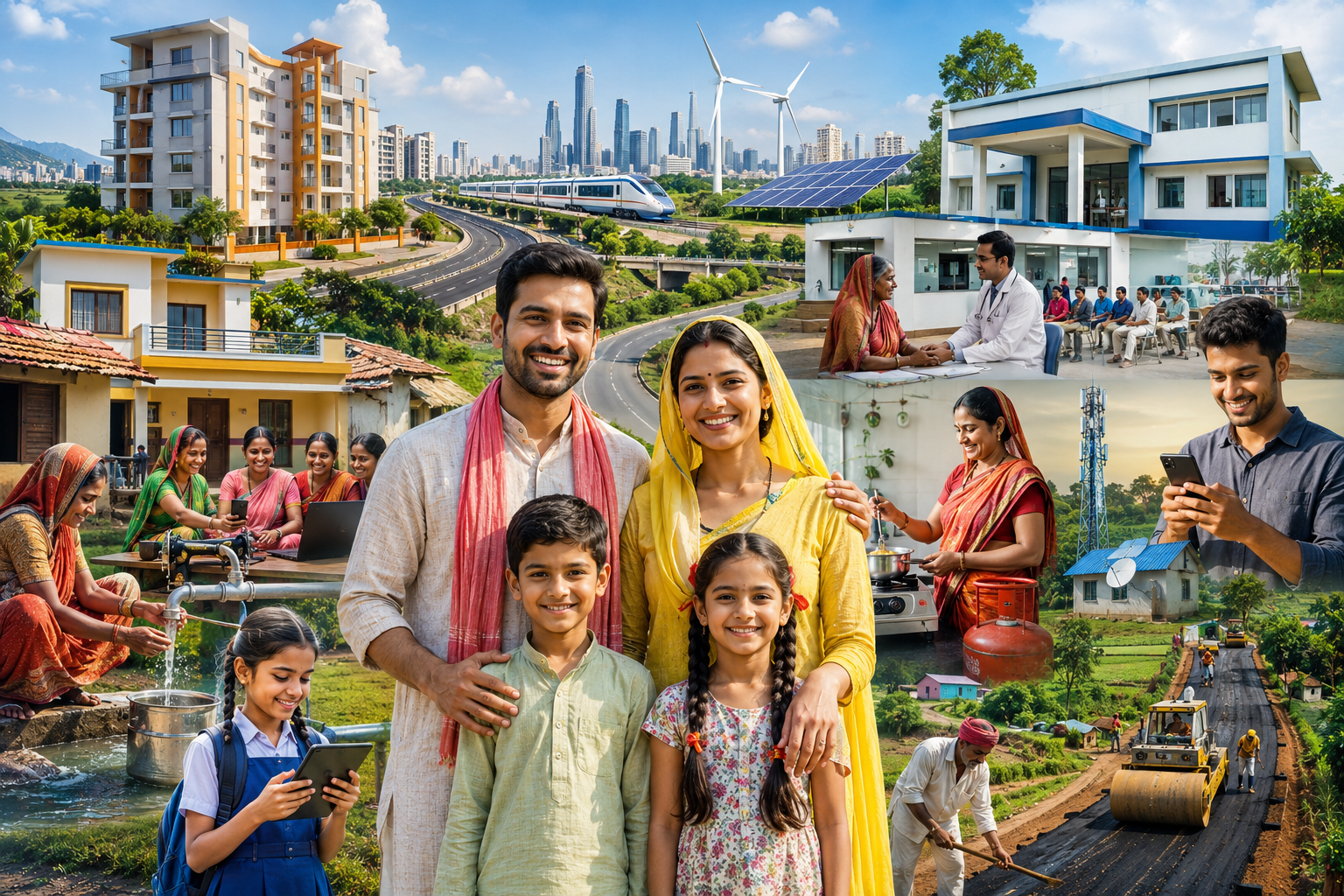
Over the past decade, India’s welfare landscape has undergone a significant transformation, marked by an expansion of social protection programmes, improved access to basic services and greater use of technology in public service delivery. Government data indicate that nearly 25 crore people moved out of multidimensional poverty between 2013-14 and 2022-23, while access to housing, healthcare, sanitation, financial services and livelihood opportunities expanded across the country.
Poverty Reduction and Welfare Expansion
India’s multidimensional poverty rate declined from 29.17 per cent in 2013-14 to 11.28 per cent in 2022-23, according to official estimates. This translates into nearly 25 crore people moving out of multidimensional poverty during the period. The decline has been linked to the expansion of welfare programmes covering food security, healthcare, housing, sanitation, financial inclusion and livelihoods.
At the same time, average inflation moderated from 8.1 per cent during 2004-14 to 5.1 per cent between 2014 and 2025, contributing to greater price stability for households.
Expanding Access to Water and Sanitation
One of the most visible changes has been in access to basic amenities.
Launched in 2019, the Jal Jeevan Mission has expanded rural tap water coverage from 3.23 crore households to 15.84 crore households by May 2026, covering more than 81 per cent of rural homes. More than 2.77 lakh villages have achieved full tap-water coverage under the Har Ghar Jal initiative. Schools, Anganwadi centres and community institutions have also seen a significant increase in access to potable water.
Sanitation coverage has expanded alongside water access. More than 12.11 crore household toilets have been built under the Swachh Bharat Mission-Grameen, helping raise rural sanitation coverage from 39 per cent in 2014 to universal coverage. The focus has now shifted towards waste management and village cleanliness, with more than five lakh villages achieving ODF Plus status.
Healthcare Coverage Reaches Millions
Healthcare has been another major area of expansion.
Since its launch in 2018, Ayushman Bharat has emerged as the world’s largest publicly funded health insurance programme. More than 43.93 crore Ayushman cards have been issued, while over 12 crore hospital admissions have been supported under the scheme. The total value of treatments provided has exceeded ₹1.80 lakh crore.
The healthcare ecosystem has also been strengthened through digital initiatives. More than 88 crore Ayushman Bharat Health Accounts (ABHA) have been created, enabling digital health records and paperless healthcare services. In parallel, the number of operational AIIMS institutions has nearly doubled compared to the pre-2014 period.
Maternal and child health indicators have shown improvement as well. India’s Maternal Mortality Ratio declined from 130 per 100,000 live births in 2014-16 to 88 in 2021-23, while institutional healthcare utilisation has increased steadily.
Housing and Basic Infrastructure
Housing programmes have significantly expanded over the last decade.
Under the Pradhan Mantri Awas Yojana, more than 98 lakh houses have been completed in urban areas, while over 3 crore houses have been built in rural India. A notable feature of the programme has been the emphasis on women’s ownership, with a majority of beneficiaries either owning homes jointly or individually.
Urban infrastructure programmes such as AMRUT have also expanded access to water supply and civic amenities, while investments in roads, railways and public utilities have sought to improve connectivity and living standards.
Clean Energy and Electrification
The Pradhan Mantri Ujjwala Yojana has provided more than 10.57 crore LPG connections to women from economically weaker households, reducing dependence on traditional cooking fuels and lowering indoor air pollution. As a result, the total number of LPG connections in the country has more than doubled over the past decade.
Electrification efforts have also expanded significantly. Universal household electrification was achieved under the Saubhagya programme, while average daily electricity supply in rural areas increased from 12.5 hours in 2014 to 22.6 hours by 2025.
Education and Women’s Empowerment
Education indicators have improved across several parameters, particularly for girls.
Female primary school dropout rates declined from 4.6 per cent in 2013-14 to 0.3 per cent in 2024-25. Girls’ enrolment in secondary education also increased, supported by improved school infrastructure, expanded residential schooling facilities and targeted programmes such as Beti Bachao Beti Padhao.
Women’s economic participation has also expanded through self-help groups. The number of women associated with SHGs increased from 2.37 crore to nearly 10 crore, supported by livelihood missions, access to credit and entrepreneurship programmes. Initiatives such as Lakhpati Didi have further focused on increasing rural household incomes through women-led enterprises.
Digital Governance and Financial Inclusion
Technology has played a central role in the expansion of welfare delivery.
The number of Jan Dhan accounts increased from 17.9 crore in 2015 to more than 58 crore by May 2026, creating the foundation for direct benefit transfers. Digital payment systems have also grown rapidly, with UPI becoming one of the world’s largest real-time payment platforms.
At the grassroots level, initiatives such as BharatNet and eGramSwaraj have expanded broadband connectivity and digitised local governance processes, improving transparency and access to services.
Livelihoods and Social Security
Government programmes have increasingly focused on livelihood generation and economic empowerment.
Employment guarantee programmes have generated billions of person-days of work in rural areas, while skill development initiatives have trained millions of young people for employment opportunities. Schemes supporting artisans, street vendors, small entrepreneurs and self-help groups have expanded access to credit and market opportunities.
Social security coverage has also widened through pension and insurance schemes such as Atal Pension Yojana, PM Jeevan Jyoti Bima Yojana and PM Suraksha Bima Yojana, extending protection to millions of workers and vulnerable households.
The Road Ahead
The past decade has seen a shift towards saturation-based welfare delivery, with greater emphasis on reaching underserved households through technology-enabled governance and targeted interventions. The expansion of access to water, sanitation, healthcare, housing, education, financial services and livelihood opportunities has reshaped the country’s welfare architecture.


