







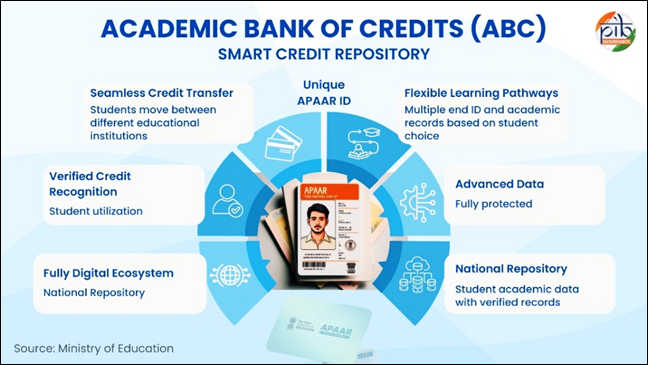
The Academic Bank of Credits (ABC) and the Automated Permanent Academic Account Registry (APAAR) are emerging as key pillars of India’s digital education ecosystem, enabling students to securely store, transfer and redeem academic credits while supporting flexible learning pathways envisioned under the National Education Policy (NEP) 2020.
Developed by the Ministry of Education and regulated by the University Grants Commission (UGC), the Academic Bank of Credits is a digital platform that allows students to maintain a lifelong academic record. The platform enables credits earned from recognised higher education institutions to be accumulated, transferred and redeemed, allowing learners to continue their education without losing academic progress.
The system is integrated with the APAAR (Automated Permanent Academic Account Registry), a unique 12-digit student identification number introduced under the ‘One Nation, One Student ID’ initiative. Linked to DigiLocker, APAAR consolidates a learner’s academic records across school education, higher education, skill development and other learning programmes into a single digital identity. According to the Ministry of Education, more than 26.30 crore verified APAAR IDs have been generated across the country as of June 2026.
The initiative supports key reforms proposed under NEP 2020, including multiple entry and exit, academic mobility and lifelong learning. Students who discontinue their studies can preserve the academic credits they have already earned and use them when they resume their education within the prescribed validity period.
Under the ABC framework, students receive an ABC or APAAR ID linked to their Aadhaar and DigiLocker accounts, while recognised higher education institutions upload academic credits directly to the platform. The National Academic Depository (NAD) serves as the backbone of the system by securely storing academic awards and educational records.
The UGC has directed all higher education institutions to upload students’ academic credit data to the ABC portal by June 30, 2026. As per official data, 2,963 institutions have registered on the platform, while more than 110.65 crore educational records have been uploaded.
The platform also enables seamless credit transfer between institutions, reducing documentation requirements through consent-based digital verification. It supports the Multiple Entry and Exit (MEE) framework, allowing students to earn certificates, diplomas and degrees at different stages of their academic journey. According to the ministry, 153 universities currently offer multiple entry options, benefiting more than 31,000 undergraduate and 5,500 postgraduate students.
ABC has also been integrated with SWAYAM, allowing students to earn up to 40 per cent of their academic credits through online courses. The platform is aligned with the National Credit Framework (NCrF), which integrates academic, vocational and experiential learning. As of 2026, 170 universities have adopted the framework.
To ensure secure handling of academic records, the platform uses encrypted systems and Aadhaar-linked authentication through DigiLocker. Common Service Centres (CSCs) have also been integrated into the system to facilitate APAAR registration in rural and remote areas, improving access to digital education services.
According to the Ministry of Education, the Academic Bank of Credits forms an important part of India’s Digital Public Infrastructure for education. Looking ahead, the ministry has proposed the adoption of Bharat Praman Chain, a sovereign blockchain platform developed by the Digital India Corporation, to further strengthen the security, authenticity and verification of digital academic credentials while ensuring compliance with the Digital Personal Data Protection Act.
The ministry said the combined ABC and APAAR framework is expected to make India’s education system more flexible, transparent and learner-centric by enabling lifelong learning, secure academic record management and seamless mobility across institutions.


