







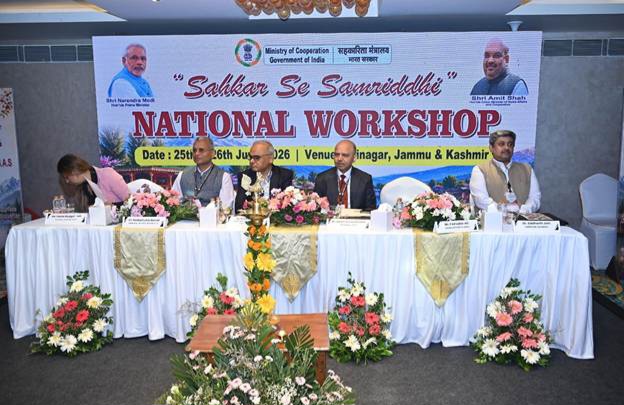
The Ministry of Cooperation on Thursday outlined a roadmap for the next phase of India’s cooperative sector reforms, with a strong focus on technology adoption, professional management, sustainability and measurable grassroots impact during the 8th National Conference on Cooperation held in Srinagar.
Addressing the conference, Cooperation Secretary Dr. Ashish Kumar Bhutani said the creation of a separate Ministry of Cooperation had transformed the sector from a regulatory framework to a development-oriented model aimed at strengthening cooperatives as engines of rural prosperity and inclusive growth. While highlighting progress made over the past five years through initiatives such as computerisation of Primary Agricultural Credit Societies (PACS), adoption of model bye-laws, formation of multipurpose PACS, dairy and fishery cooperatives, and establishment of national-level cooperatives in exports, organic products and seeds, he said the focus must now shift from numbers to quality, accountability, professional management and visible outcomes on the ground.
Dr. Bhutani stressed that cooperative banks must adopt modern technology platforms to remain relevant in an era dominated by UPI and digital financial services. He also called for sustainability and circularity initiatives in sectors such as dairy, compressed biogas and sugar by-products, saying cooperatives could play a significant role in converting rural waste into value, generating clean energy and creating additional income streams for members. He highlighted the upcoming National Cooperative Database 2.0 as a tool to strengthen data-driven governance by enabling cooperatives to update and validate information directly.
The conference also reviewed progress under the World’s Largest Grain Storage Plan, with states urged to accelerate infrastructure creation and reduce post-harvest losses. Discussions focused on expanding the cooperative network through new multipurpose PACS, dairy and fishery cooperatives in uncovered panchayats, while emphasising computerisation, business diversification and improved governance.
A key feature of the conference was its state-led format, with states and Union Territories sharing best practices, innovations and challenges from the ground. Deliberations also focused on cooperative development in the North-East, where participants highlighted the need for region-specific strategies, stronger institutional support and better market linkages.
Representatives from institutions including NABARD, NDDB, IFFCO, KRIBHCO, NAFED, NCCF and NCDC participated in discussions on financing, capacity building, market support and institutional development.
The conference also underscored the role of new-age national cooperatives such as NCEL, NCOL and BBSSL in building national value chains in exports, organic products and seeds. Digital transformation, data-driven decision-making and the use of emerging technologies, including artificial intelligence, were identified as key priorities for the sector’s future growth.
The conference concluded with states and national federations drawing up actionable points and six-month targets aimed at accelerating implementation and strengthening the cooperative movement under the vision of ‘Sahkar se Samriddhi’.


