







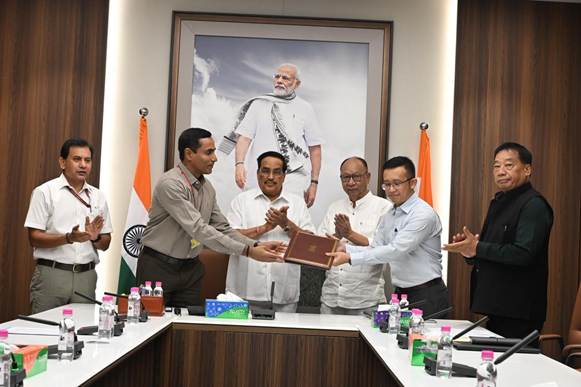
The Centre on Wednesday signed reform-linked Memoranda of Understanding (MoUs) with Bihar and Manipur under Jal Jeevan Mission (JJM) 2.0, aimed at strengthening sustainable and community-driven rural drinking water supply systems.
The agreements seek to promote a Gram Panchayat-led, service-based and community-centred model of rural water governance to ensure regular access to drinking water of adequate quantity and prescribed quality in rural areas.
The MoU with Manipur was signed in the presence of Union Jal Shakti Minister C.R. Patil and Manipur Chief Minister Yumnam Khemchand Singh. The agreement was exchanged between D. Senthil Pandiyan, Joint Secretary, National Jal Jeevan Mission (NJJM), and Dr. Neilinthang Teilien, Secretary to the Chief Minister of Manipur.
The Bihar MoU was signed later in the day in the presence of Patil, Union Minister of State for Jal Shakti Raj Bhushan Choudhary and Bihar Public Health Engineering Minister Sanjay Kumar Singh. The agreement was exchanged between Pandiyan and Rajesh Kumar, Principal Secretary, Public Health Engineering Department, Bihar.
Senior officials of the Department of Drinking Water and Sanitation (DDWS), including Secretary Ashok K.K. Meena and Additional Secretary and Mission Director, NJJM, Kamal Kishore Soan, were present during the signing ceremonies.
Addressing the meetings, Patil said Jal Jeevan Mission, launched under the leadership of Prime Minister Narendra Modi, had transformed rural drinking water supply across the country and reduced the burden of fetching water, particularly for women and girls.
The Minister said the focus under JJM 2.0 would be on sustaining infrastructure created under the mission, ensuring functionality of tap connections, maintaining water quality, strengthening source sustainability, improving operation and maintenance systems, enhancing community ownership and regular monitoring.
Patil also stressed the need for water conservation, rainwater harvesting, groundwater recharge and catchment area protection. He called for community-based water quality monitoring and said Gram Panchayats, District Water and Sanitation Missions, State Water and Sanitation Missions and local communities should work together to ensure reliable drinking water services.
Referring to Manipur, Patil expressed confidence that the state would complete the remaining tap water connections and achieve universal rural tap water coverage. He also appreciated the state’s efforts in implementing the mission despite challenging conditions.
For Bihar, the minister emphasised proper operation and maintenance of water supply infrastructure and expressed confidence that the state would complete the remaining work after achieving more than 90 per cent rural tap water coverage.
Speaking on the occasion, Manipur Chief Minister Singh said JJM 2.0 marked a shift from infrastructure creation to ensuring long-term and sustainable drinking water service delivery. He said the next phase of the mission focuses on service delivery, source sustainability, digital monitoring frameworks, policy reforms, sustainable funding mechanisms and community participation.
Bihar minister Sanjay Kumar Singh said the state had remained committed to providing safe drinking water to rural households and highlighted the ‘Har Ghar Nal Ka Jal’ programme launched in 2016. He said central assistance had helped Bihar expand rural drinking water infrastructure and improve service delivery despite geographical and socio-economic challenges.
DDWS Secretary Meena said the MoUs prioritise sustainable water services managed at the grassroots level and emphasised decentralisation and community ownership through Gram Panchayats and Village Water and Sanitation Committees. He also stressed the importance of regular meetings of District Water and Sanitation Missions to support village-level planning and monitoring.
NJJM Mission Director Soan said the objective of Jal Jeevan Mission extends beyond providing tap connections and seeks to ensure reliable access to safe drinking water for the next 25 to 30 years through sustainable infrastructure and service delivery systems.
According to the Department of Drinking Water and Sanitation, 33 of the 34 states and Union Territories covered under Jal Jeevan Mission have now signed reform-linked MoUs with the Centre under JJM 2.0.


