







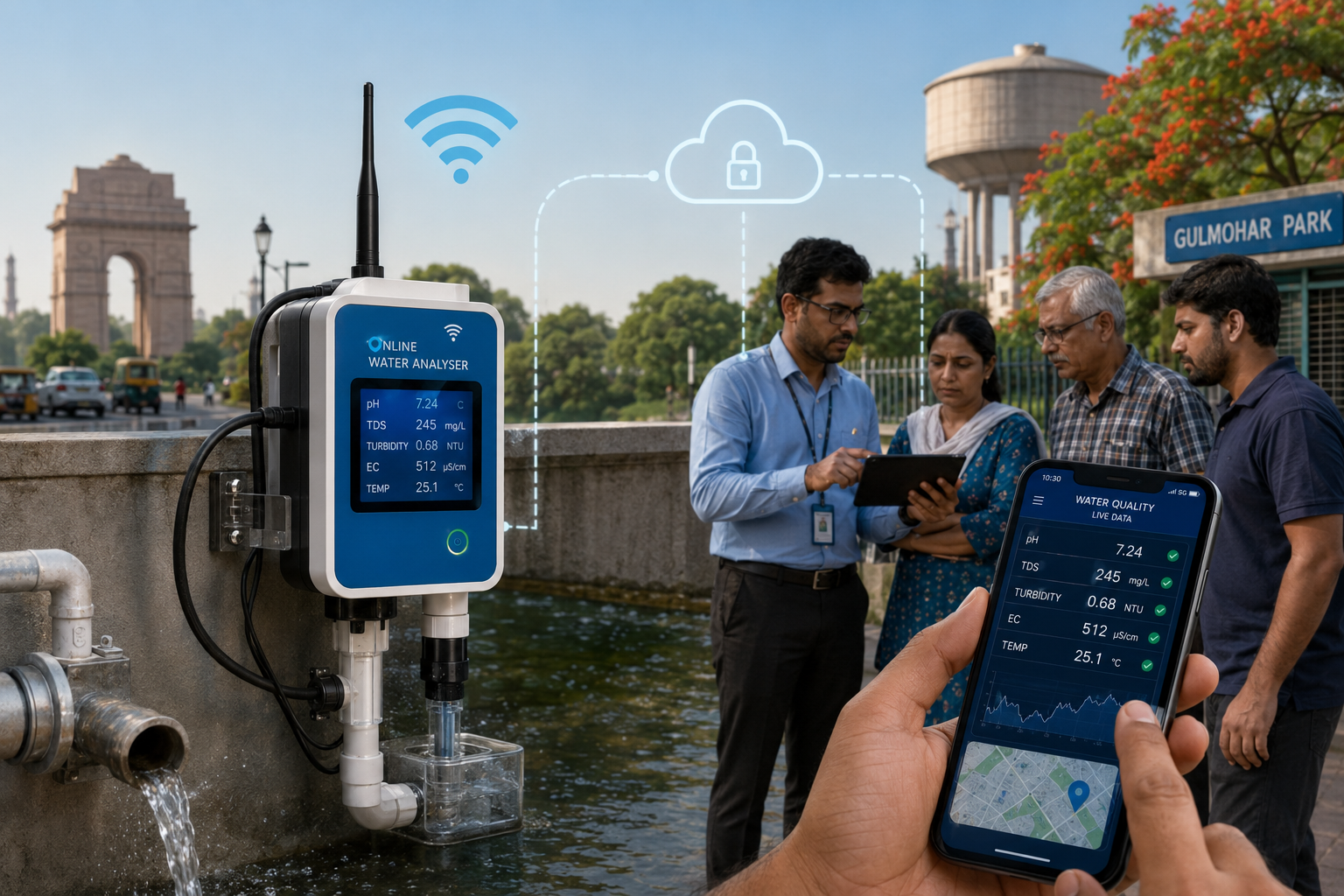
The Delhi Jal Board (DJB) has launched a pilot project in the Gulmohar Park area by installing an online water analyser to monitor water quality in real time, following recent complaints of water contamination.
The system is designed to continuously track key water quality parameters, including pH levels, total dissolved solids (TDS) and chlorine content, enabling authorities to detect contamination and identify its source more effectively.
Bharatiya Janata Party (BJP) MLA from Malviya Nagar, Satish Upadhyay, said the initiative was introduced after residents raised concerns over the quality of the water supply in the area. If the pilot project proves successful, similar analysers will be installed across Delhi to strengthen water quality monitoring.
“Ten days ago, there were complaints of water contamination in the Gulmohar Park area, which were addressed by the Delhi Jal Board. Because the water pipelines run underground, using such water analysers, we can check pH, TDS and chlorine levels in water. This technology will help identify any contamination and its source. Delhi Jal Board will use this technology throughout the city if this pilot is successful,” Upadhyay told ANI.
He said the project is being implemented under a Public-Private Partnership (PPP) model and that the complete installation and commissioning of the system is expected within a week.
“This has been installed via the PPP model, and its complete set-up will be done in a week’s time,” he added.
Meanwhile, Gulmohar Park Residents’ Welfare Association (RWA) President Atul Bal said authorities responded promptly after residents reported the contamination issue.
“This problem started three weeks ago. Immediately, we approached the MLA office. Both the MLA office and the Delhi Jal Board worked with us for two weeks to resolve the issue. They identified different contamination points and other problems. Today, the issue of water contamination has been completely resolved,” Bal told ANI.
The pilot project is expected to help the Delhi Jal Board strengthen surveillance of water distribution networks and enable faster responses to potential contamination incidents.
(With ANI inputs)


