







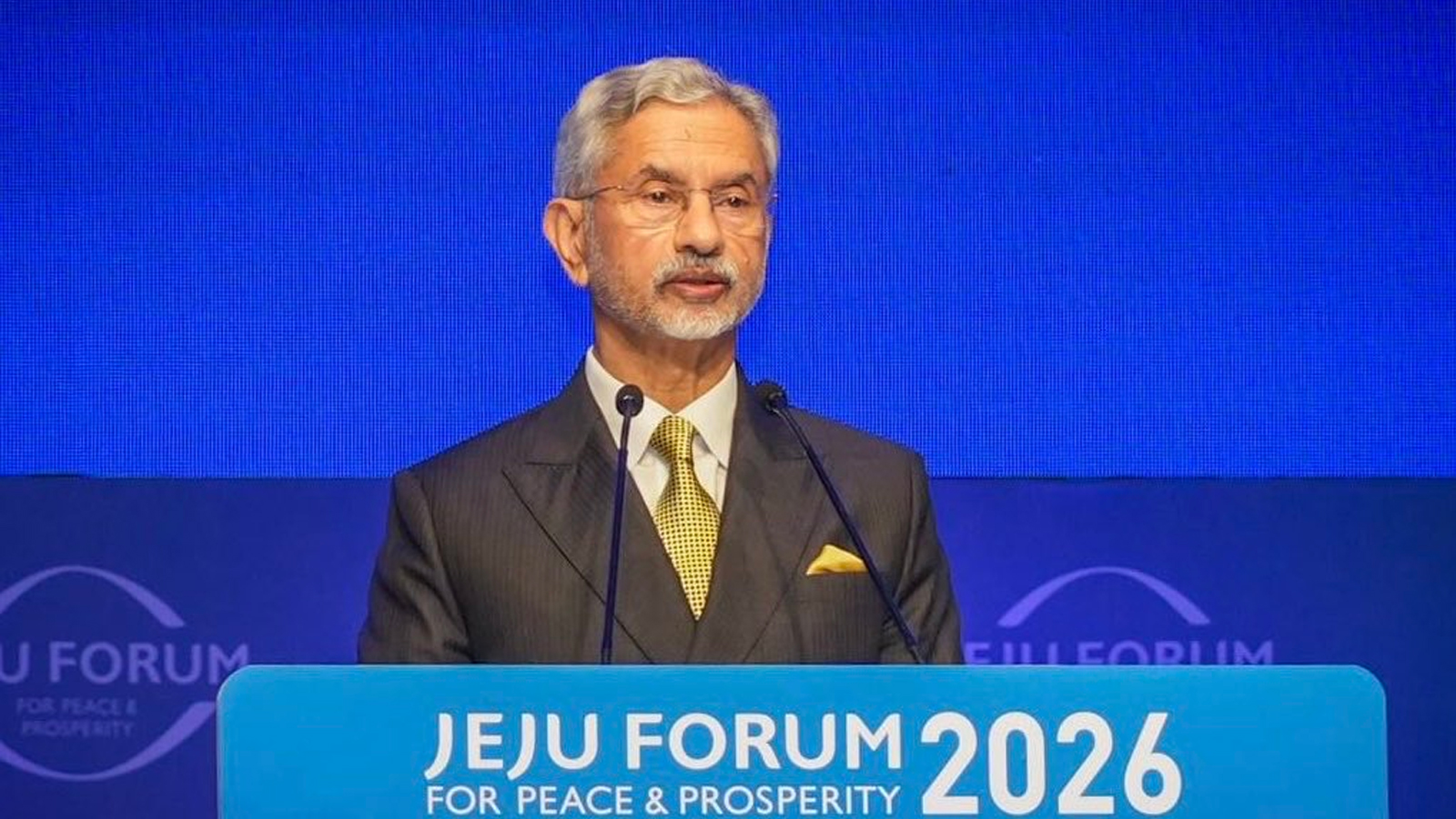
External Affairs Minister Dr. S. Jaishankar on Thursday called for a renewed framework of international cooperation to address the challenges of an increasingly fragmented global order, while delivering the keynote address at the Jeju Forum for Peace and Prosperity 2026 in South Korea.
Addressing delegates at the international forum, Jaishankar said that while fragmentation has become a defining feature of the contemporary world, it is not entirely negative. He said the shift away from concentrated dominance has created greater space for democratization, multipolarity and broader participation in global affairs.
“The world today is undergoing a complex rebalancing—economic, political and cultural,” Jaishankar said, noting that globalization and fragmentation now coexist, creating both opportunities and challenges for nations.
Fragmentation Here to Stay
The Minister observed that fragmentation is likely to remain a long-term reality in international relations. While economic interdependence, global supply chains, technological integration and mobility of talent have brought countries closer together, strategic competition, technological rivalries and geopolitical calculations are simultaneously driving divisions.
He highlighted that today’s world is characterized by unprecedented economic integration through supply chains, logistics networks and technology-driven connectivity. However, the same interconnectedness has also intensified competition over resources, markets, technologies and strategic influence.
“The natural play of commerce is increasingly influenced by strategic calculations,” Jaishankar said, adding that technology rivalry, once confined largely to military domains, has now spread across multiple sectors of the global economy.
Global Challenges Require Collective Responses
Jaishankar stressed that major contemporary challenges such as pandemics, terrorism and climate change transcend national boundaries and cannot be effectively addressed by individual countries acting alone.
Referring to India’s civilizational philosophy of “Vasudhaiva Kutumbakam” (the world is one family), he underscored the importance of maintaining openness toward international cooperation despite growing geopolitical tensions.
The Minister warned that responses to global challenges are becoming increasingly nationalistic, citing examples such as the COVID-19 pandemic, counter-terrorism efforts and climate change commitments.
He also expressed concern about what he described as the manipulation of competitiveness and market access, arguing that such practices hinder industrialization and development opportunities for many developing nations.
Five-Point Roadmap for Global Cooperation
Outlining India’s vision for rebuilding cooperation in a fragmented world, Jaishankar proposed a five-point framework.
First, he emphasized the need to de-risk the international economy through diversification of production bases and supply chains, making resilience and redundancy central elements of economic security.
Second, he called for forging new partnerships and understandings among influential nations to stabilize the global order and address challenges through issue-specific cooperation.
Third, he advocated greater awareness of the costs associated with confrontation and narrow strategic thinking, stressing the importance of protecting international laws and institutions, including the United Nations Convention on the Law of the Sea (UNCLOS).
Fourth, Jaishankar urged the international community to enhance opportunities and capacities for the Global South, arguing that empowering developing nations would generate new engines of global growth.
Finally, he stressed the importance of providing global public goods through collective efforts and advancing reforms in multilateral institutions to better reflect contemporary realities.
Concerns Over Weaponization and Technology Competition
The minister noted that the world is witnessing growing weaponization of economic and technological capabilities, increased risk-taking by states and a more confrontational style of politics influenced by the social media era.
Jaishankar said technological advancements are accelerating competitive behavior among nations, while the interests of a few powerful actors often take precedence over broader global welfare.
“As the interests of a few are openly prioritized, the costs to the many are less considered,” he remarked, adding that such trends can only be countered through wider and deeper international cooperation.
India-South Korea Partnership
Highlighting the significance of India-Republic of Korea relations, Jaishankar said the two countries possess strong complementarities in sectors such as shipbuilding, digital technology, healthcare, infrastructure and defence.
He noted that enhancing economic and technology partnerships, strengthening strategic cooperation and expanding people-to-people exchanges between India and South Korea would contribute not only to bilateral growth but also to broader regional and global stability.
The minister said discussions during his bilateral engagements in South Korea focused on leveraging these opportunities to deepen cooperation in areas of mutual interest.
Reinforcing India’s Global Vision
Following his address, Jaishankar shared highlights of his remarks on X, reiterating the need to reinvent cooperation in a fragmented world.
He emphasized strengthening supply chain resilience, building new partnerships, upholding international law, expanding opportunities for the Global South and advancing reformed multilateralism as key pillars for navigating an increasingly complex global landscape.
The Jeju Forum for Peace and Prosperity is one of Asia’s leading international dialogue platforms, bringing together policymakers, diplomats, academics and business leaders to discuss regional and global challenges. This year’s forum focused on the theme of addressing global fragmentation through renewed cooperation and collective action.


