







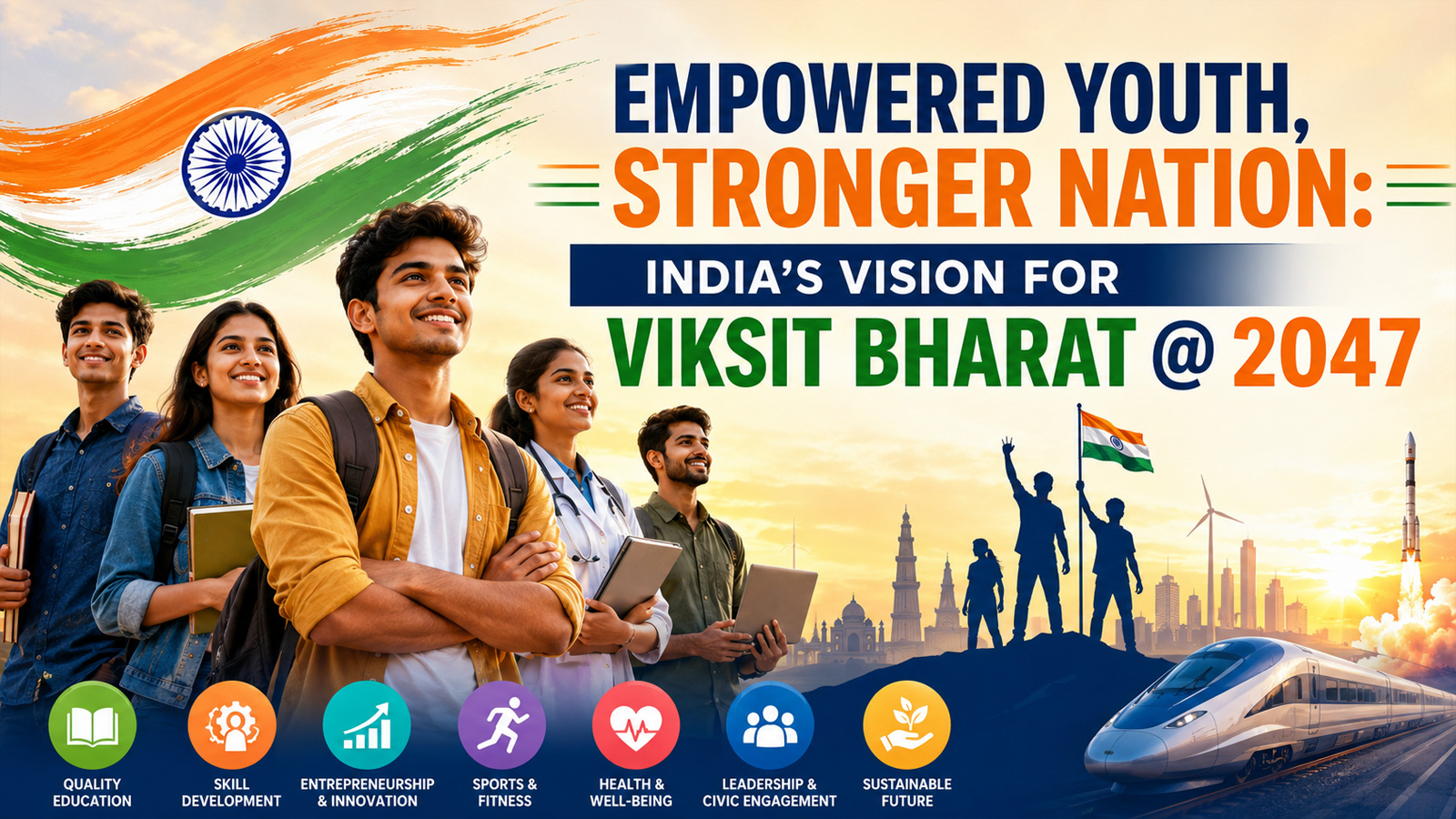
Over the past twelve years, India has witnessed a transformative shift in its approach to youth development, moving beyond welfare-driven interventions to a model that positions young people as active partners in nation-building. With nearly 65 per cent of the population below the age of 35, the country is leveraging its demographic dividend through large-scale investments in education, skills, employment, entrepreneurship, sports, health, and civic engagement.
The vision is clear: empower the nation’s youth – described as the “Amrit Peedhi” – to become the driving force behind the goal of transforming India into a developed nation by 2047.
From Youth Development to Youth-Led Development
India’s youth policy framework has evolved significantly since the introduction of the National Youth Policy 2014. While the earlier framework focused on education, employment, health, and social inclusion, recent initiatives have embraced a broader philosophy of youth-led development.
The proposed National Youth Policy 2025 reflects this transition by emphasizing entrepreneurship, leadership, future-ready skills, civic participation, digital engagement, and sustainable development. Rather than viewing young people merely as beneficiaries of government programmes, policymakers increasingly see them as co-creators of India’s future.
This shift underpins the broader vision of Viksit Bharat 2047, where the aspirations and capabilities of young Indians are expected to drive economic growth, technological innovation, and social transformation.
Reimagining Education for the Future
At the heart of India’s youth empowerment strategy lies education reform, anchored by the National Education Policy (NEP) 2020.
The policy represents the most comprehensive restructuring of India’s education system in decades. It aims to create a learner-centric ecosystem that promotes flexibility, multidisciplinary learning, creativity, and innovation.
The impact is visible across the school and higher education sectors.
More than 1.49 lakh schools have been covered under Information and Communication Technology initiatives, while over 1.76 lakh smart classrooms and nearly 1.8 lakh ICT laboratories have been sanctioned. Residential schools and hostels for girls, tribal students, and children from disadvantaged backgrounds have expanded educational access to remote and underserved regions.
These interventions have contributed to improved enrolment rates and reduced school dropout levels, ensuring that more students complete secondary and higher secondary education.
Higher Education Expands in Scale and Reach
India’s higher education landscape has undergone significant expansion.
Student enrolment has increased from 3.42 crore in 2014-15 to 4.46 crore in 2022-23. The number of higher education institutions has risen from over 51,000 to more than 70,000.
The country now operates one of the world’s largest education systems, serving nearly 25 crore students through more than 14.7 lakh schools.
Medical education has also expanded dramatically. The number of medical colleges has grown from 431 in 2014 to 818 in 2025-26, while MBBS and postgraduate medical seats have nearly doubled.
India’s premier institutions are also extending their global footprint. IIT campuses have been established in Zanzibar and Abu Dhabi, while IIM Ahmedabad has opened a campus in Dubai. Several foreign universities are expected to establish campuses in India, enhancing international collaboration in higher education.
Technology Reshaping Learning
Digital education has emerged as a major pillar of India’s education strategy.
The SWAYAM platform now offers more than 18,500 courses and has recorded over 6.1 crore enrolments. Meanwhile, DIKSHA hosts educational content in 135 languages, ensuring accessibility across diverse linguistic communities.
The Academic Bank of Credits and APAAR digital student identity system are creating a flexible academic ecosystem where students can accumulate, transfer, and redeem educational credits throughout their learning journey.
By March 2026, over 15.48 crore verified APAAR IDs had been generated, creating one of the world’s largest digital academic record systems.
Innovation is also being nurtured through over 10,000 Atal Tinkering Labs that have engaged more than 1.1 crore students and facilitated the development of over 16 lakh projects in emerging technologies.
Building a Skilled Workforce for a New Economy
As India seeks to become a global economic powerhouse, skill development has become a national priority.
Since the launch of the Skill India Mission in 2015, the country has built a comprehensive ecosystem aimed at preparing young people for both domestic and international labour markets.
The flagship Pradhan Mantri Kaushal Vikas Yojana (PMKVY) has evolved from a certification-based programme into a large-scale, industry-driven skilling initiative. Under its current phase, training focuses on emerging sectors such as artificial intelligence, drones, green energy, electronics, and advanced manufacturing.
More than 27 lakh candidates have been trained under PMKVY 4.0 alone across 741 districts.
The Jan Shikshan Sansthan network has expanded grassroots skill training, particularly benefiting women, rural youth, and tribal communities. Since 2018, more than 36 lakh beneficiaries have received training in locally relevant skills ranging from handicrafts to food processing.
Apprenticeship programmes have also gained momentum. More than 54 lakh apprentices have been engaged under the National Apprenticeship Promotion Scheme since 2016, helping bridge the gap between classroom learning and industry requirements.
ITIs Undergoing a Massive Upgrade
Recognising the importance of vocational education, the government launched the PM-SETU programme in 2025 with an estimated outlay of ₹60,000 crore.
The initiative aims to modernise 1,000 government Industrial Training Institutes (ITIs) through industry partnerships, state-of-the-art infrastructure, and updated curricula aligned with labour market needs.
At the same time, artificial intelligence education is being introduced at the school level through the SOAR programme, preparing students for the rapidly evolving digital economy.
Bridging Education and Employment
Creating employment opportunities remains a critical component of India’s youth strategy.
According to EPFO data, more than 3.45 crore young people aged between 18 and 28 joined the formal workforce between April 2020 and June 2025.
A series of employment-focused initiatives has supported this trend.
The Pradhan Mantri Viksit Bharat Rozgar Yojana, announced in 2025 with a ₹1 lakh crore outlay, seeks to facilitate the creation of 3.5 crore jobs within two years through employment-linked incentives.
The National Career Service portal has emerged as a major digital employment marketplace, connecting millions of job seekers with employers across sectors.
Meanwhile, the Prime Minister Internship Scheme is offering structured, paid internships that provide young people with valuable workplace experience. Opportunities are available across more than 25 sectors and over 730 districts.
Manufacturing Becomes a Major Job Generator
The Make in India initiative and Production Linked Incentive (PLI) schemes have played a key role in generating employment.
By March 2026, PLI-supported sectors had attracted investments exceeding ₹2.4 lakh crore, generated production worth over ₹22.6 lakh crore, and created more than 14 lakh direct and indirect jobs.
India has emerged as a major global smartphone manufacturing hub, while sectors such as pharmaceuticals, automobiles, electronics, textiles, and drones continue to expand.
These industries are creating opportunities for a new generation of skilled workers and engineers.
Startup India Fuels Entrepreneurial Revolution
Few areas illustrate India’s transformation more vividly than entrepreneurship.
In 2014, the country had approximately 350 startups. Today, it boasts more than 2.3 lakh recognised startups, making India the world’s third-largest startup ecosystem.
The number of unicorns – privately held startups valued at over $1 billion – has grown from just four in 2014 to more than 120 by 2026, with a combined valuation exceeding $350 billion.
Importantly, nearly half of these startups are emerging from Tier-II and Tier-III cities, signalling the democratization of innovation.
Collectively, these startups have generated over 23 lakh jobs.
A robust funding architecture now supports entrepreneurs at every stage, from seed capital through the Startup India Seed Fund Scheme to growth-stage investments through the Fund of Funds for Startups and collateral-free lending under the Credit Guarantee Scheme for Startups.
The Pradhan Mantri Mudra Yojana and Stand-Up India Scheme have further expanded access to finance, particularly for women and entrepreneurs from marginalized communities.
MY Bharat: A Digital Platform for Youth Engagement
The creation of Mera Yuva Bharat (MY Bharat) in 2023 marked a significant step toward integrating youth engagement under a single umbrella.
The platform combines physical and digital participation, offering volunteering opportunities, experiential learning, mentorship, civic engagement, career services, and leadership development.
As of June 2026, more than 2.19 crore youth had registered on the platform.
Through initiatives such as Youth Parliaments, Viksit Bharat Young Leaders Dialogue, and community service programmes, MY Bharat seeks to nurture a generation of informed, engaged, and socially responsible citizens.
India’s Sporting Transformation
India’s sporting ecosystem has undergone a remarkable transformation over the past decade.
The Khelo India programme has established over 1,000 training centres and State Centres of Excellence across the country, making quality coaching and infrastructure accessible to athletes in urban and rural areas alike.
More than 23,000 athletes currently receive support under various Khelo India programmes.
The introduction of the KIRTI talent identification programme has further strengthened the sports pipeline through scientific and data-driven assessment methods.
At the elite level, the Target Olympic Podium Scheme (TOPS) provides customised support to athletes competing on the international stage.
The result has been a steady improvement in India’s global sporting performance and growing confidence among young athletes that sports can be a viable career path.
Building a Healthier Generation
Youth development extends beyond education and employment to health and well-being.
The Rashtriya Kishor Swasthya Karyakram has significantly expanded adolescent health services, with beneficiaries increasing from 39 lakh in 2014-15 to 1.7 crore in 2024-25.
Mental health support has also expanded through the Tele-MANAS initiative, which has handled over 39 lakh calls since its launch in 2022.
Campaigns against substance abuse, digital health initiatives under the Ayushman Bharat Digital Mission, and the expansion of Ayushman Arogya Mandirs have strengthened healthcare access for young people across the country.
Meanwhile, the Fit India Movement has transformed fitness into a nationwide campaign, engaging more than 23 crore participants and integrating physical well-being into school education.
Youth as Global Ambassadors
India’s youth engagement increasingly extends beyond national borders.
Through partnerships with countries and multilateral organisations such as BRICS and the Shanghai Cooperation Organisation, youth exchange programmes are fostering international cooperation and leadership development.
Events such as the BIMSTEC Youth Summit, Central Asia Youth Delegation Programme, and India’s Y20 Presidency activities have provided young Indians with opportunities to engage on global platforms.
The participation of Indian diaspora youth in initiatives like the Viksit Bharat Young Leaders Dialogue reflects India’s growing soft power and global outreach.
The Road Ahead
The story of India’s youth over the past decade is one of expanding opportunities and rising aspirations.
The country has built an integrated ecosystem that spans education, skilling, entrepreneurship, employment, health, sports, digital engagement, and leadership development. The objective is not merely to prepare young people for jobs but to equip them to lead, innovate, and shape the future.
As India advances toward the goal of becoming a developed nation by 2047, the success of this vision will depend largely on the capabilities of its young citizens.
The foundations have been laid through policy reforms, institutional expansion, digital innovation, and targeted investments. The emergence of the Amrit Peedhi as a confident, skilled, and entrepreneurial generation suggests that India’s demographic dividend may become one of its greatest strategic advantages in the decades ahead.
In the journey toward Viksit Bharat 2047, India’s youth are no longer just participants in the nation’s development story – they are increasingly its authors.


