







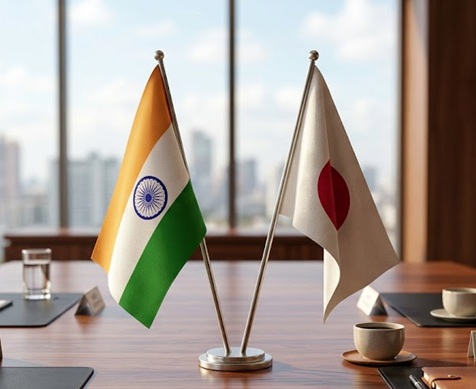
India and Japan have steadily transformed their bilateral relationship into one of the country’s most significant strategic partnerships through sustained political dialogue, annual summits and expanding cooperation in areas ranging from defence and infrastructure to technology, clean energy and economic security.
The two countries established diplomatic relations in 1952, and the relationship has been strengthened over the decades through regular exchanges between political leaders and members of the Imperial Family. Among the early landmark visits were those by Japanese Prime Minister Nobusuke Kishi, Crown Prince Akihito and Crown Princess Michiko to India, while Prime Minister Jawaharlal Nehru and President Rajendra Prasad visited Japan, laying the foundation for closer bilateral ties.
A major turning point came in 2000, when the two countries elevated their relationship to a Global Partnership. This was followed by its elevation to a Strategic and Global Partnership in 2006, the year India and Japan also institutionalised annual summit meetings between their Prime Ministers. In 2014, during Prime Minister Narendra Modi’s first annual summit with Japan, the relationship was further upgraded to a Special Strategic and Global Partnership, reflecting the growing depth of cooperation.
One of the most significant milestones in bilateral relations came in 2013, when Emperor Akihito and Empress Michiko visited India, marking the first visit by a reigning Japanese Emperor.
Former Japanese Prime Minister Shinzo Abe played a defining role in shaping the modern India-Japan partnership. His landmark “Confluence of Two Seas” address to the Indian Parliament in 2007 laid the intellectual foundation for the Indo-Pacific concept. Abe later attended India’s Republic Day celebrations in 2014 as Chief Guest and was posthumously awarded the Padma Vibhushan in 2021.
Since assuming office in 2014, Prime Minister Narendra Modi has visited Japan eight times, including for annual summits, the G20 Summit in Osaka (2019), the Quad Summit and the state funeral of Shinzo Abe in 2022, the G7 Summit in Hiroshima in 2023, and the 15th India-Japan Annual Summit in Tokyo in August 2025.
During the 15th Annual Summit, Prime Minister Modi held talks with then Japanese Prime Minister Shigeru Ishiba, with both leaders adopting a Joint Vision for the next decade and a Joint Declaration on Security Cooperation. Japanese private companies also announced plans to invest 10 trillion yen (approximately USD 67 billion) in India over the next decade.
The summit expanded bilateral cooperation through new initiatives such as the Economic Security Initiative, Next Generation Mobility Partnership, Artificial Intelligence Initiative, India-Kansai Business Forum, India-Kyushu Business Forum, and the proposed India-Japan SME Forum. Agreements were also signed in areas including clean energy, critical minerals, digital technologies, space cooperation, environmental protection and cultural exchanges.
Prime Minister Modi’s visit also included the joint inauguration of the India-Japan Economic Forum, meetings with former Japanese Prime Ministers Yoshihide Suga and Fumio Kishida, interactions with governors from 16 Japanese prefectures, and a visit to the Tokyo Electron manufacturing facility.
Earlier, in March 2023, then Japanese Prime Minister Fumio Kishida visited India for the 14th Annual Summit, where the two countries adopted a joint statement titled “Partnership for a Peaceful, Stable and Prosperous Post-COVID World.” Japan announced a target of 5 trillion yen in public and private investment and financing for India over five years.
The summit also witnessed the launch of the India-Japan Clean Energy Partnership, a roadmap under the India-Japan Industrial Competitiveness Partnership, and the signing of exchange notes for seven Official Development Assistance (ODA) loan projects worth over 300 billion yen, including support for the Mumbai-Ahmedabad High-Speed Rail Project.
During the visit, Prime Minister Kishida unveiled “Japan’s New Plan for a Free and Open Indo-Pacific” at the Indian Council of World Affairs, underscoring India’s central role in Japan’s regional vision. The two countries also renewed their cooperation on Japanese language education and declared 2023 as the India-Japan Year of Tourism Exchange under the theme “Connecting Himalayas with Mount Fuji,” later extending the initiative through 2024.
Over the years, India and Japan have broadened cooperation beyond traditional diplomacy to include defence and maritime security, economic security, critical and emerging technologies, semiconductor supply chains, clean energy, connectivity, infrastructure development, people-to-people exchanges and regional stability in the Indo-Pacific.


