







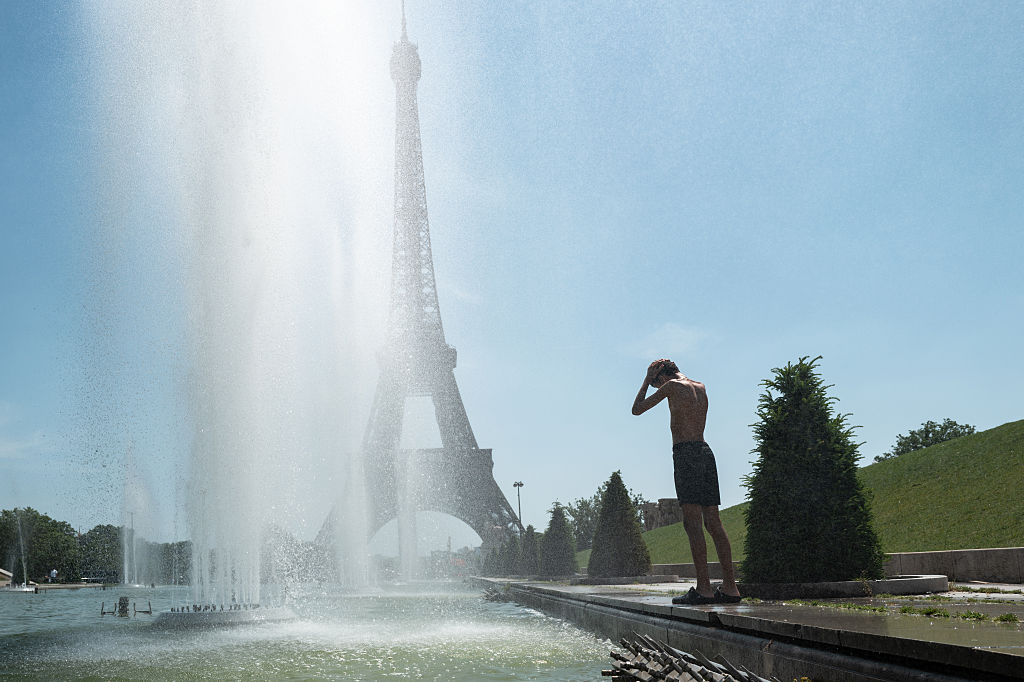
Forty people have drowned in France over recent days as they sought to cool down to escape record heat, the prime minister said on Tuesday, as a heatwave swept across much of Europe.
Britain, Italy, Switzerland and Spain were also sweltering in extreme heat, with record temperatures in some areas disrupting schools and transport networks and forcing tourist sites – including the Eiffel Tower – to shut.
Europe is warming at more than twice the global average, according to the World Meteorological Organization, making such prolonged heat episodes increasingly likely.
HEAT ALERT ACROSS FRANCE
France experienced its hottest day on record on Tuesday, Meteo France forecaster said, with a peak of 44.3 degrees Celsius (111.74 degrees Fahrenheit) in one town in the south west.
Fifty-four departments are under red alerts in what Meteo France said was unprecedented. That will jump to 58 on Wednesday.
Across the country, people have been jumping into canals and rivers to cool off. Sports minister Marina Ferrari said she understood the urge to escape the heat but warned against swimming in unauthorized or dangerous areas.
Speaking ahead of an emergency meeting on the heatwave, Prime Minister Sebastien Lecornu called the drownings “a sad scourge” and said there had been 40 deaths since June 18, most of them young people.
On Monday, first responders were unable to resuscitate two children, aged 2 and 4, who were found unconscious by their mother in the family car outside their home, said a prosecutor in Carpentras, southeast France.
HEAT DOME
The heatwave is being driven by a weather pattern known as an Omega block, because it takes the shape of the Greek letter Ω, with a bulge of hot air trapped between cooler systems, allowing temperatures to build day after day. Heatwaves and storms are being intensified by climate change.
Meteo France said current conditions were comparable to the August 2003 heatwave, which lasted 16 days and led to an estimated 80,000 excess deaths across Europe. It was uncertain how long the current episode would last.
“Thursday will once again be a sweltering day (in France), with temperatures remaining just as high. On Friday, a gradual drop is expected to begin from the Atlantic coast,” the weather forecaster said.
Heatwaves can affect people’s physical and mental healthbut also force businesses to adapt and put grain harvests at risk.
HEAT ALERTS IN ITALY, BRITAIN
In Italy, the health ministry issued its highest level alert for 15 cities and authorities took measures to curtail work in some sectors. Storms were expected over the Alps and Apennines, bringing heavy rain, gusty winds and hail.
Britain is also in the grip of the heat, with the Met Office forecasting temperatures of up to 37 C in southern England on Tuesday — potentially a new June record — before rising further on Wednesday and Thursday. Dozens of schools planned early closures.
Transport networks across Europe came under strain, with trains cancelled or running more slowly.
CLIMATE SHELTERS
Spain’s meteorological agency has issued red alerts across parts of the country, warning of dangerous heat with temperatures expected to reach 44 C. Dozens of municipalities across northern Spain cancelled traditional bonfires due to wildfire risks.
Madrid has opened climate shelters for the homeless and other vulnerable people.
In Belgium, soaring temperatures forced a primary school near Brussels to relocate its final exams to a nearby church.
In Switzerland, the northeastern canton of St. Gallen restricted water withdrawal from rivers and lakes, citing low levels and high temperatures.
TRYING TO ADAPT
In cities affected by the heatwave, fans and air conditioning units were flying off the shelves.
“I came quick, I haven’t even had my coffee this morning, I ran here to buy an electric fan,” said filmmaker Victoria Yakubov, who managed to snag one last remaining fan in a Paris shop. “Everything was gone in less than 30 minutes.”
It was the same story in London, with fans “flying off the shelves”, John Lewis Oxford street branch manager, Paul Marsden said.
As parts of Europe baked, and the Eiffel Tower closed at 4 p.m. (1400 GMT) because of the heat, cooler northern destinations were drawing tourists seeking a “coolcation”.
“We were thinking about travelling to Croatia, but we came to Sweden because it’s cooler here,” said German tourist Katharina Rexing in Stockholm’s Old Town, on a day when it was 22 C in the Swedish capital and 30 C in Croatia’s Zagreb.
(Reuters)


