







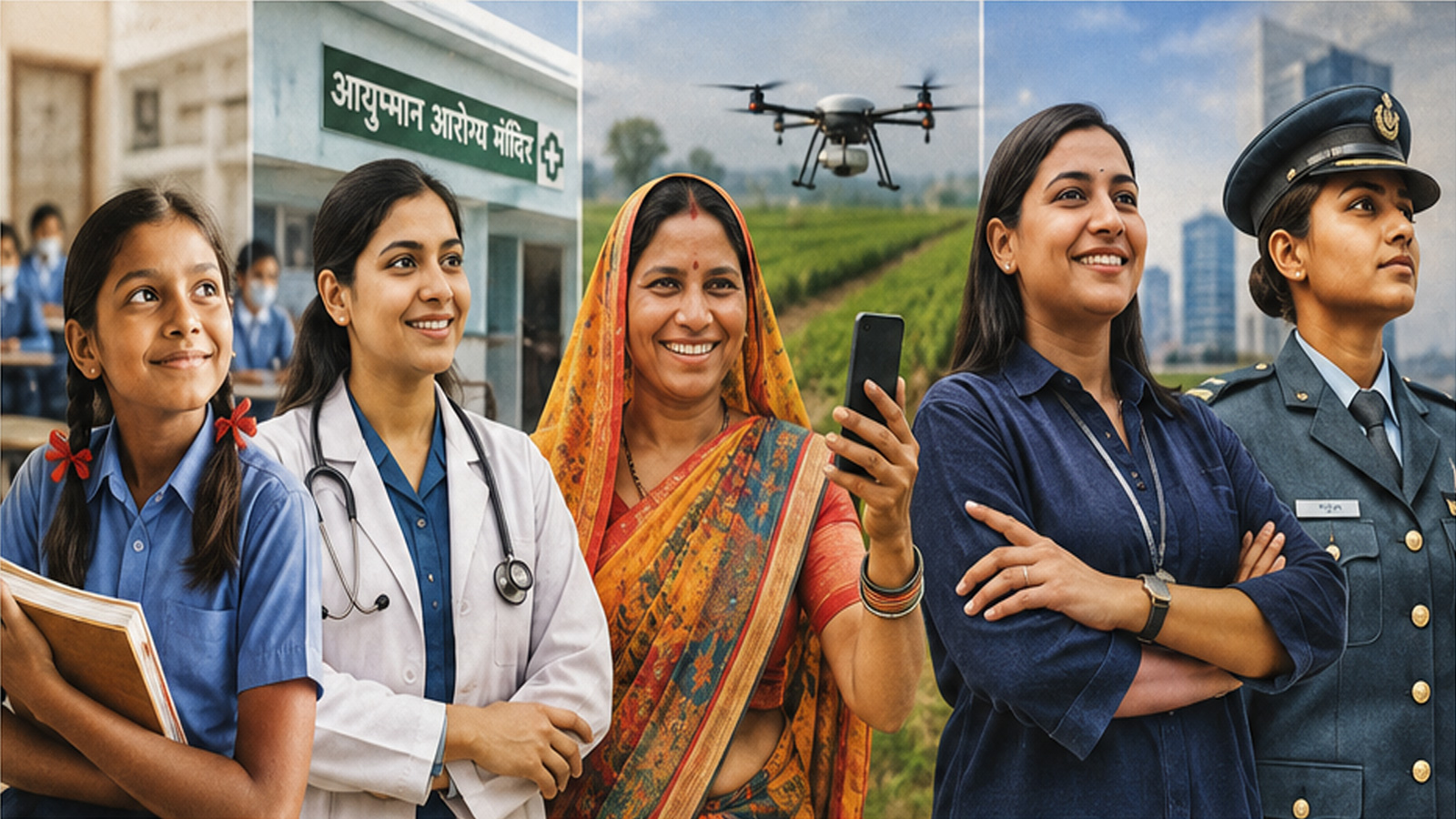
Over the past twelve years, India has witnessed a significant transformation in its approach to women’s empowerment, moving beyond traditional welfare measures towards a model centred on women-led development. Women are increasingly emerging not merely as beneficiaries of government schemes but as active participants in economic growth, governance, entrepreneurship, education, innovation, and nation-building.
This shift has been driven by a lifecycle-based approach that seeks to support women from birth through adulthood, addressing healthcare, education, nutrition, financial inclusion, livelihood opportunities, safety, and leadership. The result is a broader social transformation that is reshaping both communities and institutions across the country.
The journey begins with efforts aimed at protecting and educating the girl child. Launched in 2015, the Beti Bachao Beti Padhao programme sought to tackle declining child sex ratios and challenge deeply rooted gender biases. Combining strict enforcement of laws against sex-selective practices with nationwide awareness campaigns, the initiative has evolved into a movement promoting the survival, protection, and education of girls. Its impact is reflected in demographic trends, with the National Family Health Survey-5 recording 1,020 women for every 1,000 men, a significant improvement from the 943 recorded in the 2011 Census.
Maternal healthcare has also seen major improvements. Recognising that safe pregnancies and healthy childbirth are central to women’s well-being, the government introduced the Pradhan Mantri Matru Vandana Yojana in 2017. The scheme provides financial assistance to pregnant and lactating mothers, helping them access nutrition and healthcare services during critical stages of pregnancy. By April 2026, nearly 4.92 crore women had enrolled under the programme, with over ₹20,150 crore disbursed through direct benefit transfers.
Complementing these efforts, the Pradhan Mantri Surakshit Matritva Abhiyan has transformed antenatal care across India. Since its launch in 2016, the programme has provided free, quality antenatal check-ups to pregnant women, particularly those in the second and third trimesters. More than 7.4 crore women have been examined under the initiative, leading to the identification and monitoring of over one crore high-risk pregnancies. These interventions have contributed to a significant decline in India’s Maternal Mortality Ratio, which has fallen from 130 maternal deaths per lakh live births in 2014-15 to 88 in 2021-23.
Education has emerged as another pillar of women’s empowerment. Government initiatives such as Samagra Shiksha have expanded access to quality education while strengthening school infrastructure. Female enrolment has grown dramatically over the past decade, reaching nearly 11.93 crore students and accounting for almost half of all enrolments in schools. Improved access to drinking water, separate toilets for girls, electricity, and libraries has helped reduce dropout rates and encourage continued participation in education.
Residential institutions such as Kasturba Gandhi Balika Vidyalayas have played a crucial role in supporting girls from disadvantaged backgrounds. These schools provide not only education but also an environment where girls can pursue aspirations that might otherwise remain out of reach. Stories of former students becoming civil servants and international athletes illustrate the transformative power of educational access and sustained support.
The focus on higher education and science has also strengthened. Programmes such as Vigyan Jyoti have encouraged girls to pursue careers in science, technology, engineering, and mathematics. Women’s representation in premier institutions has increased significantly, aided by additional seats in IITs and NITs, while female participation among STEM scholars continues to rise.
As educational opportunities have expanded, efforts have also focused on ensuring women possess the skills needed for emerging sectors of the economy. Through the Pradhan Mantri Kaushal Vikas Yojana, millions of women have received industry-relevant training. The programme now includes cutting-edge fields such as artificial intelligence, drone technology, renewable energy, and electronics, preparing women for future-ready careers. The NAVYA initiative, launched in 2025, further aims to equip adolescent girls with digital and vocational skills, helping them participate in a rapidly changing economy.
Healthcare access has broadened considerably through Ayushman Bharat. Nearly half of all Ayushman cards issued belong to women, and millions have benefited from affordable healthcare services under the scheme. The expansion of Ayushman Arogya Mandirs and digital health infrastructure has improved access to preventive, primary, and specialised healthcare, particularly in rural and underserved regions.
Nutrition interventions have also gained momentum through Saksham Anganwadi and Poshan 2.0. These programmes focus on maternal nutrition, child development, and early childhood education, while investments in Anganwadi infrastructure and frontline workers have strengthened service delivery at the grassroots level.
Financial inclusion has emerged as one of the most significant drivers of women’s empowerment. The Pradhan Mantri Jan Dhan Yojana opened the doors of the formal banking system to millions of women, enabling them to access savings, credit, insurance, and government benefits directly. This foundation has enabled broader economic participation and strengthened women’s financial independence.
Self Help Groups have become a powerful engine of rural transformation under the Deendayal Antyodaya Yojana-National Rural Livelihood Mission. What began as a mechanism for collective savings has evolved into one of the world’s largest women-led economic movements. Today, more than ten crore women are linked through nearly ninety-four lakh Self Help Groups, with access to substantial bank credit and livelihood opportunities.
The government’s Lakhpati Didi initiative seeks to build on this success by enabling women to achieve annual incomes of at least ₹1 lakh. Through access to credit, skill development, and enterprise support, the programme aims to create six crore financially empowered women across rural India.
Women entrepreneurs have also benefited from schemes such as the Pradhan Mantri Mudra Yojana, Stand-Up India, PM SVANidhi, and NaMo Drone Didi. These programmes have expanded access to collateral-free loans, technology, markets, and modern agricultural tools. In particular, the Drone Didi initiative is redefining women’s role in agriculture by training them to operate drones for precision farming and agricultural services.
Market access has improved through initiatives like Womaniya on the Government e-Marketplace, which connects women entrepreneurs directly with government procurement systems. Meanwhile, the newly announced SHE-Mart initiative seeks to create dedicated retail spaces for women-led enterprises, helping them transition from small-scale livelihoods to sustainable businesses.
Alongside economic empowerment, the government has focused on strengthening women’s safety, dignity, and quality of life. Mission Shakti has created an integrated framework that combines safety and empowerment services through One Stop Centres, women’s helplines, shelter homes, and grievance redressal mechanisms. Millions of women have accessed assistance through these facilities, improving their ability to seek support and justice.
The Swachh Bharat Mission has delivered profound social benefits by eliminating open defecation and expanding sanitation infrastructure. Access to toilets has improved safety, privacy, and dignity for women across urban and rural India. Similarly, the Pradhan Mantri Ujjwala Yojana has provided more than ten crore LPG connections, reducing exposure to harmful indoor air pollution and easing household burdens.
Access to safe drinking water has expanded dramatically through the Jal Jeevan Mission. Millions of rural households now have tap water connections, reducing the time women spend collecting water and enabling them to engage in education, livelihood activities, and family care. For countless women, this has translated into improved health, greater productivity, and enhanced dignity.
The growing empowerment of women is also visible in India’s democratic institutions. Women now constitute nearly half of the country’s electorate, with voter turnout surpassing that of men in recent elections. Representation in Parliament has steadily improved, while local governance has witnessed a remarkable transformation, with over 14.5 lakh women serving as elected representatives in Panchayati Raj Institutions.
The Nari Shakti Vandan Adhiniyam in 2023 marked another milestone by providing 33 per cent reservation for women in the Lok Sabha and State Legislative Assemblies. The law will be implemented after the completion of the census and the subsequent delimitation process. Women are also breaking barriers in traditionally male-dominated sectors, including the armed forces, where the first batch of women cadets graduated from the National Defence Academy in 2025.
Taken together, these developments illustrate a broader transformation in India’s approach to women’s empowerment. The emphasis is no longer confined to welfare and protection. Instead, women are increasingly being recognised as leaders, innovators, entrepreneurs, policymakers, and nation-builders.
As India advances towards its vision of Viksit Bharat by 2047, women are expected to play an even more central role in shaping the country’s future. From classrooms and laboratories to village councils, startups, farms, and boardrooms, their participation is driving social progress and economic growth. The transition from women-centric welfare to women-led development is not merely changing individual lives—it is redefining the trajectory of India’s development itself.


