







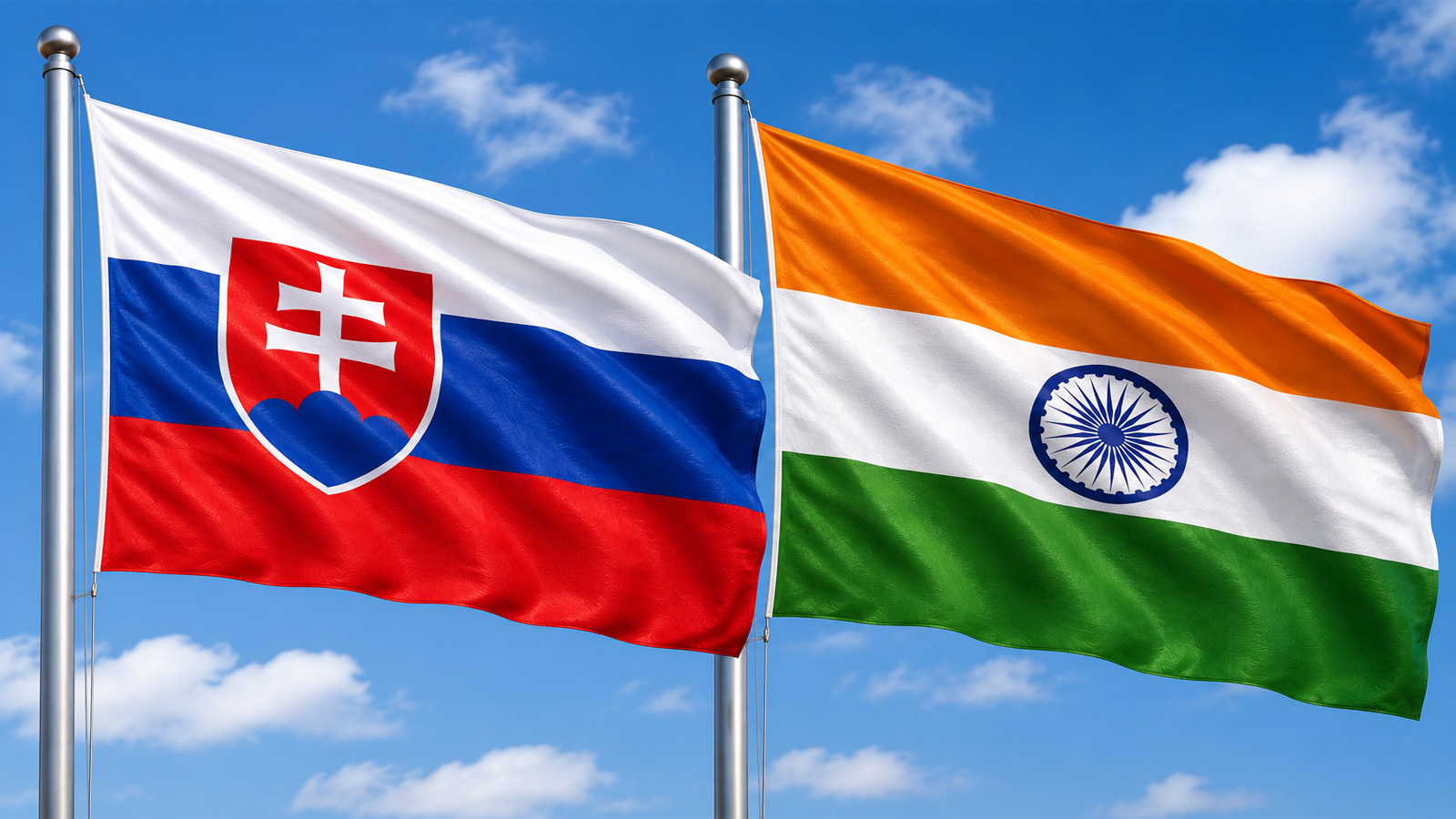
From early diplomatic recognition and high-level state visits to growing cooperation in trade, technology, education, and multilateral forums, India and Slovakia have steadily transformed their traditionally warm relationship into a dynamic and multifaceted partnership. As both nations deepen engagement across sectors, bilateral ties are entering a new phase marked by increasing political dialogue, institutional cooperation, and strategic convergence.
India and Slovakia share a relationship rooted in history, democratic values, and mutual respect. While the two countries are separated by geography, their partnership has steadily evolved over the decades through sustained diplomatic engagement and expanding cooperation in political, economic, educational, and cultural spheres.
According to the Ministry of External Affairs (MEA), the relationship traces its origins to 1921, when a Czechoslovak consulate was established in Bombay, laying the foundation for contacts between the peoples of the two nations. Following the peaceful dissolution of Czechoslovakia and the emergence of the Slovak Republic on January 1, 1993, India was among the first countries to formally recognize the newly independent state.
The swift recognition reflected New Delhi’s commitment to strengthening relations with the emerging Central European nation. Slovakia subsequently opened its resident embassy in New Delhi in 1993, while India established its embassy in Bratislava in August 1995, creating a permanent diplomatic framework for bilateral engagement.
Today, Slovakia maintains honorary consulates in Mumbai, Bengaluru, and Kolkata, with the Kolkata consulate inaugurated in March 2025, underscoring the growing importance of India in Slovakia’s foreign policy and economic outreach.
Partnership Built on Shared Democratic Values
At the core of India-Slovakia relations lies a common commitment to democratic governance, the rule of law, individual freedoms, and equality. These shared principles have provided a stable foundation for cooperation over the past three decades.
As both countries navigate a rapidly changing geopolitical landscape, their engagement increasingly reflects common interests in economic development, technological innovation, education, security, and international cooperation.
The relationship has evolved from a largely diplomatic association into a broader partnership involving governments, businesses, educational institutions, and civil society organizations.
Presidential Diplomacy Marks New Momentum
High-level political exchanges have played a crucial role in strengthening bilateral relations.
One of the earliest major visits from India was undertaken by former President Dr. Shankar Dayal Sharma, who visited Slovakia in October 1996 as part of a broader European tour. During the visit, he held discussions with Slovak President Michal Kováč and explored opportunities for expanding economic cooperation.
Former Vice President Krishan Kant followed with a visit in June 2000, reinforcing political ties between the two nations.
A significant milestone came in April 2025 when the President of India Droupadi Murmu paid a State Visit to Slovakia, marking the first presidential-level visit from India in nearly three decades. The visit signaled renewed political commitment and elevated bilateral engagement to a higher level.
Accompanied by a business delegation, the President’s visit resulted in the signing of two important agreements. One focused on cooperation between the foreign service institutes of both countries, while the second established collaboration between India’s National Small Industries Corporation (NSIC) and the Slovak Business Agency to support micro, small, and medium enterprises.
These agreements reflected a broader effort to institutionalize cooperation in diplomacy, entrepreneurship, and economic development.
Slovak Leaders Expand Engagement with India
Slovakia has also maintained active political engagement with India through high-level visits.
Former Slovak Prime Minister Jozef Moravčík visited India in July 1994, accompanied by senior ministers and officials. The visit laid the groundwork for economic and political cooperation during the early years of Slovakia’s independence.
In 2004, Slovak President Ivan Gašparovič undertook a State Visit to India with a large delegation that included ministers responsible for culture, defence, and foreign affairs, along with business leaders seeking to explore investment opportunities.
More recently, Slovak President Peter Pellegrini visited India in February 2026 to participate in the AI Impact Summit in New Delhi. During the visit, he met with India’s President and Prime Minister while participating in discussions on emerging technologies, artificial intelligence, and global innovation.
The visit highlighted the growing importance of technology and digital transformation in bilateral cooperation.
Foreign Ministers Drive Political Dialogue
Foreign minister-level engagement has intensified significantly in recent years, reflecting the growing importance both countries attach to their partnership.
A landmark moment came in June 2022 when External Affairs Minister Dr. S. Jaishankar became the first Indian External Affairs Minister to visit Slovakia since the country’s independence in 1993.
During his visit, Jaishankar participated in the prestigious GLOBSEC Forum and held discussions with Slovak Prime Minister Eduard Heger and Foreign Minister Ivan Korčok. The visit opened new avenues for cooperation in political, economic, and strategic domains.
On the Slovak side, a series of foreign ministerial visits have reinforced engagement with India.
Former Foreign Minister Rastislav Káčer visited India in 2023 for the Raisina Dialogue, during which the two countries signed the Cultural Exchange Programme for 2023–2026, expanding cooperation in arts, education, and cultural diplomacy.
His successor, Foreign Minister Juraj Blanár, visited India twice in consecutive years for the Raisina Dialogue, leading large delegations comprising government officials, business leaders, and defence industry representatives.
His 2024 visit resulted in extensive discussions on defence cooperation, standards and quality infrastructure, and economic collaboration. An agreement between India’s Bureau of Indian Standards (BIS) and Slovakia’s Office of Standards, Metrology and Testing was signed during the visit.
In 2025, Blanár returned to India with a high-profile delegation that included Slovakia’s Finance Minister Ladislav Kamenický and senior government officials. During the visit, he inaugurated Slovakia’s Honorary Consulate in Kolkata and held discussions aimed at strengthening economic and strategic cooperation.
Although a planned visit to India for the Raisina Dialogue in 2026 was cancelled due to developments in West Asia, diplomatic contacts continued through multilateral forums and bilateral consultations.
Expanding Ministerial and Sectoral Cooperation
Beyond heads of state and foreign ministers, both countries have expanded engagement through ministerial-level exchanges covering diverse sectors.
India’s Minister of Law and Justice Kiren Rijiju visited Slovakia in 2022 as a special envoy during the evacuation of Indian students from Ukraine amid the conflict in Eastern Europe. Slovakia played an important role as a transit and support hub during the humanitarian operation.
In November 2025, Minister of State for Education Sukanta Majumdar led an Indian delegation to Slovakia for the OECD Global Forum on the Future of Education and Skills 2040. During the visit, he met Slovak education officials, visited academic institutions, and interacted with Indian professionals working in Slovakia.
A delegation from Karnataka, led by state ministers Dr. Sharan Prakash Patil and Dr. M.C. Sudhakar, visited Slovakia later that year to explore industrial cooperation and engage with Indian workers employed in the country’s automotive sector.
On the Slovak side, Economy Minister Karel Hirman visited India in 2023 for the Smart Cities India Expo and held discussions with Indian ministers responsible for commerce, power, and renewable energy.
Education cooperation also gained momentum when Slovak State Secretary Robert Zsembera led a delegation of Slovak universities to New Delhi in 2025 for the Asia-Pacific Association for International Education conference.
These visits underscore the broadening scope of bilateral engagement beyond traditional diplomacy.
Multilateral Platforms Create New Opportunities
In addition to bilateral visits, leaders and ministers from both countries have regularly interacted on the sidelines of international forums.
Over the past five years, meetings between Indian and Slovak foreign ministers have taken place during gatherings such as the Sir Bani Yas Forum in the United Arab Emirates, the Slavkov Format in Austria, the United Nations General Assembly, and the European Union Foreign Affairs Council.
These interactions have ensured continuity in political dialogue and allowed both sides to coordinate positions on international issues.
Institutional Mechanisms Strengthen Cooperation
An important feature of India-Slovakia relations is the network of institutional mechanisms supporting regular engagement.
The MEA said that the Foreign Office Consultations mechanism, established through a bilateral protocol signed in 1994, serves as the primary platform for political and diplomatic dialogue.
Since its inception, six rounds of consultations have been held, enabling officials from both countries to review bilateral cooperation, exchange views on regional and global developments, and identify new areas for collaboration.
The most recent round took place in New Delhi in February 2023 and was co-chaired by senior officials from the foreign ministries of both countries.
These consultations provide continuity and strategic direction to the partnership, ensuring that bilateral relations remain responsive to emerging opportunities and challenges.
A Relationship Entering a New Phase
Over the past three decades, India and Slovakia have steadily transformed their relationship from one focused primarily on diplomatic goodwill into a comprehensive partnership spanning politics, economics, technology, education, culture, and people-to-people exchanges.
Recent high-level visits, growing institutional engagement, expanding economic cooperation, and increasing collaboration in emerging sectors such as artificial intelligence, innovation, and advanced manufacturing indicate that the relationship is entering a new phase of maturity.
The frequency of political exchanges in recent years reflects a shared recognition that closer cooperation can generate tangible benefits for both countries.
For India, Slovakia offers access to one of Europe’s most industrialized economies and an important gateway to Central and Eastern Europe. For Slovakia, India represents a rapidly growing economic power, a major technology hub, and a key partner in the Indo-Pacific region.
Looking Ahead
As both countries navigate a changing global environment marked by technological transformation, geopolitical shifts, and evolving economic priorities, India and Slovakia are increasingly finding common ground on issues ranging from innovation and sustainability to education and industrial development.
The strengthening of diplomatic institutions, growing political trust, and expanding people-to-people connections provide a strong foundation for future cooperation.
Three decades after India became one of the first nations to recognize the Slovak Republic, the partnership continues to evolve with renewed energy and ambition. The trajectory of recent years suggests that India-Slovakia relations are poised to become deeper, more strategic, and increasingly consequential in the years ahead.


