







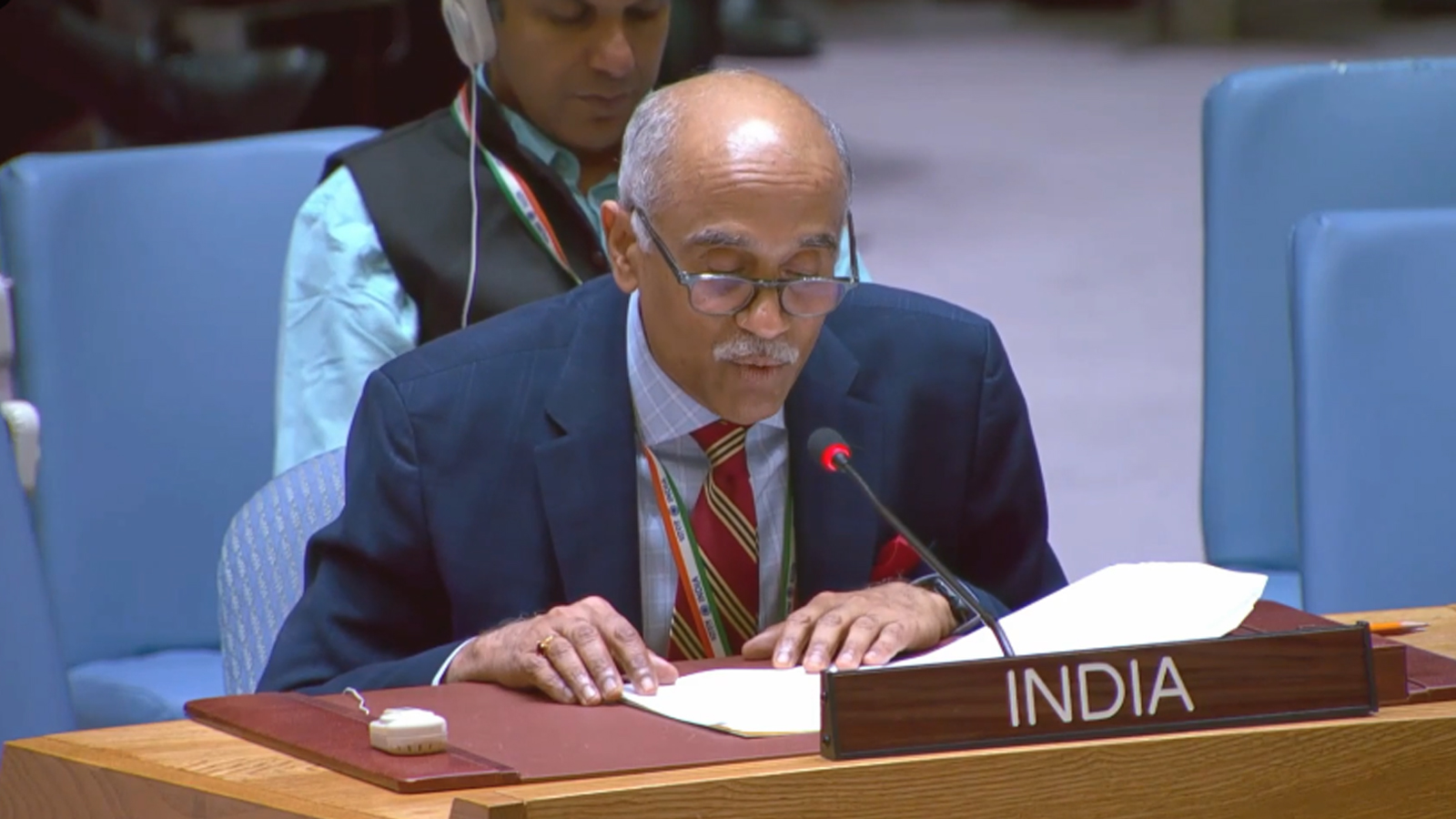
India underscored the critical role of women in peacebuilding, governance and economic development at the United Nations Security Council (UNSC) Open Debate on Women, Peace and Security, highlighting its achievements in political empowerment, women-led development and international peacekeeping.
Delivering India’s statement at the high-level debate on the theme “Peace is Decided with Women: Emerging from Conflict by Enhancing Their Participation,” India’s Permanent Representative to the United Nations, Ambassador Harish Parvathaneni, emphasized that meaningful participation of women is indispensable for achieving durable peace and sustainable development.
Addressing the Security Council, Parvathaneni noted that women often bear the heaviest burden during armed conflicts, facing displacement, loss of livelihoods and family members, and gender-based violence that can leave long-lasting physical, psychological and social scars.
“Peace agreements that leave women’s concerns unaddressed are incomplete and fragile. Women’s meaningful participation in peace processes is a prerequisite for durable peace,” he said, referring to the principles enshrined in the landmark UNSC Resolution 1325 on Women, Peace and Security.
The Indian envoy highlighted numerous examples from around the world where women have played transformative roles in conflict resolution and reconciliation efforts. He cited the women-led peace movement in Liberia, whose sustained advocacy helped bring warring parties to the negotiating table, and grassroots women’s networks in Colombia that contributed significantly to building the country’s national action plan on security.
Parvathaneni said women’s deep understanding of local communities and their role as caregivers and community anchors often make them uniquely effective mediators in conflict situations.
A significant portion of India’s intervention focused on the contribution of women in United Nations peacekeeping operations. The ambassador described the deployment of women peacekeepers as one of the most visible and impactful aspects of the Women, Peace and Security agenda.
“They build trust in communities. They give hope to vulnerable populations, particularly women and children. They serve as visible symbols of women’s agency in maintaining peace and security,” he said.
Highlighting India’s pioneering role in this field, Parvathaneni recalled that India became the first country to deploy an all-female Formed Police Unit to the United Nations Mission in Liberia. The deployment is widely credited with inspiring thousands of Liberian women to join their country’s police force and strengthening confidence in women’s leadership in security institutions.
India continues to be among the leading contributors of women peacekeepers to UN missions. The ambassador said more than 160 Indian women peacekeepers are currently serving in various United Nations peacekeeping operations across the globe.
India has also invested significantly in training and capacity-building initiatives for women in peacekeeping. The Centre for United Nations Peacekeeping (CUNPK), established by the Indian Army in New Delhi, has been training female military officers from different countries since 2016.
Further strengthening international cooperation, India hosted the Conference for Women Peacekeepers from the Global South in February 2025, bringing together women peacekeepers from 35 countries to exchange experiences and best practices. In August 2025, India also hosted the UN Women Military Officers Course, which saw participation from 15 countries.
India’s contributions to peacekeeping have received international recognition over the years. Parvathaneni noted that Indian women peacekeepers have won prestigious United Nations Gender Advocate Awards in 2019, 2024 and most recently in 2026.
He highlighted the achievement of Major Abhilasha Barak, who received the award in 2026 for her efforts in engaging with local communities, empowering women and implementing women-focused initiatives in peacekeeping environments.
Turning to India’s domestic efforts, the ambassador stressed that sustainable peace and development require genuine empowerment of women politically, financially and socially.
He noted that constitutional reservations in local self-governing institutions have enabled more than one million women to enter public office, with women currently occupying one-third of elected positions in local governance bodies across the country.
The Women’s Reservation Act, enacted in 2023, further strengthens political representation by extending reservation provisions to the Parliament of India, he said.
Parvathaneni also highlighted India’s longstanding tradition of women occupying key constitutional positions. India has had a woman Prime Minister and a woman Speaker of Parliament, while the country is currently led by a woman President serving as Head of State.
The envoy pointed to the growing presence of women in the Indian Armed Forces and outlined the government’s vision of “women-led development,” which seeks to position women as active drivers of economic growth and social transformation.
Through initiatives promoting digital inclusion, financial inclusion, direct benefit transfers, education, skill development and healthcare access, India is working to create opportunities for women to become economically independent and socially empowered, he said.
“Women-led development is a model promoted by the Government of India to make women the driving force of India’s economic growth. Through digital and financial inclusion, direct benefit transfers, access to education, skill development and health services, India is investing in building independent and strong women that bring our society together,” Parvathaneni said.
Concluding his remarks, the Indian envoy emphasized that societies where women are economically self-reliant, politically represented and socially respected are more resilient and recover faster from conflict.
“Women bind communities fractured by violence. Communities in which women are economically self-reliant, politically represented and socially respected recover faster from conflict and are more resistant to its recurrence. The road to lasting peace cannot be walked without women,” he said.


