







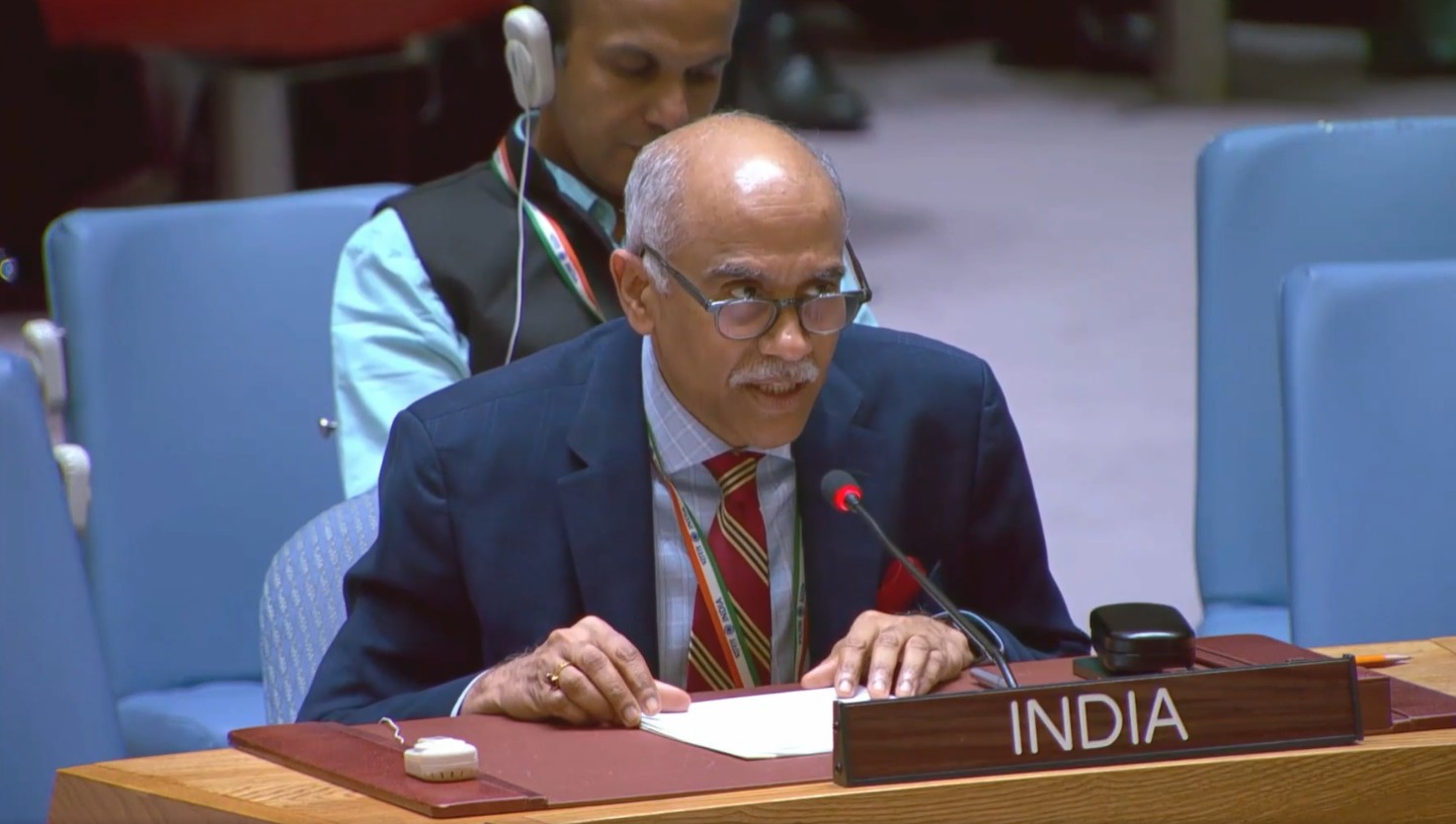
Women peacekeepers give hope to vulnerable women in conflict situations, serving as symbols of female empowerment, and the more than 160 women in UN missions exemplify this role, according to India’s Permanent Representative to UN P. Harish.
Indian Army Major Abhilasha Barak, who was awarded the UN Peacekeeper’s Gender Advocate Award this month, and the two other Indian women awardees before her, are outstanding examples of this role, P. Harish told the Security Council on Wednesday.
The “deployment of uniformed women in UN peacekeeping operations represents one of the most tangible and impactful dimensions of the Women, Peace and Security agenda”, the India’s envoy to UN said during a debate on “Women Peace and Security” focusing on enhancing their participation as they emerge from conflicts.
“India was the first to deploy an all-female Unit to the United Nations Mission in Liberia, inspiring 1000s of Liberian women to join their national police,” he added.
“Today, more than 160 Indian women peacekeepers serve in the field in various UN Missions.”
On the importance on deploying women in peacekeeping operations, P. Harish said, “They build trust in communities. They give hope to vulnerable populations, particularly women and children. They serve as visible symbols of women’s agency in maintaining peace and security.”
“Most critically, they help address gender-based violence and ensure that peace processes reflect the needs and perspectives of all segments of society,” he added.
To enhance the role of women peacekeepers from around the world, P. Harish said, “India set up the Centre for UN Peacekeeping in Delhi to train women military officers from across the globe since.”
“Last year, participants from 15 countries attended the UN Women Military Officers Course, and women peacekeepers from 35 countries came together for the Conference for Women Peacekeepers from the Global South,” he added.
But these efforts to empower women cannot “ultimately yield lasting results unless women are genuinely empowered: politically, financially and socially,” the Indian envoy to UN said.
He cited the example of India in empowering women through the Constitutional reservation of one-third of seats in local self-governing bodies that brought more than a million women to decision-making roles, and the Women’s Reservation Act of 2023 that extended the provision to the Parliament.
He mentioned the nation’s “consistent record” of women in high offices — President Droupadi Murmu, former Head of government (Prime Minister Indira Gandhi) and Parliament Speakers (Sumitra Mahajan and Meira Kumar).
“Women-led development is a model promoted by the Government of India to make women the driving force of India’s economic growth,” P. Harish added.
The Executive Director of UN-Women, Sima Bahous, said, “Gender equality and women’s empowerment is among the most powerful approaches to achieving peace.”
Since the Council adopted a resolution in 2000 calling for empowering women and involving them in peace processes, evidence shows these measures reduce violence, strengthen peacekeeping, and ensure sustainability of peace agreements.
“Women nether choose nor lead many of the conflicts around the world today, yet when they are kept out of the negotiations to end them, they are affected the most,” she said.
Kaavya Asoka, an activist and advocate for women, said, “Every day, we see International law increasingly undermined in favour of narrow interests.”
She warned, “The cost of dismantling the norms we have collectively built will be far greater.”
Asoka, who is the Executive Director of the NGO Working Group on Women, Peace and Security, called for the Council to go beyond “empty condemnation of attacks on civilians” and take concrete actions like ending arms transfers.
–IANS


