







Over the last decade, India has undergone one of the most significant technological transformations in the world. Once regarded primarily as a vast market for digital services and global technology products, the country is increasingly emerging as a global technology powerhouse – building indigenous capabilities in Artificial Intelligence (AI), semiconductors, quantum technologies, supercomputing, cloud infrastructure, biotechnology, blockchain, and advanced telecommunications.
This transformation is not the result of a single policy or programme. It reflects a sustained national effort to strengthen digital infrastructure, expand technological capabilities, foster innovation, develop future-ready talent, and position India as a trusted global technology partner. As the country advances toward the vision of Viksit Bharat 2047, emerging technologies are becoming central to India’s economic growth, strategic autonomy, and global influence.
The Foundation: Digital India’s Transformational Impact
India’s technological rise began with a fundamental question: how can technology be made accessible to every citizen?
The answer came through the Digital India Programme, launched in 2015, which laid the groundwork for the country’s digital transformation.
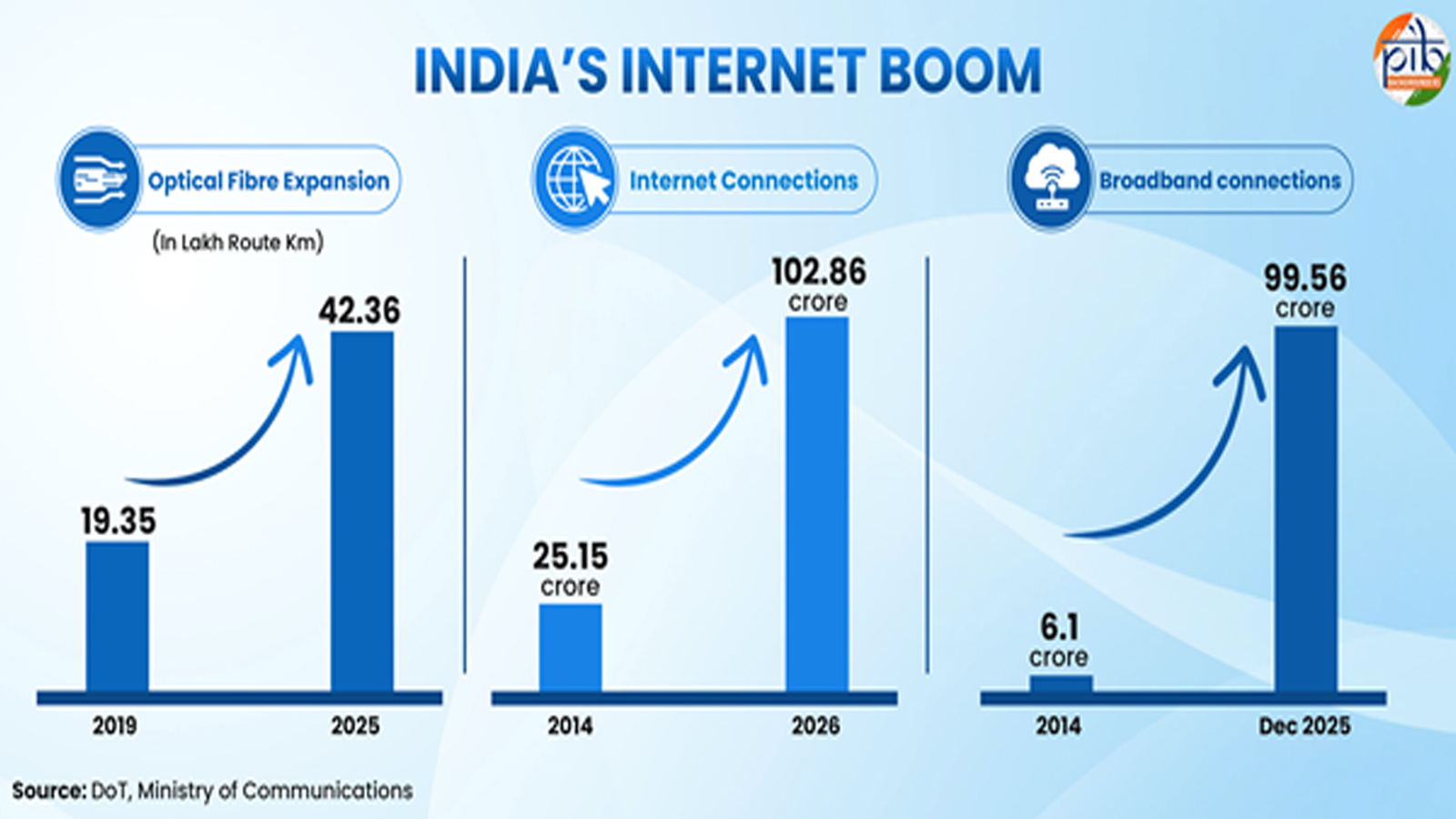
The expansion of digital infrastructure has been unprecedented. Optical fibre coverage more than doubled, growing from 19.35 lakh route kilometres in 2019 to 42.36 lakh route kilometres in 2025. Simultaneously, India executed one of the world’s fastest 5G rollouts, bringing services to almost every district in the country.
The results have been transformative. Internet connections surged from 25 crore in 2014 to more than 102 crore in 2026, while broadband subscriptions expanded from 6.1 crore to nearly 100 crore. Affordable connectivity played an equally important role. Data costs fell dramatically from ₹269 per GB in 2014 to about ₹8-10 per GB, making India one of the most affordable internet markets globally.
As connectivity expanded, digital adoption accelerated. Citizens embraced online payments, telemedicine, digital education, e-commerce, and e-governance services. This widespread digital participation created fertile ground for emerging technologies and innovation-driven entrepreneurship.
Today, Digital India is not merely a programme; it is the backbone supporting India’s entire technology ecosystem.
Building Indigenous Technological Capability
With digital infrastructure in place, India shifted focus toward building advanced technological capabilities that would define future economic and strategic competitiveness.
Supercomputing: Accelerating Scientific Discovery
In an era driven by data and computational power, supercomputers have become critical national assets. They support weather forecasting, climate modelling, artificial intelligence, drug discovery, aerospace research, and defence applications.
Recognising this, India launched the National Supercomputing Mission (NSM) in 2015 with an investment of ₹4,500 crore.
Since then, the country has deployed 38 supercomputers with a combined computational power of 47 petaflops across premier research institutions.
A major milestone has been the development of the indigenous PARAM Rudra series, designed using Indian hardware and software capabilities. The achievement marks an important step toward self-reliance in high-performance computing and strengthens India’s ability to undertake cutting-edge scientific research independently.
Semiconductors: Building the Brains of the Digital Age
No technology ecosystem can thrive without semiconductors. These tiny chips power everything from smartphones and computers to electric vehicles, defence systems, and AI applications.
Recognising their strategic importance, the Government launched the Semicon India Programme in 2021 with a ₹76,000 crore outlay. The programme seeks to build a comprehensive semiconductor ecosystem encompassing fabrication, chip design, packaging, testing, talent development, and research.
The momentum has continued with the launch of India Semiconductor Mission (ISM) 2.0 in the Union Budget 2026–27.
India’s semiconductor ambitions are already yielding results. By June 2026, 12 major semiconductor projects worth approximately ₹1.64 lakh crore had been approved, including fabrication facilities and advanced packaging units.
A critical pillar of this effort is the Design Linked Incentive (DLI) Scheme, which supports indigenous chip design. As of March 2026, 24 companies had received fiscal support, while more than 100 applicants benefited from Electronic Design Automation (EDA) tools. Several chips, including advanced 12-nanometre designs, have already progressed from concept to fabrication.
India is positioning itself not merely as a manufacturing destination but also as a global hub for semiconductor innovation.
Quantum Technologies: Preparing for the Next Frontier
If semiconductors define the present, quantum technologies are expected to define the future.
Quantum computing, sensing, communication, and materials have the potential to revolutionise healthcare, finance, logistics, cybersecurity, and scientific research.
To ensure India remains at the forefront of this technological revolution, the Government launched the National Quantum Mission in 2023 with an outlay exceeding ₹6,000 crore.
The mission focuses on four strategic domains – Quantum Computing, Quantum Communication, Quantum Sensing and Metrology, and Quantum Materials and Devices.
Progress has been rapid. Four specialised thematic hubs have already been established, engaging researchers across dozens of institutions. India has also demonstrated a 1,000-kilometre secure quantum communication network, achieving a major milestone years ahead of schedule.
The foundation stone of India’s first Quantum Valley in Amaravati in 2026 further signals the country’s long-term commitment to becoming a global quantum technology leader.
Artificial Intelligence: Powering the Next Growth Engine
Artificial Intelligence is rapidly becoming the defining technology of the 21st century. India, with its massive digital ecosystem and technology talent base, is uniquely positioned to harness AI at scale.
To accelerate progress, the Government approved the IndiaAI Mission in 2024 with an allocation exceeding ₹10,300 crore.
The mission aims to build indigenous AI computing infrastructure; expand access to advanced GPUs; support AI startups and research; promote responsible and inclusive AI development; and enable AI adoption across public services.
By 2026, nearly 89 percent of newly registered startups in India were using AI solutions. The mission is also creating a shared computing facility featuring over 38,000 GPUs, democratizing access to advanced computational resources.
Meanwhile, the AI Kosh platform hosts thousands of datasets and hundreds of AI models spanning multiple sectors, enabling innovation across healthcare, agriculture, education, and governance.
India’s AI vision goes beyond economic gains – it seeks to create trustworthy, inclusive, and human-centric AI systems.
Cloud Infrastructure: The Digital Backbone
As digital services expand, cloud computing has become indispensable.
India’s government cloud journey began with MeghRaj, launched in 2014. Over time, the platform evolved into MeghRaj 2.0, incorporating hybrid architecture and stronger cybersecurity protections.
Government adoption has expanded dramatically – from 342 departments in 2015-16 to more than 2,300 departments by 2026.
Major digital platforms such as DigiLocker, MyGov, and the National Scholarship Portal rely on cloud infrastructure to deliver services efficiently and securely.
Policy support provided in the 2026-27 Union Budget is further encouraging investments in cloud and AI infrastructure, strengthening India’s digital sovereignty.
Blockchain: Building Trust in the Digital Era
Blockchain technology is increasingly transforming governance and digital trust.
India’s National Blockchain Framework, launched by the Ministry of Electronics and Information Technology, seeks to create a secure and interoperable blockchain ecosystem.
Indigenous solutions such as Vishvasya Blockchain Stack, NBFLite Sandbox, Praamaanik Verification System, and National Blockchain Portal are already enabling practical applications.
The impact is visible. More than three crore property documents have been verified using blockchain systems, helping reduce disputes and improve transparency.
The Reserve Bank of India’s Digital Rupee pilots and blockchain-based systems adopted by regulators such as TRAI further demonstrate how distributed ledger technologies are entering mainstream governance and finance.
Data Centres: Fueling India’s Digital Economy
Behind every cloud service, AI model, and digital transaction lies a data centre.
India’s data centre sector has witnessed explosive growth, with capacity increasing from 375 MW in 2020 to nearly 1,500 MW by 2025.
Major hubs have emerged in, Mumbai, Navi Mumbai, Hyderabad, Bengaluru, Noida, and Jamnagar.
New hyperscale and AI-focused facilities are being developed across multiple states, supporting India’s ambitions in cloud computing, AI, and digital services.
These facilities are becoming critical infrastructure assets for India’s digital economy.
Biotechnology: The Next Innovation Frontier
Technology leadership is not limited to digital domains.
Biotechnology is emerging as a major driver of healthcare innovation, food security, industrial manufacturing, and economic growth.
India’s biotechnology sector crossed USD 150 billion in 2023, achieving national targets ahead of schedule, and reached approximately USD 190 billion by 2026.
Government initiatives such as National Biopharma Mission, BioE3 Policy, BioNEST incubators, and BIRAC innovation programmes have accelerated research, startup development, and commercialization.
Today, 94 bioincubators across India support innovation in genomics, synthetic biology, precision medicine, and bio-manufacturing.
Investing in Talent: The Human Capital Advantage
Technology ecosystems succeed only when supported by skilled human resources.
India has therefore invested heavily in research institutions, skill development programmes, industry-academia collaboration, and Centres of Excellence.
The Anusandhan National Research Foundation (ANRF) and the ₹1 lakh crore Research Development and Innovation Scheme are strengthening advanced research and commercialization.
Meanwhile, programmes such as FutureSkills PRIME, Skill India Digital Hub, NIELIT training networks, Chips to Startup Programme, and SOAR (Skilling for AI Readiness) are preparing millions of Indians for careers in emerging technologies.
These initiatives are creating one of the world’s largest future-ready technology workforces.
Growing Global Credibility
India’s technology rise is increasingly being recognised internationally.
The country improved from 81st position in the Global Innovation Index in 2015 to 38th in 2025, reflecting substantial gains in innovation capacity.
India also hosts over 2,100 Global Capability Centres (GCCs) employing approximately 2.36 million professionals, many focused on AI, cybersecurity, analytics, and advanced engineering.
Global initiatives such as Bharat 6G Alliance, SEMICON India, India AI Impact Summit, and India Stack Diplomacy have further enhanced India’s credibility as a trusted technology partner.
The country’s Digital Public Infrastructure model – including Aadhaar, UPI, DigiLocker, CoWIN, and UMANG – is increasingly being studied and adopted worldwide.
India has already signed digital cooperation agreements with more than 20 countries, demonstrating growing confidence in its technological solutions.
The Road to Viksit Bharat 2047
India’s technology transformation is not merely about innovation or economic growth. It is about building strategic capability, enhancing self-reliance, generating employment, improving public service delivery, and strengthening national competitiveness.
Over the past twelve years, the country has laid strong foundations through digital infrastructure, research ecosystems, startup support, advanced manufacturing, and future-ready skilling initiatives.
The transformation reflects a broader shift – from being a technology consumer to becoming a technology creator, innovator, and global partner.
As emerging technologies reshape the global economy, India’s investments in AI, semiconductors, quantum technologies, biotechnology, cloud computing, and digital public infrastructure are positioning the nation to play a defining role in the technological landscape of the 21st century.
The journey toward Viksit Bharat 2047 is still unfolding, but the foundations of a technology-driven future are already firmly in place.


