







From expanding forests and restoring rivers to leading global climate initiatives, India’s environmental journey over the past twelve years reflects a broad transformation driven by conservation, sustainability, and public participation. Guided by the principles of Vishwaas (trust), Nirman (development), and Jan Kalyaan (public welfare), the country has strengthened ecological resilience, expanded green infrastructure, improved environmental governance, and emerged as a significant voice in global climate diplomacy.
A Decade of Environmental Transformation
Over the last twelve years, India has pursued a comprehensive environmental agenda that seeks to balance economic growth with ecological responsibility. Amid growing global concerns over climate change, biodiversity loss, pollution, and resource depletion, the country has focused on strengthening natural ecosystems while building institutional and technological capacity to support sustainable development.
The transformation has been anchored on three key pillars: enhancing ecological capability and biodiversity, expanding national capacity for sustainable development, and strengthening global credibility through environmental leadership and diplomacy.
These efforts have resulted in measurable gains in forest cover, wildlife conservation, river rejuvenation, wetland restoration, waste management, climate action, and disaster resilience, positioning India as an increasingly influential player in global environmental governance.
Pillar One: Strengthening Ecological Capability and Biodiversity
Expanding Forests and Green Cover
Forests remain one of India’s most critical natural assets, supporting biodiversity, water security, carbon sequestration, and rural livelihoods. Recognising their importance in climate resilience, the government has undertaken large-scale afforestation and ecosystem restoration initiatives.
The Green India Mission, launched under the Ministry of Environment, Forest and Climate Change, has emerged as a major driver of landscape restoration. Since FY 2015-16, over ₹1,019 crore has been released to states under the mission to improve forest quality and expand green cover.
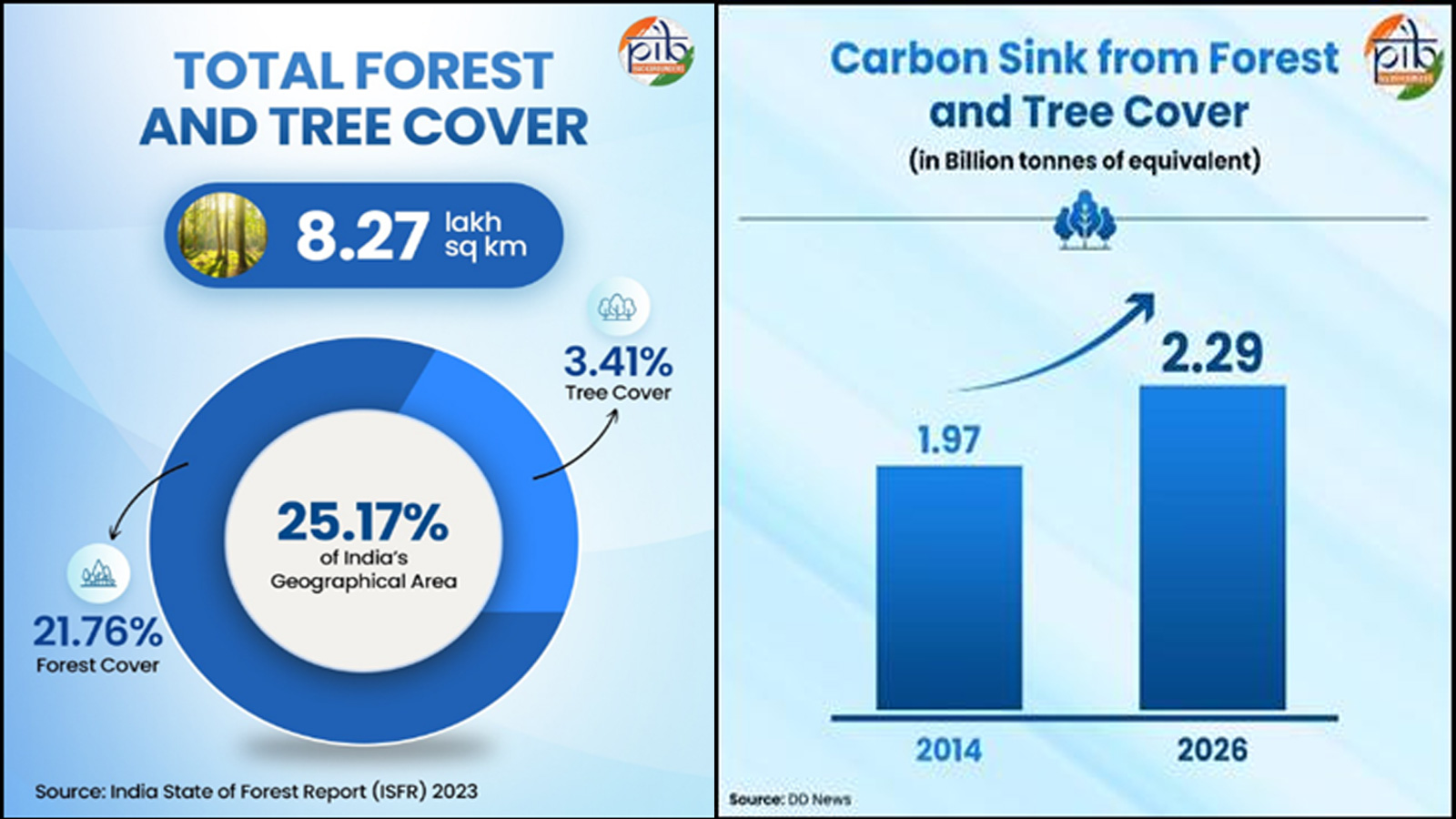
According to the India State of Forest Report 2023, India’s total forest and tree cover now stands at 8.27 lakh square kilometres, representing 25.17 percent of the country’s geographical area. Forest cover alone accounts for 7.15 lakh square kilometres, while tree cover contributes 1.12 lakh square kilometres.
India’s forests currently store an estimated 30.43 billion tonnes of carbon stock, making them one of the country’s most valuable natural carbon sinks.
Several complementary initiatives have supported this growth:
The Compensatory Afforestation Fund Management and Planning Authority (CAMPA) has undertaken more than 3.2 lakh hectares of compensatory afforestation between FY 2020-21 and FY 2024-25.
The Nagar Van Yojana has facilitated the development of hundreds of urban forests and green spaces, with over ₹557 crore released for 626 Nagar Vans and Vatikas.
The Aravalli Green Wall Initiative aims to restore over 6.31 million hectares of degraded landscapes across Rajasthan, Haryana, Gujarat, and Delhi.
Ek Ped Maa Ke Naam: A People’s Movement
Among the most notable public participation campaigns has been Ek Ped Maa Ke Naam, launched by Prime Minister Narendra Modi in 2024.
The initiative transformed tree plantation into a mass environmental movement by encouraging citizens to plant trees in honour of their mothers. By December 2025, more than 262 crore saplings had been planted, making it one of the world’s largest environmental campaigns.
Digital monitoring through the Meri LiFE portal has further strengthened accountability and public engagement.
Rejuvenating Rivers Through Namami Gange
Water pollution has long posed a challenge to India’s ecological health and public welfare. To address this, the government launched the Namami Gange Programme in 2014 as a flagship mission to rejuvenate the River Ganga and its tributaries.
Initially approved with an outlay of ₹20,000 crore and later expanded through an additional ₹22,500 crore allocation under Phase II, the programme integrates infrastructure development with ecological restoration.
Major Achievements
As of February 2026, 524 projects worth ₹43,030 crore have been sanctioned; around 355 projects have been completed; and more than ₹21,340 crore has been disbursed.
A key focus has been sewage treatment and pollution control.
218 sewerage projects costing ₹35,698 crore have been approved; combined treatment capacity of 6,610 million litres per day (MLD) has been created; and 138 sewage treatment plants with 3,977 MLD capacity are already operational.
Industrial pollution has also seen significant reductions:
Industrial Biological Oxygen Demand (BOD) load has declined from 26 tonnes per day in 2017 to 10.75 tonnes per day in 2024; and Industrial effluent discharge has reduced from 349 MLD to 265.56 MLD.
Ecological Restoration
The programme has also focused heavily on biodiversity and habitat restoration.
More than 33,000 hectares have been afforested across the Ganga basin; seven biodiversity parks and five wetlands have been developed; and over 203 lakh fish fingerlings have been released to strengthen aquatic biodiversity.
Population assessments have estimated around 6,327 Gangetic dolphins across 28 rivers and approximately 3,037 gharials across 22 rivers.
The launch of Project Dolphin in 2020 further strengthened protection for riverine ecosystems and freshwater biodiversity.
Wetlands: Protecting Ecological Lifelines
Wetlands play a critical role in groundwater recharge, flood mitigation, water purification, and biodiversity conservation.
Through the National Plan for Conservation of Aquatic Ecosystems (NPCA) and the Wetlands (Conservation and Management) Rules, 2017, India has significantly expanded wetland protection efforts.
Government support for wetland conservation has steadily increased:
148 wetlands were covered under NPCA in 2018; coverage expanded to 165 wetlands by 2023; and financial assistance crossed ₹1,088 crore.
Ramsar Success
One of India’s biggest achievements has been the rapid expansion of internationally recognised Ramsar wetlands.
India had only 26 Ramsar sites in 2014.
By 2026, that number had increased to 100, reflecting a major conservation milestone and stronger ecosystem protection efforts nationwide.
Mangroves and Coastal Ecosystems
Mangrove forests are among the most effective natural defences against cyclones, coastal erosion, and rising sea levels.
The MISHTI (Mangrove Initiative for Shoreline Habitats & Tangible Incomes) scheme has accelerated mangrove restoration.
As a result mangrove cover increased from 4,628 square kilometres in 2013 to 4,992 square kilometres in 2023 and India gained 363 square kilometres of mangrove forests over the decade.
Strengthening the Coastline
India’s 7,500-kilometre coastline has also benefited from initiatives under the National Coastal Mission and Coastal Regulation Zone reforms.
The number of internationally recognised Blue Flag beaches has risen steadily from 8 beaches in 2020 to 18 beaches by 2025-26.
The National Marine Turtle Action Plan has further strengthened marine biodiversity conservation, resulting in nearly 8,000 turtle hatchlings being successfully released with a remarkable hatching success rate of 96.7 percent.
Wildlife Conservation: A Global Success Story
India has emerged as a global leader in wildlife conservation through integrated landscape-level management and species-specific programmes.
Tigers
Under Project Tiger, India now hosts over 70 percent of the world’s wild tigers.
Tiger reserves increased from 46 in 2014 to 58 in 2025 and tiger numbers rose from 2,226 to 3,682.
Asiatic Lions
The success of Project Lion has been equally remarkable.
Lion numbers increased from 523 in 2015 to 891 in 2025, while their habitat range expanded significantly.
Cheetahs
Project Cheetah, launched in 2022, marked the world’s first intercontinental translocation of a large carnivore.
Since then 29 cheetahs have been brought from Namibia, South Africa, and Botswana and India’s cheetah population has grown to 53.
Snow Leopards
India’s first comprehensive snow leopard survey estimated 718 snow leopards across Himalayan states, strengthening conservation planning for fragile mountain ecosystems.
Elephants
Elephant reserves increased from 26 to 33 through Project Elephant; elephant corridors expanded from 88 to 150; and the first DNA-based national elephant estimation recorded 22,446 wild elephants.
One-Horned Rhinoceros
India’s rhino population has surpassed 4,000, representing nearly a 170 percent increase since the 1980s and demonstrating the success of long-term conservation strategies.
Pillar Two: Expanding Capacity for Sustainable Development
Tackling India’s Waste Challenge
India has dramatically improved solid waste management over the past decade.
In 2014, only 17 percent of municipal waste was scientifically processed. By 2024, waste processing exceeded 77 percent.
Urban India now processes over 1.29 lakh tonnes of waste daily.
Clearing Legacy Dumpsites
The government has also launched a nationwide effort to eliminate decades-old waste dumps.
So far, 1,138 dumpsites have been remediated; 877 lakh metric tonnes of legacy waste have been cleared; and 7,646 acres of land have been reclaimed.
The newly launched Dumpsite Remediation Accelerator Programme (DRAP) aims to eliminate all dumpsites by October 2026.
Building a Circular Economy
India has expanded Extended Producer Responsibility (EPR) frameworks across multiple sectors including plastic waste, electronic waste, batteries, used oil, tyres, and construction waste.
By March 2026, more than 4,500 recyclers were registered, and over 417 lakh metric tonnes of waste had been processed through EPR systems.
These reforms are helping transition India toward a circular economy that prioritises reuse, recycling, and resource efficiency.
Education, Skills and Technology
Environmental stewardship has increasingly become a societal movement.
Through programmes such as National Green Corps; environmental education, awareness and training scheme; eco-clubs; and green skill development initiatives.
Millions of students have participated in conservation activities and sustainability awareness campaigns.
Advanced scientific infrastructure has also strengthened conservation.
A Next Generation DNA Sequencing facility at the Wildlife Institute of India now supports wildlife genetics, population studies, and forensic investigations.
Technology-driven systems such as AI-based surveillance, digital wildlife databases, and real-time monitoring tools have further enhanced conservation enforcement.
Building Disaster Resilience
Climate resilience has become a key pillar of environmental governance.
The National Disaster Management Plan, advanced forecasting systems, risk atlases, glacial lake monitoring, and nationwide early warning systems have significantly improved India’s preparedness.
More than 4,500 crore disaster alerts have been disseminated through digital platforms, strengthening public safety and disaster response.
Pillar Three: Global Leadership and Environmental Diplomacy
India’s environmental progress has increasingly translated into global influence.
Climate Commitments Ahead of Schedule
India has achieved several climate targets years ahead of schedule.
Emissions intensity has been reduced by over 36 percent from 2005 levels; the country met its target of 40 percent non-fossil electricity capacity nine years early; and by February 2026, non-fossil energy sources accounted for 52.57 percent of installed power capacity.
India has also created an additional 2.29 billion tonnes of CO₂-equivalent carbon sink, making significant progress toward its long-term climate goals.
Leading Global Initiatives
India has played a central role in shaping international environmental cooperation through initiatives such as:
International Solar Alliance (ISA)
Launched jointly with France in 2015, the ISA now includes 112 member countries and has become a major platform for promoting solar energy deployment globally.
One Sun One World One Grid (OSOWOG)
The initiative seeks to create interconnected renewable energy networks across nations, advancing clean energy cooperation.
Coalition for Disaster Resilient Infrastructure (CDRI)
Launched in 2019, CDRI has positioned India as a global leader in climate-resilient infrastructure planning.
Mission LiFE
Mission LiFE promotes sustainable lifestyles and behavioural change, shifting focus from excessive consumption to responsible resource use.
International Big Cat Alliance (IBCA)
Established as an intergovernmental organisation in 2025, the alliance brings together countries from Asia, Africa, and Latin America to protect seven big cat species globally.
Sustainability at the Heart of Viksit Bharat
India’s environmental journey over the last twelve years illustrates a broader shift in national development priorities. Sustainability is no longer treated as a separate policy objective but has become deeply integrated into economic planning, infrastructure development, resource management, and social welfare.
From expanding forests and restoring wetlands to reviving rivers, protecting wildlife, modernising waste management, and leading international climate action, India has built a multidimensional framework for environmental stewardship.
As the country advances toward the vision of Viksit Bharat, the principles of Vishwaas, Nirman, and Jan Kalyaan continue to shape its environmental trajectory – strengthening ecological resilience, improving quality of life, and reinforcing India’s position as a global leader in sustainable development.


