







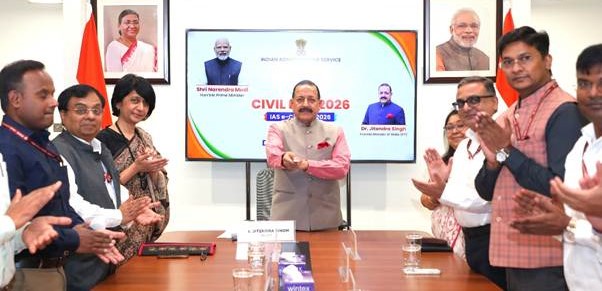
Union Minister of State (Independent Charge) for Science and Technology and Minister of State for Personnel, Public Grievances and Pensions, Jitendra Singh, on Monday launched the IAS e-Civil List 2026, describing it as a key digital governance tool that strengthens administrative planning, talent mapping and evidence-based decision-making.
Launching the 71st edition of the Civil List at Kartavya Bhawan in New Delhi, the Minister said digital platforms such as the e-Civil List have transformed the way governments manage human resources by providing easy access to information on officers’ qualifications, experience, cadre allocation and postings. He said the digital database enables governments and institutions to identify expertise, deploy talent effectively and improve overall governance outcomes.
Singh said the Civil List has evolved beyond being a directory of officers and now serves as a dynamic knowledge resource for policymakers, administrators and institutions. Equipped with advanced search and hyperlinking features, the digital platform allows users to identify officers based on domain expertise, professional background and administrative experience, helping improve governance planning and policy implementation.
Highlighting the government’s emphasis on technology-driven administration, the Minister said the initiative reflects the commitment to improving efficiency, accessibility and transparency in governance. He noted that the Department of Personnel and Training (DoPT), in coordination with state governments and cadres, undertakes extensive efforts every year to update and maintain the database.
Singh also reviewed the cadre strength position of the Indian Administrative Service and discussed the evolving manpower requirements of both the Centre and states. He observed that governance responsibilities continue to expand across sectors, making effective human resource planning increasingly important. Regular cadre reviews and continuous assessment of requirements, he said, would help strengthen administrative capacity and address emerging governance needs.
The Minister emphasised the need to account for India’s geographical and developmental diversity while designing governance frameworks. Administrative requirements vary significantly across regions, particularly in remote, hilly and geographically challenging areas, he said, adding that technology-enabled databases can assist governments in identifying officers with suitable expertise for diverse developmental challenges.
He further said the transition from printed publications to digital platforms is aligned with the vision of Digital India and contributes to the modernisation of public administration. The move not only improves accessibility and administrative efficiency but also reduces expenditure on printing and promotes optimal utilisation of public resources.
The e-IAS Civil List 2026 is the sixth edition to be released as an e-book and contains detailed information on IAS officers, including their batch, cadre, current posting, pay level, educational qualifications and date of superannuation. It also includes data on cadre-wise strength, projected retirements over the next five years and appointments made through the Civil Services Examination since 1969.
According to the Department of Personnel and Training, the cadre-controlling authority for the IAS, a total of 5,755 IAS officers were in position across 25 cadres as on January 1, 2026, against an authorised cadre strength of 7,026.
The launch event was attended by Secretary, Department of Personnel and Training, Rachna Shah, Establishment Officer and Additional Secretary Manish Saxena, Additional Secretary (Services and Vigilance) Faiz Ahmed Kidwai, Additional Secretary (Personnel Policy) Manoj Kumar Dwivedi and other senior officials.
The e-IAS Civil List 2026 has been made available on the Department of Personnel and Training’s website for public access.


