







India’s agricultural extension system is increasingly leveraging digital technology to provide farmers with timely, localized and expert-backed advisory services. One of the key initiatives driving this transformation is Kisan Sarathi, an integrated digital agro-advisory platform launched in July 2021.
Developed as a joint initiative of the Ministry of Electronics and Information Technology (MeitY) and the Ministry of Agriculture and Farmers Welfare, the platform is implemented by the Indian Agricultural Statistics Research Institute (IASRI) and the Digital India Corporation. It aims to bridge the gap between farmers, agricultural experts and government services through a single digital interface.
A Unified Agricultural Advisory Platform
Kisan Sarathi integrates multiple digital services that farmers traditionally had to access separately. These include the Kisan Call Centre, Common Service Centres (CSCs), the India Meteorological Department (IMD), MyScheme, and BHASHINI, enabling farmers to receive weather forecasts, government scheme information, expert consultations and market updates through one platform.
The platform is powered by the Interactive Information Dissemination System (IIDS), a two-way communication system that supports voice calls, video calls, text messages, image sharing and chat-based interactions between farmers and agricultural experts. It also facilitates the transfer of scientific knowledge from laboratories to farms.
Connecting Farmers with Agricultural Institutions
Kisan Sarathi has created a nationwide advisory network by linking farmers with more than 730 Krishi Vigyan Kendras (KVKs), over 100 ICAR institutes, and 65 agricultural universities. This institutional integration enables farmers to receive reliable, region-specific advisories directly from subject experts.
The platform also supports live interactions with experts in 13 regional languages, making agricultural information more accessible across diverse linguistic regions.
Services Available to Farmers
Farmers can access Kisan Sarathi through multiple channels, including the mobile application, web portal, WhatsApp, Kisan Call Centres, and Common Service Centres, ensuring that advisory services remain accessible even in areas with varying levels of digital connectivity.
The platform offers personalized advisories based on farmers’ profiles and provides information on crop management, weather forecasts, mandi prices, district-wise market trends and government welfare schemes. Farmers can also raise queries in their local languages, participate in online training sessions and consult agricultural experts through voice or video calls.
As of June 25, 2026, the platform hosts information on 610 government schemes, including 102 Central government schemes, allowing farmers to identify programmes relevant to their needs and track the status of schemes such as PM-KISAN.
Technology Behind the Platform
The Interactive Information Dissemination System (IIDS) follows a Know Your Farmer (KYF) approach, allowing experts to access farmers’ previous interactions and provide need-based recommendations.
The system routes farmer queries to relevant experts through a centralized server, maintains a history of consultations and enables farmers to subscribe to personalized advisory services, which can be modified at any time.
Coverage and Reach
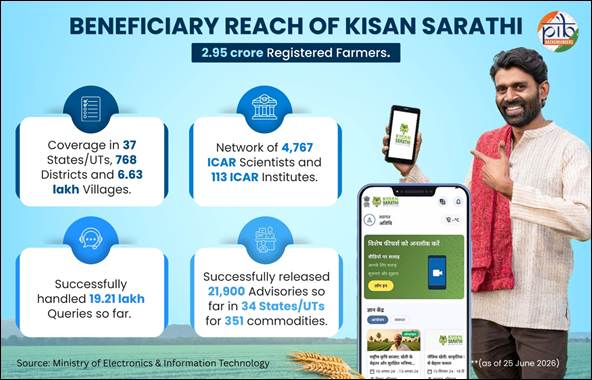
According to official data, as of June 25, 2026, Kisan Sarathi is operational across 37 States and Union Territories, covering 768 districts and 6.63 lakh villages.
The platform has registered 2.95 crore farmers, including 56.16 lakh women beneficiaries. Of these, 2.89 crore registered through Krishi Vigyan Kendras, while others enrolled via Kisan Call Centres, Common Service Centres, the mobile application and the web portal.
Since its launch, Kisan Sarathi has handled 19.21 lakh farmer queries and issued over 21,900 advisories covering 351 agricultural commodities across 34 States and Union Territories.
The platform is supported by a network of 4,767 ICAR scientists and 113 ICAR institutions, strengthening collaboration between researchers, extension agencies and farmers.


