







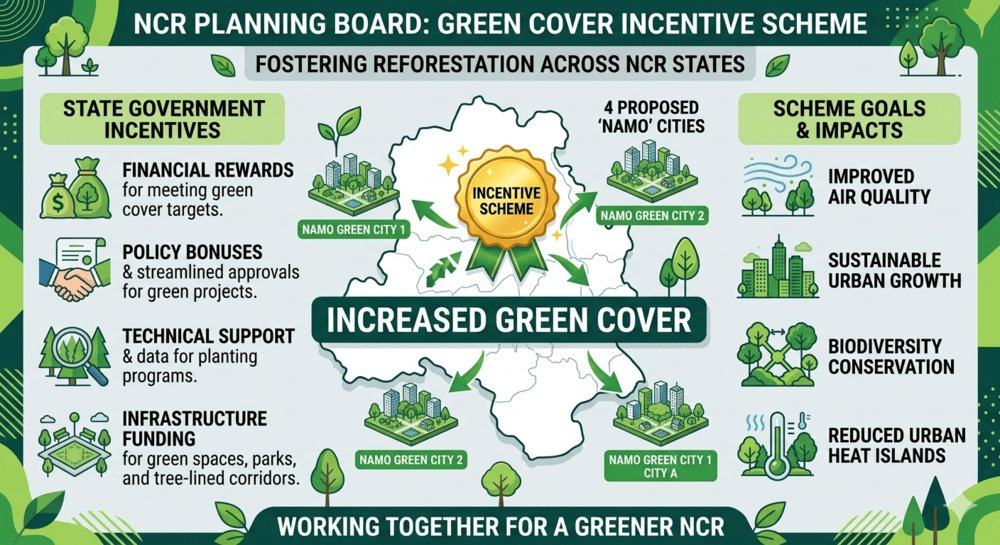
The National Capital Region Planning Board (NCRPB) on Tuesday decided to formulate a scheme to incentivise state governments to increase green cover across the National Capital Region (NCR), including through the participation of private citizens and companies.
The decision was taken at the 42nd meeting of the NCR Planning Board, chaired by Union Housing and Urban Affairs Minister Manohar Lal in New Delhi.
According to the Ministry of Housing and Urban Affairs (MoHUA), the Board held detailed discussions on the Regional Plan (RP)-2041 and decided to retain the existing geographical extent of the NCR without any changes to its current boundaries. It also resolved to promote innovative mechanisms such as green canopy credits and non-financial instruments, including transferable and saleable Special Development Rights, to encourage afforestation and environmental conservation.
The meeting was attended by Haryana Chief Minister Nayab Singh Saini, Delhi Chief Minister Rekha Gupta, Rajasthan Urban Development Minister Jhabar Singh Kharra, Uttar Pradesh Urban Development Minister Arvind Kumar Sharma, and senior officials from the Centre and NCR states.
Spanning 55,083 square kilometres across the National Capital Territory of Delhi and 27 districts in Haryana, Uttar Pradesh and Rajasthan, the NCR is home to 230 urban settlements and 11,784 villages. The region contributes nearly eight per cent of India’s GDP and is regarded as the world’s largest urban agglomeration, the ministry said.
The Board noted that the NCR’s population is projected to nearly double from 7.86 crore at present to 14.73 crore by 2041, requiring the region to accommodate almost seven crore additional residents over the next 15 years. Most of this growth is expected to occur in urban centres, particularly larger cities, making RP-2041 a critical framework for future planning and infrastructure development.
According to the ministry, the draft RP-2041 has undergone extensive consultations since a public notice issued in December 2021 attracted more than 4,500 comments. The plan has also been reviewed through multiple rounds of discussions with state and central governments up to 2025. An updated draft was shared with the four constituent states in January 2026, and their suggestions have been incorporated.
Addressing the meeting, Manohar Lal described the NCR Planning Board as a unique model of inter-state and inter-agency coordination. He emphasised that a cooperative, collaborative and coordinated approach would be essential for building an economically prosperous and future-ready NCR with citizen-centric infrastructure.
The Board also discussed the development of four semi-greenfield urban centres under RP-2041. These mixed-use, transit-oriented development (TOD) hubs are proposed to be established around selected existing and planned stations on the Namo Bharat Regional Rapid Transit System (RRTS) corridors.
The proposed urban centres, to be known as “Namo Cities”, will be identified through a competitive process among participating NCR states. To support their development, the NCRPB plans to offer a performance-linked incentive package worth Rs 5,000 crore, comprising grants, loans and guarantees, including a grant component of Rs 1,000 crore. The funding is intended to catalyse the growth of these urban nodes.
During the meeting, the Housing and Urban Affairs Minister also announced that the Centre’s proposed vehicle replacement programme would be named the Programme for Accelerated Renewal and Incentivisation of Vehicle Assets for Reducing Transport Air Pollution and Network Emission (PARIVARTAN).
The time-bound fleet modernisation scheme aims to reduce vehicular pollution in the NCR by encouraging the replacement of BS-IV and older buses and trucks with cleaner BS-VI, CNG or electric vehicles.
The Board further decided that RP-2041 would be notified after examining the issues raised during the meeting and completing the necessary administrative procedures.
(With ANI inputs)


