







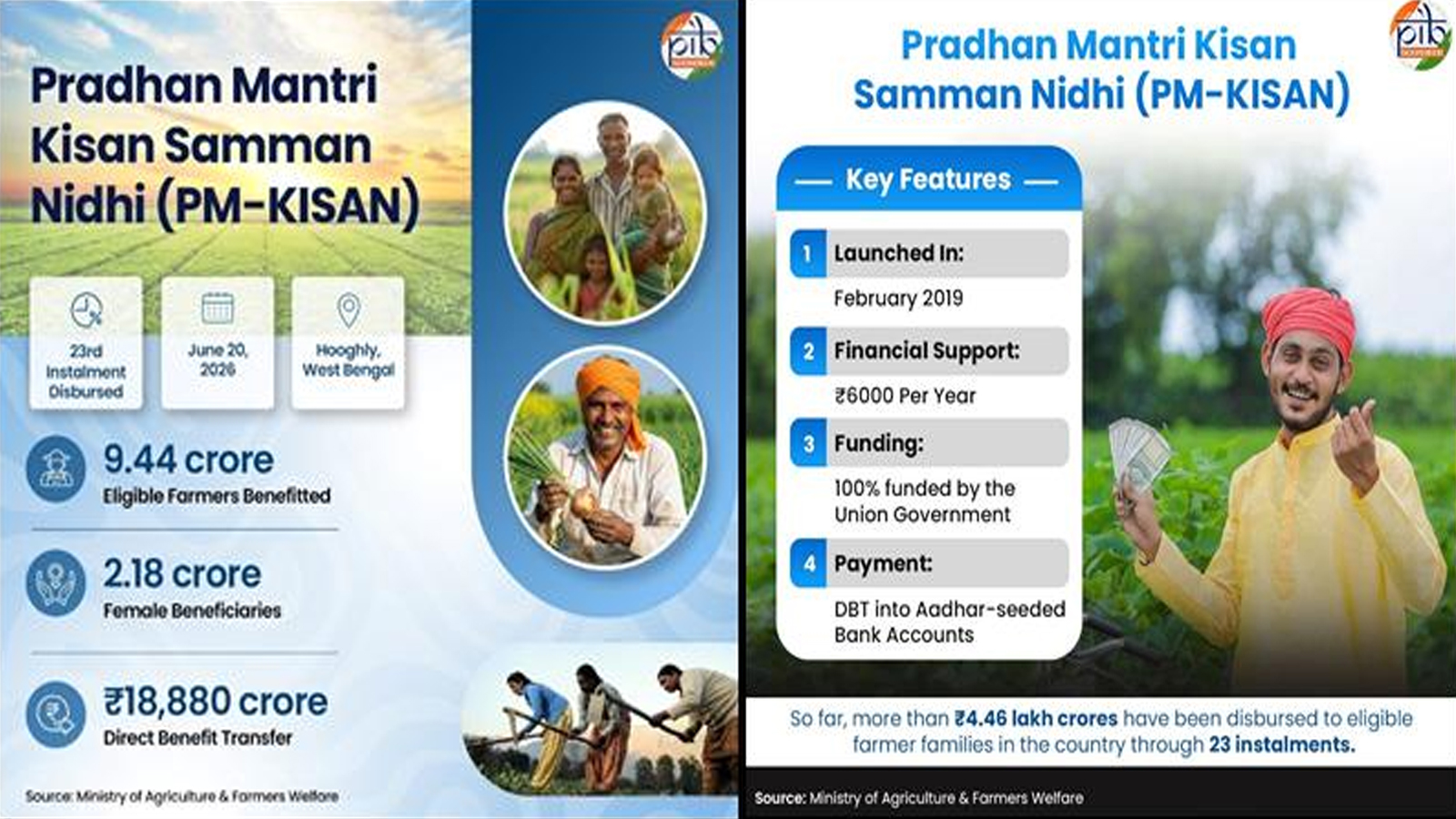
In a major boost to India’s agricultural sector, Prime Minister Narendra Modi released the 23rd installment of the Pradhan Mantri Kisan Samman Nidhi (PM-KISAN) scheme on June 20, transferring more than ₹18,880 crore directly into the bank accounts of 9.44 crore farmers across the country.
The event, held at Tarakeswar in Hooghly district of West Bengal, marked another milestone for one of the world’s largest Direct Benefit Transfer (DBT) programmes. Among the beneficiaries were more than 2.18 crore women farmers, underscoring the scheme’s growing role in promoting inclusive rural development.
More than one crore farmers participated virtually in the event, which was celebrated nationwide as “PM KISAN Utsav Diwas.”
The latest installment takes the cumulative disbursement under PM-KISAN to over ₹4.46 lakh crore since the scheme was launched in February 2019, reaffirming the government’s commitment to strengthening income security for India’s farming community.
From Welfare to Empowerment
When PM-KISAN was introduced in 2019, its objective appeared straightforward: provide direct income support to landholding farmer families. Every eligible farmer household receives ₹6,000 annually in three equal installments of ₹2,000 each.
However, over the years, the programme has evolved into much more than a financial assistance scheme.
For millions of small and marginal farmers, the timely transfer of funds has become a reliable source of support for purchasing seeds, fertilizers, pesticides, and other agricultural inputs. The scheme has reduced dependence on informal credit sources and strengthened farmers’ capacity to invest in their fields.
In many villages, PM-KISAN payments arrive precisely when farmers need working capital the most – before sowing seasons and during critical agricultural operations.
Predictable income support improves liquidity and helps farmers make better production decisions, reducing vulnerability to market fluctuations and seasonal uncertainties.
A Record of Scale and Inclusion
Few welfare programmes in the world operate at the scale achieved by PM-KISAN.
Since its inception, more than ₹4.46 lakh crore has been transferred directly into beneficiaries’ Aadhaar-linked bank accounts, eliminating middlemen and reducing leakages.
The programme now reaches farmers in virtually every district of the country. Women constitute over 23 percent of total beneficiaries, highlighting the increasing participation of women in agricultural decision-making and ownership.
Recognizing the scheme’s importance, the Union Budget 2026-27 allocated ₹60,000 crore for PM-KISAN, ensuring continuity of support to millions of farming families.
Evidence from the Ground
Studies conducted on the scheme’s impact indicate that PM-KISAN has contributed positively to farm productivity and household incomes.
A study undertaken by the Agro-Economic Research Centre at the University of Allahabad examined the scheme’s impact in Uttar Pradesh and found several notable outcomes.
Most beneficiaries were small and marginal farmers owning less than two hectares of land. The study found that farmers receiving PM-KISAN benefits reported higher agricultural investment and improved productivity.
Paddy yields on beneficiary farms were 3.08 percent higher than those of non-beneficiaries, while wheat yields were 1.93 percent higher.
More significantly, beneficiary households recorded a 9.85 percent increase in net farm income compared to non-beneficiary households.
Researchers concluded that the scheme improved liquidity, enhanced farmers’ ability to purchase agricultural inputs, and increased their willingness to take productive risks.
New Agriculture Initiatives Announced in West Bengal
Alongside the release of the 23rd installment, the government announced a series of agricultural initiatives aimed at transforming farming practices and strengthening resilience.
Expanded Crop Insurance Coverage
The Pradhan Mantri Fasal Bima Yojana (PMFBY) and the Restructured Weather-Based Crop Insurance Scheme (RWBCIS) will provide insurance protection against natural calamities, pest attacks, and adverse weather conditions.
The initiative aims to cover 1.10 crore farmers across 30 lakh hectares with an insured value of ₹28,140 crore.
AgriStack Under Digital Agriculture Mission
The rollout of AgriStack in West Bengal represents another step toward digital agriculture.
The platform seeks to integrate farmer databases and facilitate easier access to credit, crop insurance, procurement systems, and government benefits through a unified digital framework.
The initiative is expected to improve efficiency and reduce delays in service delivery.
Natural Farming Push
The National Mission on Natural Farming is set to expand sustainable agriculture practices across West Bengal.
A total of 346 natural farming clusters covering 17,300 hectares are planned, benefiting approximately 43,250 farmers.
The initiative seeks to reduce dependence on chemical fertilizers and pesticides while promoting environmentally sustainable cultivation practices.
PM Dhan-Dhaanya Krishi Yojana
The government also initiated PM Dhan-Dhaanya Krishi Yojana in four districts of West Bengal.
The scheme focuses on improving agricultural productivity, promoting crop diversification, strengthening irrigation infrastructure, and enhancing access to institutional credit.
Technology Driving Agricultural Governance
One of PM-KISAN’s biggest achievements lies in its use of technology to ensure transparent and efficient service delivery.
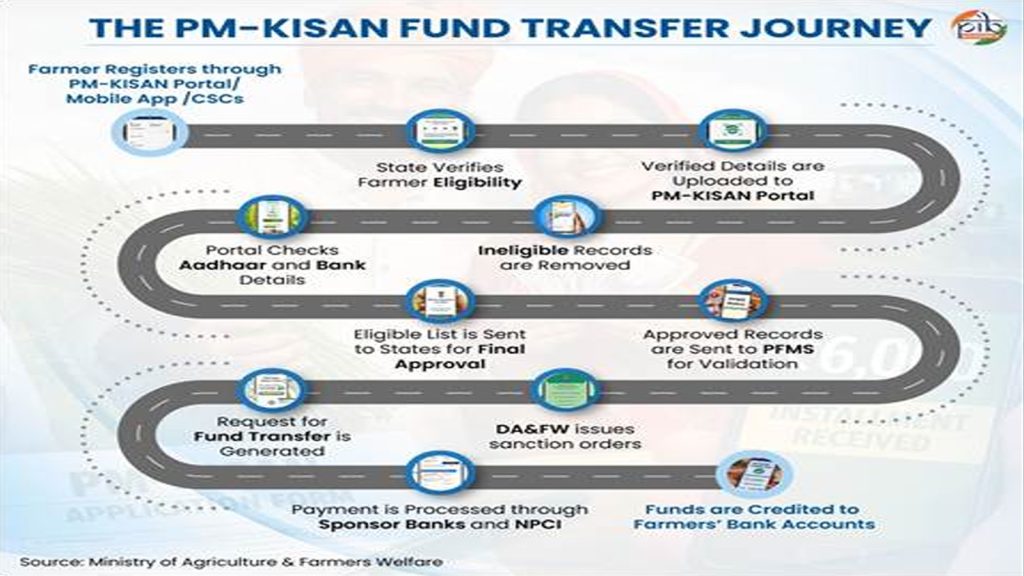
The entire ecosystem – from registration to payment transfer – is digitally integrated.
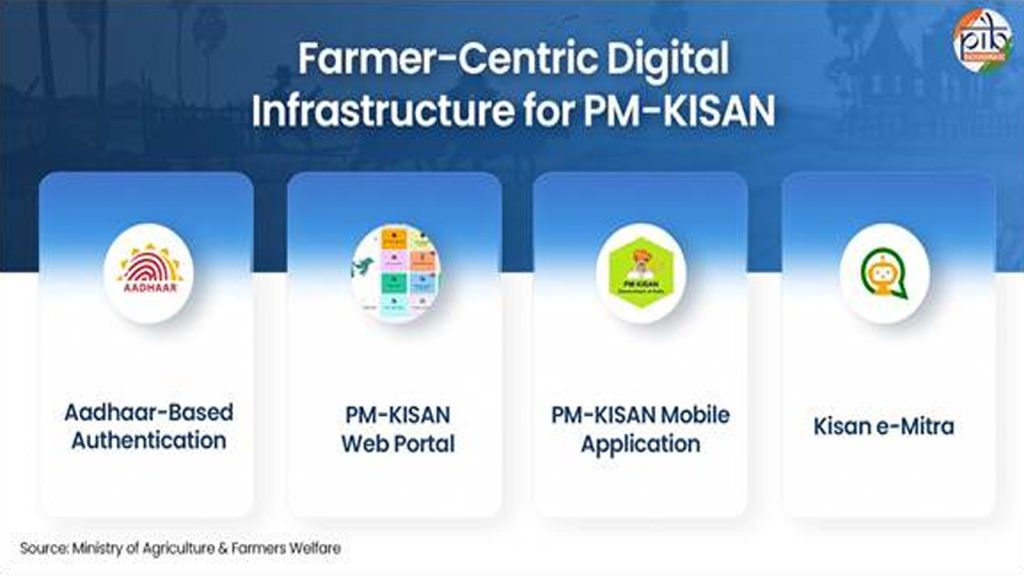
Farmers can register through the PM-KISAN portal, Common Service Centres (CSCs), or the mobile application. Aadhaar authentication and e-KYC mechanisms ensure accurate identification and minimize duplication.
The government has enabled multiple modes of e-KYC, including: OTP-based authentication, biometric verification, and face authentication technology.
The PM-KISAN mobile application, upgraded with facial recognition capabilities in 2023, has made verification easier for farmers who face challenges with biometric authentication.
Kisan-eMitra: Artificial Intelligence in Agriculture
India’s agricultural support system is also embracing artificial intelligence.
The AI-powered chatbot “Kisan-eMitra,” launched in September 2023 with support from EkStep Foundation and BHASHINI, provides real-time information to farmers regarding payments, registrations, eligibility, and grievance redressal.
Available in eleven Indian languages, the chatbot allows farmers to obtain scheme-related information through voice and text interactions.
The multilingual platform is helping bridge information gaps and making government services more accessible to rural communities.
Building a Robust Farmer Database
The success of PM-KISAN depends heavily on accurate beneficiary identification.
State governments are responsible for creating and maintaining comprehensive databases containing details such as Aadhaar numbers, bank account information, land records, and contact details.
To improve transparency, beneficiary lists are publicly displayed at the village level, enabling community verification and reducing the chances of wrongful inclusion.
Authorities have also intensified efforts to remove ineligible beneficiaries.
As of December 2025, ₹416.75 crore had been recovered from individuals who were found ineligible, including income-tax payers, government employees, public sector undertaking staff, and constitutional office holders.
Expanding Coverage Through Outreach
The government has undertaken several initiatives to ensure that eligible farmers are not left out.
More than five lakh Common Service Centres have been onboarded to assist farmers with registration and e-KYC completion.
Special drives have significantly expanded the scheme’s reach.
During the Viksit Bharat Sankalp Yatra, more than one crore eligible farmers were added to the PM-KISAN database.
The government’s 100-day programme added over 25 lakh farmers, while a dedicated campaign in September 2024 resolved pending registrations and included more than 30 lakh additional beneficiaries.
Monitoring and Accountability
PM-KISAN is monitored through a multi-tier framework involving national, state, and district-level committees.
At the national level, reviews are conducted under the chairmanship of the Cabinet Secretary, while state and district monitoring committees oversee implementation on the ground.
Farmers can submit grievances through the PM-KISAN portal and the Centralized Public Grievance Redressal and Monitoring System (CPGRAMS).
During FY 2024-25, over 24,600 grievances were recorded and addressed through the system.
A New Model of Rural Development
The significance of PM-KISAN extends beyond the transfer of ₹6,000 annually.
The scheme represents a broader shift in agricultural policy – from subsidy-driven support to direct empowerment of farmers.
By providing predictable income support, enabling digital access to services, and integrating technology into governance, PM-KISAN has helped build trust between farmers and public institutions.
The programme has demonstrated how digital governance can be deployed at a massive scale while ensuring transparency, accountability, and inclusion.
For millions of farming families, the scheme has become a financial lifeline that supports cultivation, reduces uncertainty, and encourages investment in agriculture.
As India moves toward a more technology-driven and farmer-centric agricultural ecosystem, PM-KISAN is increasingly being viewed not merely as a welfare initiative but as a foundational pillar of rural transformation.
Seven years after its launch, the programme continues to evolve, combining direct income support with digital innovation, financial inclusion, and agricultural modernization – offering a glimpse into the future of India’s farming economy.


