







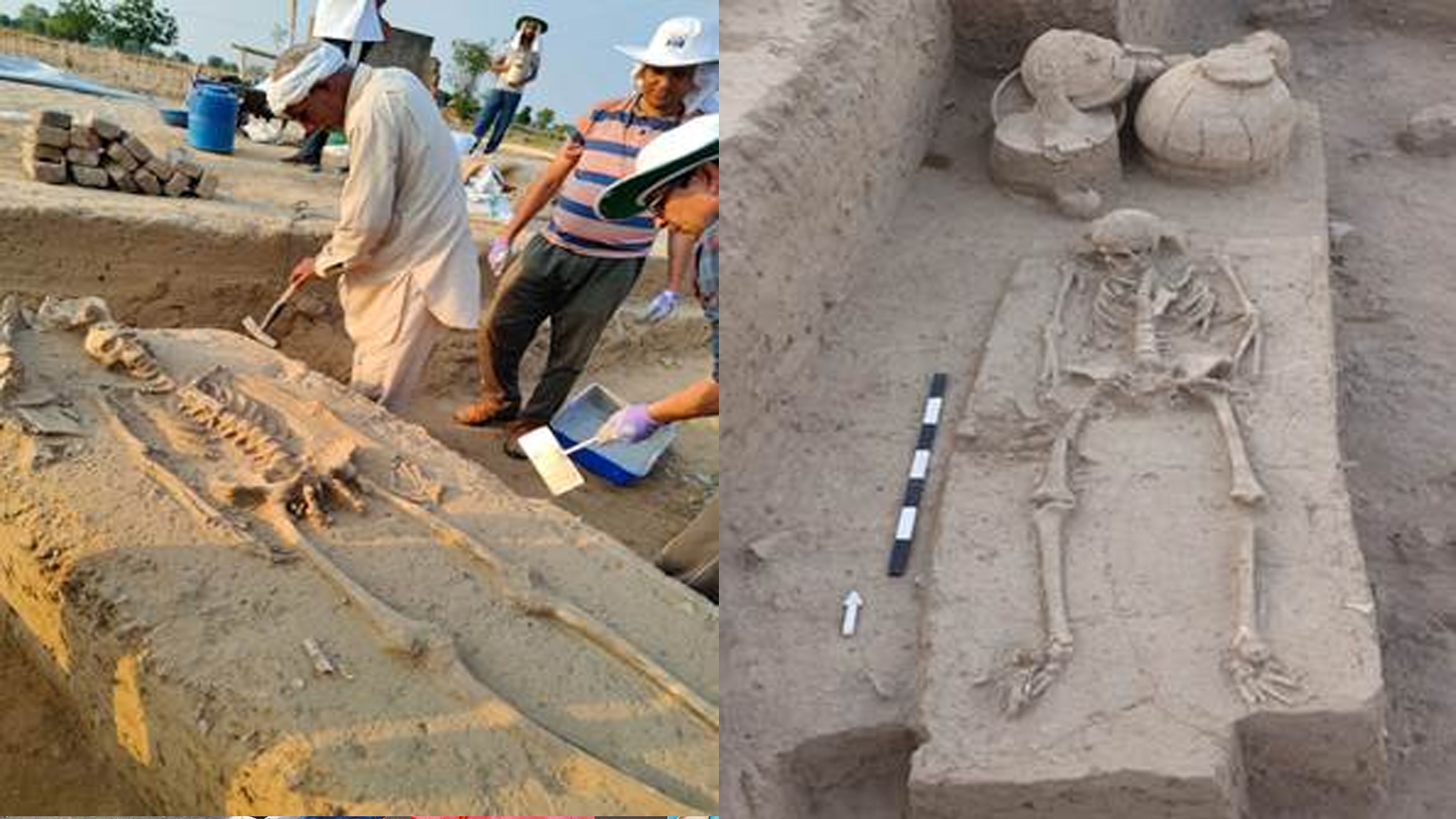
In a significant step towards deepening understanding of India’s ancient past, the Archaeological Survey of India (ASI) has formally transferred human skeletal remains excavated from the Indus-Saraswati civilization site of Rakhigarhi in Haryana to the Anthropological Survey of India (AnSI) for advanced scientific research.
The transfer follows a recently signed Memorandum of Understanding (MoU) between the two institutions and is expected to strengthen multidisciplinary studies on one of the world’s earliest urban civilizations. According to AnSI Director Prof. B.V. Sharma, the collaboration will help unlock valuable insights into the biological history, health, lifestyle, and migration patterns of people who lived in the Harappan era.
Rakhigarhi, spread across nearly 550 hectares in Haryana, is widely regarded as the largest known settlement of the Indus-Saraswati Civilization. Excavations at the site have revealed evidence of well-planned urban settlements, drainage systems, craft production centres, trade networks, and burial grounds dating from the Early Harappan to Mature Harappan periods.
During the 2025–26 excavation season, ASI’s Excavation Branch-II, Greater Noida, uncovered eight burials at Mound No. 7, a site identified as an ancient cemetery. Three complete human skeletons and skeletal fragments recovered from other burials have now been transferred to AnSI’s ancient human skeletal repository and laboratory in Kolkata for detailed examination. Additional skeletal remains from the site are expected to be transferred in the coming days.
Experts from the fields of archaeology, skeletal biology, and genetics have welcomed the initiative. Former Andhra University faculty member Prof. Vijay Prakash described the transfer as an important step toward preserving and scientifically studying India’s biological heritage. Prof. Udai Pratap Singh of Lucknow University said the move would strengthen India’s palaeoanthropological research capabilities and help reconstruct aspects of population history, health, and cultural adaptation during the Harappan period.
Researchers plan to employ a range of modern scientific techniques, including ancient DNA (aDNA) analysis, stable isotope studies, osteological assessments, palaeopathological investigations, and environmental reconstruction. These methods are expected to provide insights into ancestry, diet, disease patterns, migration, and interactions between humans and their environment nearly 5,000 years ago.
The research will be carried out in collaboration with leading institutions, including the Birbal Sahni Institute of Palaeosciences (BSIP), Lucknow, University College London (UCL), and a team of scientists from Banaras Hindu University (BHU) specialising in ancient DNA studies.
Padma Shri awardee Dr. Kumaraswamy Thangaraj of the Centre for Cellular and Molecular Biology (CCMB), Hyderabad, said ancient DNA analysis could reveal critical information about the genetic history of the Harappan population and help scientists understand how human genomes evolved and adapted since around 3000 BCE. BHU geneticist Prof. Gyaneshwer Chaubey described the collaboration as a major step in reconstructing the genomic history of the civilization and training a new generation of Indian researchers in palaeogenomics.
Officials noted that AnSI has a long tradition of studying human skeletal remains recovered from Indus-Saraswati sites since its establishment in 1945. Although such research had slowed over the years, the institution has recently revived palaeoanthropological studies through dedicated research teams and specialized training programmes.
AnSI has already completed palaeopathological studies on skeletal remains from several Indus-Saraswati sites and is preparing scientific publications based on its findings. The institution also plans to expand collaborations with organizations such as the Zoological Survey of India, Botanical Survey of India, Geological Survey of India, and experts working in palaeoclimate research.
Anthropologist Prof. Subhash Walimbe, formerly of Deccan College, Pune, emphasized that detailed examination of the remains could help researchers understand how urbanization influenced human health and biological adaptation. Former National Monument Authority Chairman Prof. Kishore K. Basa noted that such studies would have implications not only for anthropology and archaeology but also for history, genetics, nutrition, and disease research.
Officials said the ASI-AnSI partnership marks a major effort to integrate archaeology, anthropology, genetics, and environmental sciences in the study of India’s ancient heritage. The findings from the Rakhigarhi remains are expected to shed new light on the origins, health, mobility, and biological history of one of the world’s earliest urban societies.


