







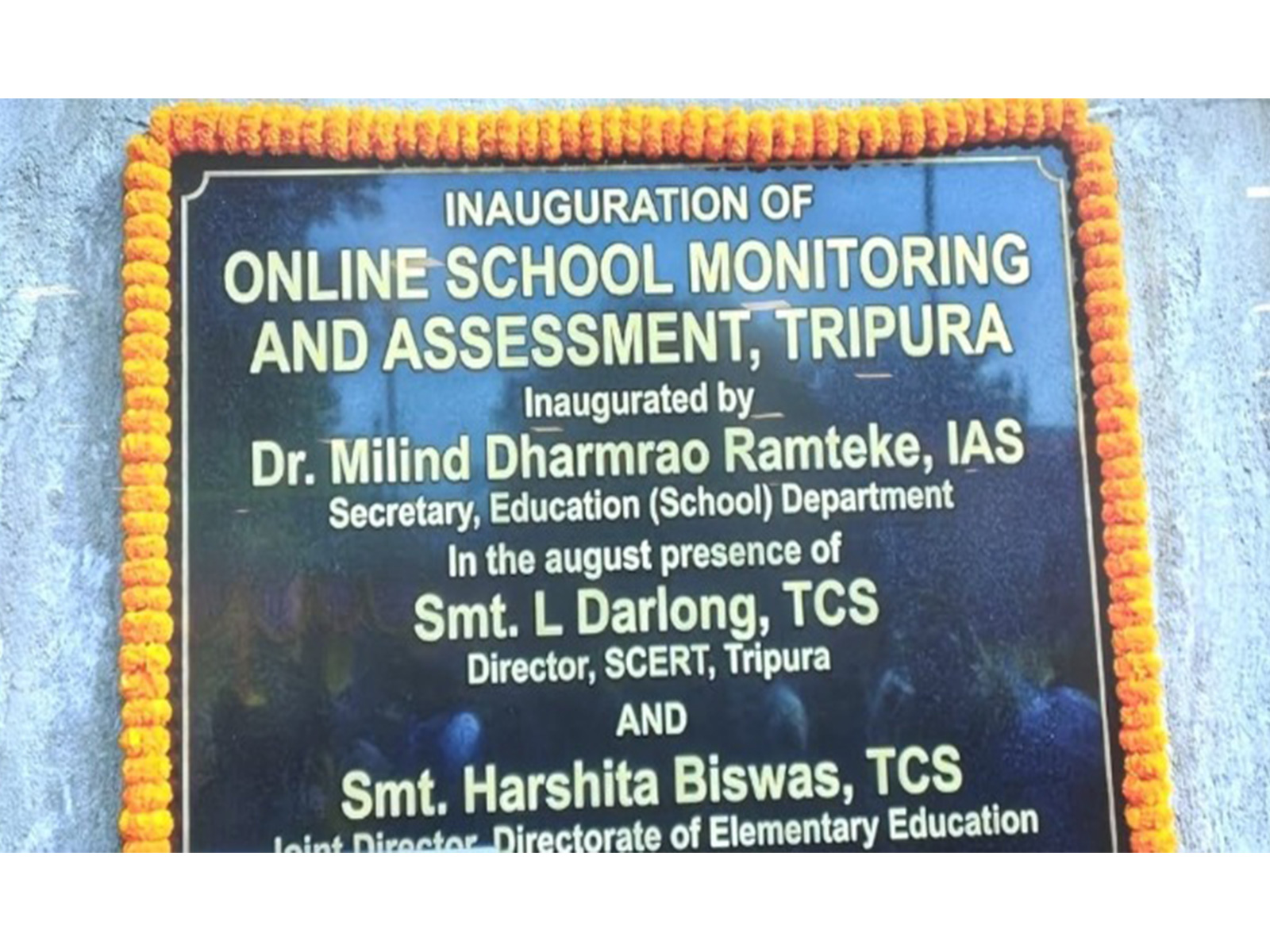
In a significant step towards improving the quality of school education and ensuring real-time academic monitoring, the School Education Department of Tripura on Wednesday formally launched the state’s first-ever Online School Monitoring System, aimed at strengthening Foundational Literacy and Numeracy (FLN) and enhancing accountability across schools.
The initiative was rolled out within 24 hours of a high-level review meeting chaired by Tripura Chief Minister Manik Saha, where foundational education and effective monitoring emerged as key priorities for the state’s education sector.
The online monitoring platform was formally launched by Dr. Milind Dharamrao Ramteke (IAS) officer of the 2009 batch, Tripura cadre , during a workshop organised by the NIPUN Tripura Cell and the Pre-Primary Cell under the Directorate of Elementary Education. The system, conceptualised under the leadership of the School Education Secretary, is expected to bring transparency, efficiency and real-time data-driven decision-making into school governance.
Officials said the platform will facilitate prompt monitoring of schools at the district and state levels, enabling authorities to identify learning gaps and undertake corrective measures without delay. This is the first time such a digital monitoring mechanism has been introduced in Tripura’s education sector.
Addressing the inaugural session, Dr. Ramteke ,emphasised that Block Resource Persons (BRPs) and Cluster Resource Persons (CRPs) would now play a central role in ensuring quality foundational education for students from Classes I to V. They will be required to conduct regular inspections of primary schools and submit reports through the Online School Monitoring System.
“Real-time educational data will now be available to the department for the first time, allowing timely intervention and evidence-based planning,” officials said.
Under the new framework, BRPs and CRPs must visit each assigned school at least once every fifteen days to assess classroom learning and track students’ academic progress. Inspectors of Schools will oversee the inspection process and simultaneously evaluate the quality of education for students from Classes VI to X. The department has also directed officials to conduct surprise inspections and spot assessments to ensure accountability.
The system will additionally allow teachers to carry out student assessments online. The department has indicated that accountability measures will be linked to learning outcomes. Teachers who fail to ensure age-appropriate learning levels among students may face appropriate action, while those demonstrating significant improvement in student performance will receive recognition, incentives and professional growth opportunities.
The launch programme was attended by L. Darlong, Harshita Biswas, and State Nodal Officer of NIPUN Mission and the Branch Officer of the Pre-Primary Cell, Abhijit Samajpati, among other senior officials.
Speaking on the occasion, Harshita Biswas reiterated the department’s commitment to ensuring quality education across the state. She stressed that Inspectors of Schools, BRPs, CRPs and teachers must work collectively and responsibly to improve learning outcomes for students. She further noted that accountability would be fixed at every level of implementation.
Inspectors of Schools from both the state administration and the TTAADC areas, along with BRPs and CRPs from all eight districts, received hands-on training on the newly launched system in two phases. The training was conducted by officials from the Vidya Samiksha Kendra, who are responsible for operating and managing the digital monitoring platform.
Education Department officials said the Online School Monitoring System marks a major reform in Tripura’s school education sector and aligns with the state’s broader efforts to improve foundational learning under the NIPUN Bharat Mission. More innovative and technology-driven initiatives are expected to be introduced in the coming months, with special emphasis on strengthening foundational education across Tripura.
The move is being viewed as a major administrative reform aimed at improving educational outcomes, increasing accountability and ensuring that every child receives quality foundational education through continuous monitoring and timely intervention.
(ANI)


