







Over the past twelve years, India has witnessed an unprecedented expansion of its heritage conservation and cultural development ecosystem under the vision of “Vikas Bhi, Virasat Bhi” – a development model that seeks to balance economic growth with the preservation and promotion of the country’s civilisational legacy.
From restoring ancient temples and redeveloping pilgrimage centres to digitising manuscripts, reclaiming stolen antiquities and expanding India’s footprint on UNESCO’s global heritage lists, the country’s cultural landscape has undergone a significant transformation. The approach has increasingly linked heritage preservation with tourism, livelihoods, urban development, digital innovation and cultural diplomacy.
Today, India has emerged not only as one of the world’s richest repositories of cultural heritage but also as a leading voice in global efforts to preserve and promote civilisational knowledge.
Heritage Conservation Becomes a National Development Priority
India’s heritage assets encompass monuments, archaeological sites, manuscripts, antiquities, oral traditions and living cultural practices accumulated over millennia. Since 2014, heritage conservation has moved beyond preservation alone and has increasingly been integrated into broader strategies for tourism promotion, economic development and international cultural engagement.
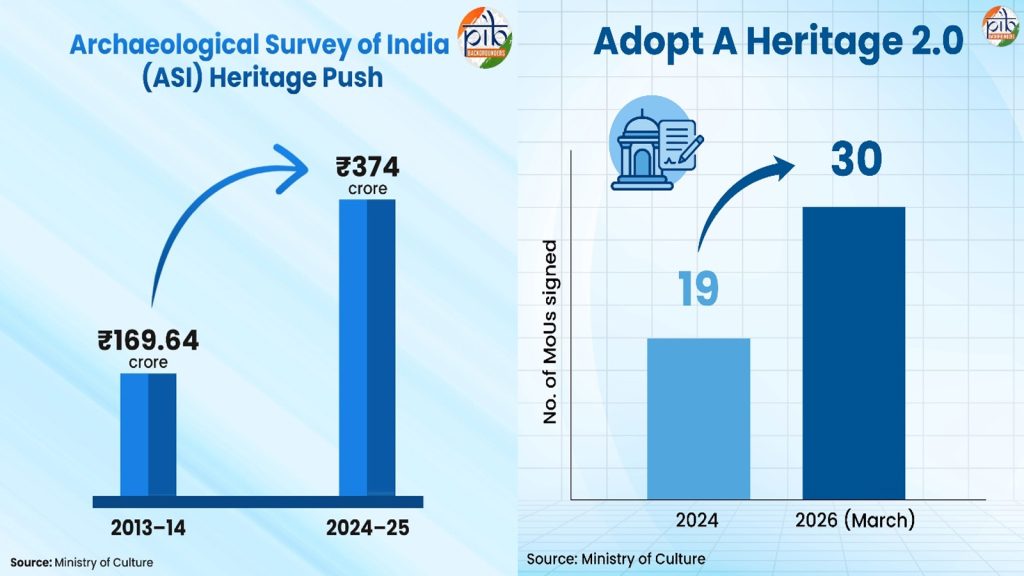
The Archaeological Survey of India (ASI), the country’s premier heritage conservation agency, currently protects 3,686 centrally protected monuments. To support conservation and maintenance efforts, the government allocated approximately ₹374 crore during 2024-25.
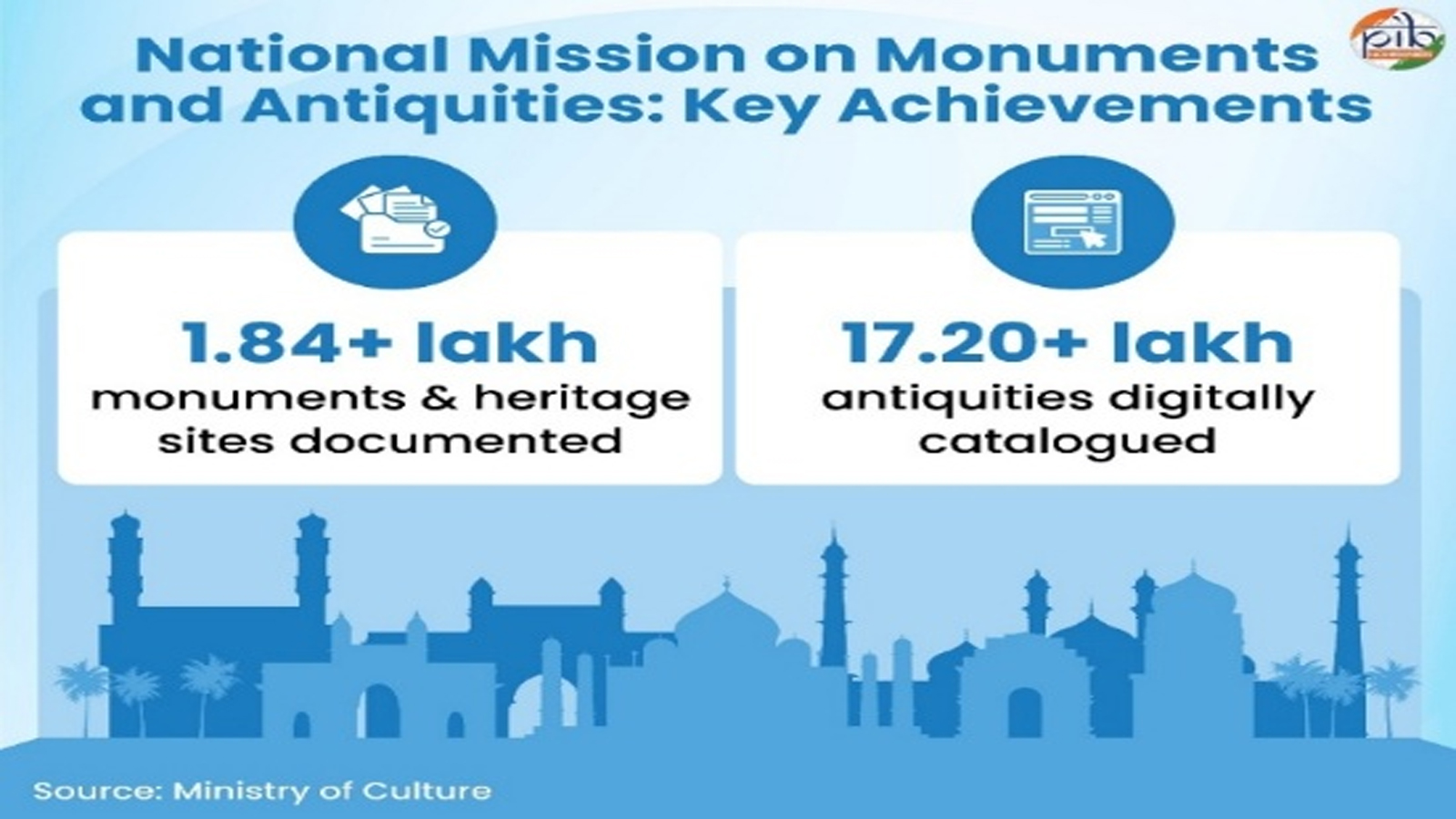
Strengthening conservation efforts further, the National Mission on Monuments and Antiquities (NMMA) has created one of the country’s largest heritage databases. As of March 2026, the mission has documented 1.84 lakh monuments and heritage sites and catalogued 17.20 lakh antiquities across India, providing critical data for future conservation planning.
Private Participation Expands Through Adopt a Heritage Programme
The Adopt a Heritage initiative, launched in 2017 and revamped as Adopt a Heritage 2.0 in 2023, has emerged as a major platform for collaboration between government agencies and private stakeholders. The programme encourages corporate entities, public sector undertakings, NGOs and trusts to develop visitor amenities at protected monuments through Corporate Social Responsibility (CSR) funding.
As of March 2026, 30 Memorandums of Understanding had been signed under the programme. The initiative has significantly enhanced visitor experiences at adopted sites, which collectively recorded a footfall of 13.59 million visitors during FY 2024-25.
The numbers indicate that better amenities, improved interpretation services and enhanced site management are contributing to increased public engagement with India’s heritage assets.
Pilgrimage Tourism Receives Major Infrastructure Boost
One of the most visible transformations has occurred through the Pilgrimage Rejuvenation and Spiritual, Heritage Augmentation Drive (PRASHAD), launched in 2015 to develop pilgrimage destinations across India.
As of February 2026, 54 projects had been sanctioned under the scheme across 28 states and Union Territories with a total investment of ₹1,726.74 crore. Of these, 32 projects have already been completed.
Among the notable projects is the ₹47.12 crore Somnath Promenade Development Project, which has strengthened the historic temple town’s position as one of India’s leading spiritual tourism destinations.
The Kedarnath PRASHAD project has significantly upgraded pilgrimage facilities, sanitation, accessibility and visitor services. More than five lakh pilgrims have already visited Kedarnath during the current season, reflecting the growing popularity of the destination.
An evaluation conducted by IIM Rohtak in 2021 concluded that the PRASHAD scheme has improved visitor satisfaction, ease of travel and overall tourist experience at heritage destinations.
Swadesh Darshan Creates Integrated Tourism Circuits
Complementing PRASHAD, the Swadesh Darshan programme has focused on integrated tourism infrastructure development.
Under Swadesh Darshan 1.0, launched in 2014-15, 76 projects were sanctioned with investments worth ₹5,290.33 crore. As of March 2026, 75 of these projects had been physically completed.
The programme has since evolved into Swadesh Darshan 2.0, which adopts a destination-centric rather than circuit-centric approach. Under the revamped programme, 53 projects have been sanctioned with investments of ₹2,208.31 crore.
Additionally, the Challenge Based Destination Development initiative introduced in March 2024 has sanctioned 38 projects worth ₹697.94 crore aimed at transforming destinations into sustainable tourism hubs through innovation and community participation.
Heritage Cities Witness Urban Transformation
The Heritage City Development and Augmentation Yojana (HRIDAY), launched in 2015, sought to integrate urban development with heritage conservation across 12 historic cities.
Cities including Ajmer, Amaravati, Badami, Amritsar, Gaya, Varanasi, Warangal, Puri, Kancheepuram, Mathura and Velankanni benefited from investments aimed at improving sanitation, security, tourism infrastructure and heritage preservation.
Though the scheme concluded in March 2019, its impact continues to be visible in improved public amenities, enhanced tourism infrastructure and strengthened cultural identities of participating cities.
Major Temple Corridors Redefine Pilgrimage Experience
Among India’s most transformative heritage projects is the Kashi Vishwanath Corridor in Varanasi.
Inaugurated in December 2021, the ₹355 crore project spans 5.5 acres and directly connects the Kashi Vishwanath Temple to the Ganga River through a four-lane pathway. The corridor has dramatically improved accessibility and crowd management.
Since its inauguration, the corridor has attracted more than 25.28 crore devotees within just three-and-a-half years. The project has generated an estimated economic impact of ₹1.25 lakh crore, with average visitor spending ranging between ₹4,000 and ₹5,000 per person.
The demographic profile of visitors also highlights its national appeal, with nearly 70 per cent of pilgrims coming from South India and around 15 per cent from other regions of the country.
Somnath Emerges as a Model Spiritual Tourism Destination
Redevelopment efforts at Somnath have coincided with the 75th anniversary of the temple’s reconstruction in 1951.
A 1.5-kilometre promenade and multiple visitor infrastructure upgrades have strengthened its status as a major pilgrimage destination. The temple attracts between 92 lakh and 97 lakh devotees annually, including 13.77 lakh Bilva Pooja participants and 3.56 lakh visitors during Maha Shivratri 2025.
The site’s Light and Sound Show has attracted over 10 lakh visitors in the last three years.
Environmental sustainability has also become a key component of redevelopment. Initiatives include treatment of 30 lakh litres of wastewater every month, a 7,200-tree Miyawaki forest capable of absorbing approximately 93,000 kilograms of carbon dioxide annually, and conversion of plastic waste into nearly 4,700 paver blocks every month. The Somgangajal initiative has benefited approximately 1.13 lakh families.
Kedarnath Ropeway to Revolutionise Himalayan Pilgrimage
One of India’s most ambitious connectivity projects is the 12.9-kilometre Sonprayag-Kedarnath Ropeway, approved under the Parvatmala Pariyojana at a cost of ₹4,081.28 crore.
The ropeway will use advanced tri-cable detachable gondola technology and carry 1,800 passengers per hour in each direction. It will reduce travel time from 8-9 hours to just 36 minutes, offering all-weather access to one of India’s twelve Jyotirlingas, which attracts around 20 lakh pilgrims annually.
Ayodhya Witnesses Unprecedented Tourism Boom
Following the consecration of the Ram Mandir in January 2024, Ayodhya has emerged as one of India’s fastest-growing spiritual tourism destinations.
Tourism revenue currently ranges between ₹8,000 crore and ₹12,500 crore annually and is projected to reach ₹18,000 crore by 2028.
Visitor numbers surged dramatically from 5.75 crore in 2023 to over 16 crore in 2024. During the first half of 2025 alone, more than 23 crore devotees visited the city.
The Uttar Pradesh government is investing over ₹5,000 crore in urban and tourism infrastructure, with Ayodhya expected to contribute nearly 25 per cent of the state’s projected ₹70,000 crore tourism economy by 2028.
Reclaiming India’s Lost Heritage
India has also accelerated efforts to recover antiquities and sacred relics taken abroad through colonial-era removal or illicit trafficking.
Major achievements include the return of the Piprahwa Relics of Lord Buddha in 2025 after 127 years, the repatriation of the Goddess Annapurna idol from Canada in 2021 after 108 years, and the return of bronze idols of Rama, Sita and Lakshmana from the United Kingdom in 2020.
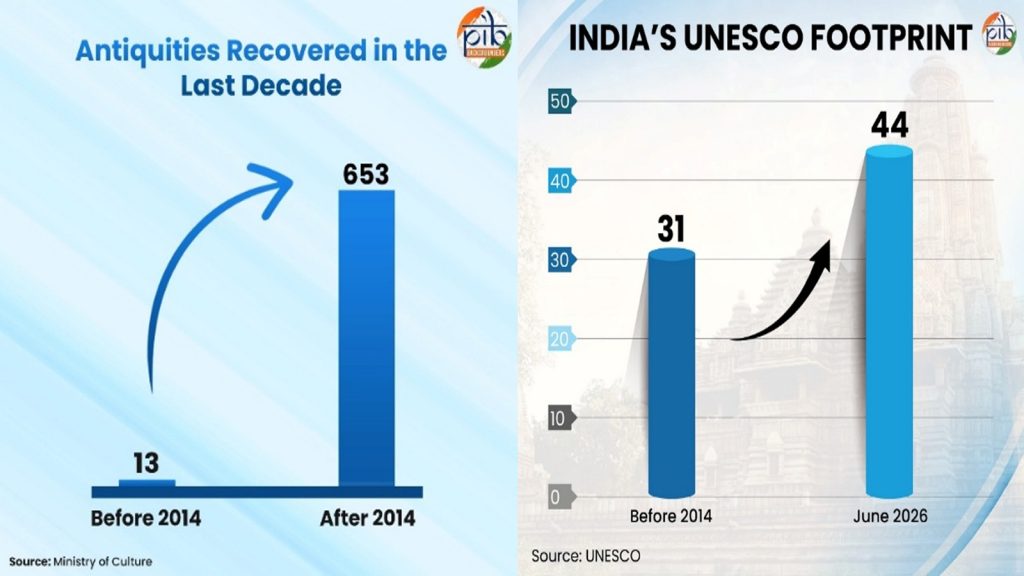
As of May 2026, India had successfully repatriated 653 antiquities since 2014. Remarkably, 613 of these artefacts were recovered during the last five years alone.
Sacred Relics Strengthen Cultural Diplomacy
India’s sacred Buddha relics have become powerful instruments of cultural diplomacy.
International exhibitions have attracted massive participation, including more than 1.5 crore devotees in Vietnam during 2025, over 90,000 visitors in Kalmykia, Russia, and special exhibitions in Bhutan and Sri Lanka.
Domestically, exhibitions in New Delhi and Ladakh showcased the reunited Piprahwa relics, drawing widespread public interest.
Museums Enter a New Era
Museum development has shifted towards immersive and technology-driven experiences.
A major milestone was achieved with the inauguration of the Archaeological Experiential Museum at Vadnagar, Gujarat, in January 2025. Built at a cost of ₹298 crore and spread over 12,500 square metres, it is described as the world’s only museum offering an immersive archaeological experience.
The museum displays more than 5,000 artefacts alongside food grains, DNA samples and skeletal remains uncovered during excavations. Its unique 4,000-square-metre open excavation zone allows visitors to directly observe archaeological layers at depths of up to 18 metres.
Meanwhile, the Yuge Yugeen Bharat National Museum, being developed in New Delhi’s North and South Blocks under the Central Vista project, will cover 1.54 lakh square metres and showcase India’s civilisational journey across millennia.
UNESCO Recognition Expands Dramatically
India’s international heritage standing has strengthened significantly over the last decade.
The country now boasts 44 UNESCO World Heritage Sites, up from 31 in 2014. Twelve new sites have been added since then.
India also has 15 elements inscribed on UNESCO’s Intangible Cultural Heritage list, including Yoga, Kumbh Mela, Durga Puja, Garba and Deepawali.
The country further reinforced its leadership role by hosting the 46th UNESCO World Heritage Committee Session in New Delhi in 2024.
Digital Preservation Opens New Frontiers
The digitisation of cultural knowledge has emerged as a major pillar of heritage preservation.
The Gyan Bharatam Mission, launched in 2025, aims to preserve and digitise India’s manuscript wealth. More than eight lakh digitised manuscripts are currently being reformatted according to mission standards.
Of these, 1.29 lakh manuscripts have already been made publicly accessible through the National Digital Repository.
The mission is supported by a National Manuscript Survey launched in March 2026 to create a comprehensive national database of manuscripts.
Artificial Intelligence Joins Heritage Preservation
Technology is increasingly being deployed for documentation and conservation.
Tools such as LiDAR scanning, GIS mapping and drone surveys are now routinely used in heritage management. Artificial Intelligence is also being integrated into manuscript preservation through handwritten text recognition, optical character recognition and intelligent cataloguing systems.
The BHASHINI platform, launched in 2022, now supports 22 languages through voice and 36 through text, powered by more than 350 AI models and over four billion language transactions.
The BharatGen initiative is developing AI models for all 22 scheduled Indian languages, while the Adi-Vaani platform is helping preserve tribal languages such as Santali, Bhili, Mundari and Gondi.
Under the Gyan Bharatam Mission, AI technologies are being used to process more than 44 lakh documented manuscripts under a programme with an outlay of ₹482.85 crore between 2024 and 2031.
Preserving Vedic and Cinematic Heritage
The Vedic Heritage Portal, launched in March 2023, has become a major digital repository of India’s ancient knowledge systems. It contains more than 500 hours of audio-visual recordings covering Vedic traditions, manuscripts and ritual practices.
India has also intensified efforts to preserve its cinematic legacy through the National Film Heritage Mission. As of December 2025, 1,469 film titles comprising 4.3 lakh minutes of footage had been digitised and restored.
The National Museum of Indian Cinema in Mumbai, inaugurated in 2019 at a cost of ₹140.61 crore, continues to attract growing public interest. The museum recorded more than 17,000 visitors in May 2026 alone.
A Civilisational Project for the Future
The transformation of India’s heritage sector over the last decade reflects a broader effort to reconnect development with cultural identity. Heritage conservation is increasingly being viewed not merely as the preservation of monuments and artefacts, but as an instrument of economic growth, tourism development, cultural confidence and international engagement.
From temple corridors and pilgrimage circuits to digital manuscript repositories and UNESCO recognitions, India is pursuing a model where heritage serves both as a bridge to the past and a foundation for the future.
As the country advances toward its broader developmental goals, the philosophy of “Vikas Bhi, Virasat Bhi” continues to position cultural heritage not as a relic of history but as a living asset shaping India’s national identity, global influence and civilisational resurgence.


