







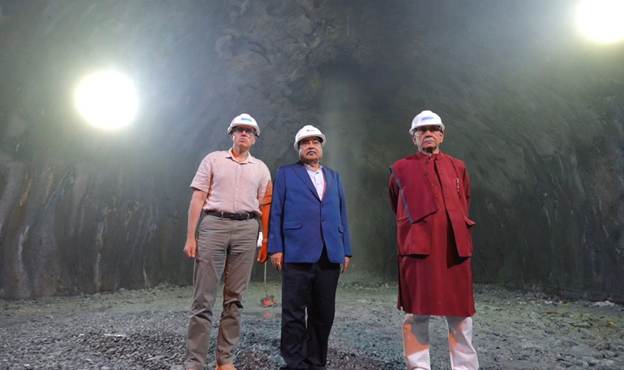
Union Minister for Road Transport and Highways Nitin Gadkari on Tuesday witnessed the historic breakthrough of the main tunnel at the eastern portal of the Zojila Tunnel Project at Minamarg in Ladakh’s Kargil district, marking a major milestone in India’s infrastructure development journey.
The breakthrough brings the country a step closer to achieving year-round road connectivity between Jammu & Kashmir and Ladakh, a long-standing objective aimed at improving mobility, boosting economic activity and strengthening strategic access in the region.
Being constructed between Baltal and Minamarg on National Highway-1, the nearly 14-kilometre-long bi-directional Zojila Tunnel is among India’s most ambitious mountain infrastructure projects. Built at an altitude ranging from 2,900 metres to 3,310 metres and at an estimated cost of around ₹6,800 crore, the tunnel is designed to provide uninterrupted connectivity through one of the country’s most challenging terrains.
Despite heavy snowfall, harsh weather conditions and complex geological challenges, the project has progressed steadily through the efforts of engineers, workers and various implementing agencies, including the National Highways and Infrastructure Development Corporation Limited (NHIDCL).
Highlighting the tunnel’s features, Gadkari said it will be equipped with advanced ventilation systems, automatic fire detection mechanisms, CCTV surveillance and pedestrian cross-passages to ensure safe and efficient travel. The project also includes snow galleries, avalanche protection structures, bridges, culverts, catch dams and approach roads.
Upon completion, travel time between Sonamarg and Minamarg is expected to reduce from nearly two hours to about 30 minutes. The tunnel is also expected to reduce weather-related disruptions and accident risks while improving access to remote areas.
The Minister said the project will boost tourism, facilitate trade, create employment opportunities and strengthen connectivity to border regions. He added that year-round access will enhance the movement of defence personnel, equipment and logistics, contributing to national security.
Highlighting broader infrastructure development efforts in the region, Gadkari said road and tunnel projects worth about ₹18,000 crore are currently under implementation between Kargil and Leh. These include the Kargil–Zanskar–Padum highway, the proposed Fatu-La Twin-Tube Tunnel and the Kela Pass Tunnel.
He also informed that tunnel projects at Baralacha La, Lachulung La and Tanglang La are being planned along the Manali–Leh route to improve all-weather connectivity and reduce travel time.
The Minister further said highway projects worth approximately ₹1.35 lakh crore, including completed, ongoing and proposed works, are being implemented across Jammu & Kashmir. Key projects include the Jammu–Udhampur–Srinagar corridor, Jammu–Chenani–Anantnag corridor, Srinagar–Baramulla–Uri corridor and Jammu–Akhnoor–Poonch corridor.
Among other strategic initiatives, Gadkari highlighted the Katra–Srinagar High-Speed Corridor, the Rafiabad–Kupwara–Tangdhar road project and the Srinagar–Sonamarg–Gumri corridor, aimed at improving access to border areas, supporting tourism and enhancing regional connectivity.
The Minister also underlined the role of the Srinagar and Jammu Ring Road projects in reducing urban congestion and improving traffic movement.
He said the Delhi–Amritsar–Katra Greenfield Expressway will further strengthen connectivity between northern India and Jammu & Kashmir through a modern access-controlled corridor.
Describing tunnel infrastructure as a key component of highway development in the Himalayan region, Gadkari said such projects are critical for ensuring all-weather connectivity, enhancing road safety and strengthening strategic mobility.
“The successful breakthrough of the Zojila Tunnel symbolizes a New India that transforms geographical challenges into opportunities for development, prosperity and national progress,” he said.


