







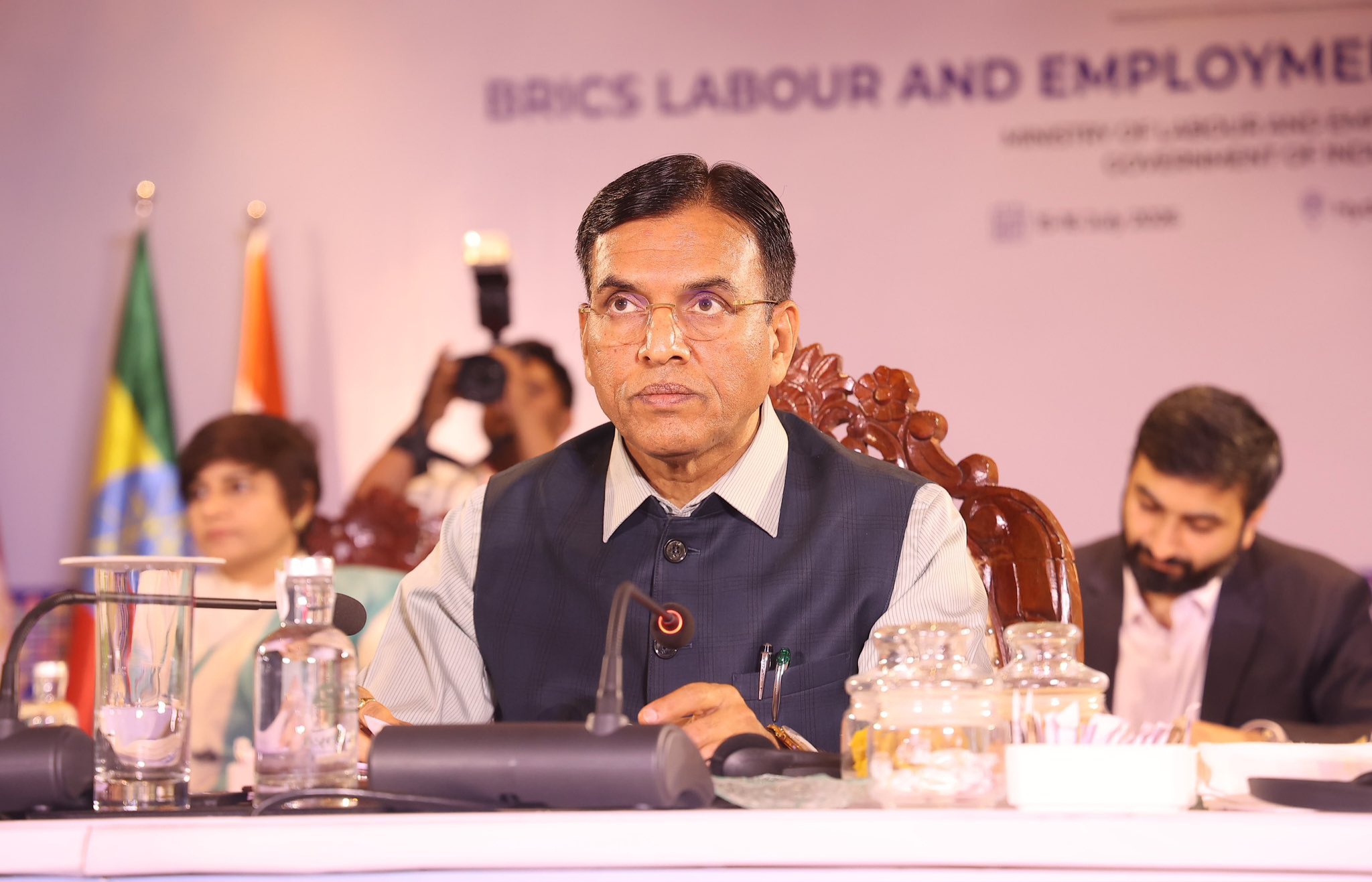
BRICS countries on Wednesday adopted a landmark Labour and Employment Ministers’ Declaration, reaffirming their commitment to strengthening social protection, expanding women’s workforce participation, improving employability and skills development, and leveraging digital technologies for inclusive labour markets. India also launched BRICS CONNECT, a new platform aimed at enhancing technical cooperation, knowledge exchange, and capacity building among member countries.
The decisions were taken at the 12th BRICS Labour and Employment Ministers’ Meeting held in Hyderabad under India’s BRICS Chairship 2026, which is themed “Building for Resilience, Innovation, Cooperation and Sustainability.”
Addressing the gathering, Union Labour and Employment Minister Mansukh Mandaviya said India’s BRICS Chairship has been guided by Prime Minister Narendra Modi’s vision with a “people-centric” approach and in the spirit of “Humanity First.” He said BRICS has a shared responsibility to shape a future of work that is productive, equitable and inclusive, adding that the forum offers the Global South a unique opportunity to develop practical and people-centric labour solutions.
Highlighting India’s labour reforms, the minister said the country consolidated 29 labour laws into four Labour Codes in November 2025, creating a modern worker-centric framework. He also noted that the e-Shram portal has registered over 317 million unorganised workers, enabling seamless access to welfare benefits through digital identification.
Mansukh Mandaviya said India’s digital labour platforms, including the National Career Service portal, integrate job matching, skills mapping and counselling, while remaining flexible enough to include emerging worker categories such as gig and platform workers. He added that India has also shared its digital public infrastructure with partner countries, including Mauritius.
Emphasising India’s growing role in the global workforce, the minister said the country currently hosts over 2,100 Global Capability Centres (GCCs), employing 2.35 million professionals and generating nearly USD 98 billion in annual revenue.
In a video message, International Labour Organization (ILO) Director-General Gilbert F. Houngbo praised India’s leadership in placing labour and employment at the centre of the BRICS agenda. He said India’s social protection system now covers one billion people, describing it as a significant milestone that offers valuable lessons for South-South cooperation.
A key outcome of the meeting was the adoption of the BRICS Labour and Employment Ministers’ Declaration, which outlines four priority areas for future cooperation.
Under the first priority, member countries agreed to progressively expand social protection coverage and strengthen labour market formalisation in line with their national priorities and capacities.
The second priority focuses on increasing women’s participation in the workforce through stronger policy frameworks, improved access to skills development, parental leave, protection against workplace harassment and discrimination, and greater representation of women in leadership positions.
The third priority centres on employability, skills mapping and development. Member countries welcomed the ongoing feasibility study on an International Reference Classification of Occupations, being conducted by the ILO in collaboration with India and Brazil, and encouraged wider participation in pilot projects covering the digital, care and green sectors.
The fourth priority emphasises cooperation in leveraging digital technologies for all workers, including gig and platform workers, through knowledge sharing, peer learning and South-South collaboration.
The meeting also marked the launch of BRICS CONNECT, an initiative proposed by India to institutionalise cooperation among member countries. The platform will facilitate the exchange of best practices on labour market intelligence, future skills, digital employment services, social security systems and labour market reforms. Member countries welcomed the initiative as a step towards translating policy dialogue into practical, country-driven collaboration.
Delegations from BRICS nations presented national statements outlining their labour market priorities and reforms. Indonesia highlighted skills development and social protection for informal workers, while the UAE showcased its labour reforms driven by digital technologies and artificial intelligence. South Africa welcomed BRICS CONNECT as an institutional innovation for building a more inclusive labour market.
Ethiopia shared its demand-driven vocational education strategy aimed at creating one million jobs by 2030. Russia highlighted falling unemployment and digitalisation of labour administration, Brazil spoke about its micro-internship programme and called for greater cooperation on artificial intelligence, while China underlined the growing importance of the platform economy and welcomed the adoption of the declaration.
Representatives of workers’ and employers’ organisations also participated in technical sessions, stressing the importance of social justice, portability of benefits, continuous upskilling, recognition of prior learning and responsible use of artificial intelligence.
Mandaviya said the declaration reflected the collective commitment of BRICS nations to building labour markets that are formal, inclusive, gender-responsive, digitally empowered and future-ready, while ensuring that no worker is left behind. He also acknowledged the contributions of international organisations, including the ILO, the International Social Security Association (ISSA) and the United Nations Resident Coordinator’s Office (UNRCO), in supporting the deliberations.
The meeting concluded with a shared commitment by BRICS countries to continue strengthening cooperation to promote social justice, decent work, innovation, resilience and inclusive development in the changing world of work.


