







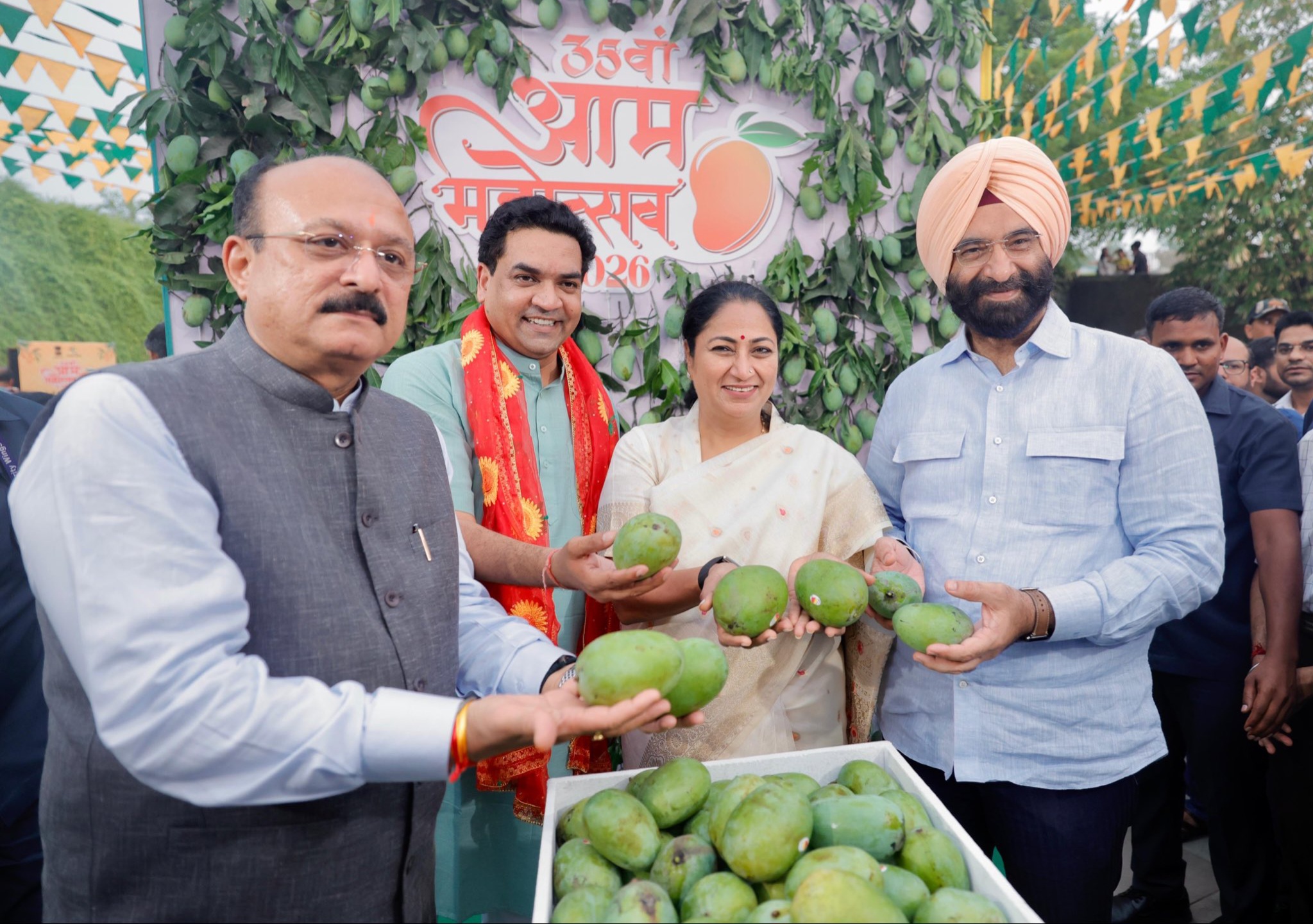
Delhi Chief Minister Rekha Gupta on Friday inaugurated the three-day 35th Annual Mango Festival 2026 at Dilli Haat, Janakpuri, saying the mango is not only the “King of Fruits” but also an emotional symbol deeply rooted in Indian culture.
Organised by the Delhi Tourism Department, the festival features more than 400 varieties of mangoes from across the country. Cabinet Ministers Kapil Mishra, Ashish Sood and Manjinder Singh Sirsa were also present.
According to the Chief Minister’s Office, CM Gupta said the mango is deeply connected with Indian culture, family traditions and countless childhood memories. She said festivals such as the Mango Festival serve as an important platform for connecting the younger generation with these cherished experiences and India’s rich cultural heritage.
Speaking at the event, the Delhi CM said bringing together a diverse range of mangoes from across the country under one roof and giving people an opportunity to taste them is a commendable initiative to promote India’s agricultural and cultural heritage. She appealed to the people of Delhi, especially children and families, to visit the festival in large numbers and take part in the celebrations.
The Chief Minister said the Indian mango is no longer merely a fruit or a gift but has become a symbol of India’s cultural identity. Owing to its superior quality and global popularity, Indian mangoes have strengthened the country’s image worldwide, she said, adding that “Mango Diplomacy” has also given a new dimension to India’s cultural and diplomatic relations across the globe.
CM Gupta also said the Delhi government’s Tourism Department is continuously working to develop the national capital into one of the country’s leading tourism and cultural destinations.
In a post on X, CM Gupta wrote, “The season of mangoes is, in truth, the season of childhood’s return. Every mango brings with it a sliver of sunshine and an afternoon from childhood. Today, along with Cabinet colleagues Ashish Sood, Manjinder Singh Sirsa and Kapil Mishra, I inaugurated the Mango Festival at Dilli Haat, Janakpuri. I urge all Delhi residents to come to this festival with their families. Just as Delhi is the confluence of all of India, the mangoes from across the country gathered here introduce India’s diversity and sweetness.”
Tourism Minister Kapil Mishra said mango growers from across the country are participating in the festival. Visitors will not only get an opportunity to taste a wide range of mangoes but will also learn about mango cultivation, production techniques and different varieties. He said the festival offers children and families a unique opportunity to enjoy mangoes while learning about them.
Mishra said that under the leadership of Prime Minister Narendra Modi and Chief Minister Rekha Gupta, Delhi is being transformed from a transit city into a major tourist destination. A Religious Tourism Circuit is being developed to promote spiritual tourism.
He said the Delhi Tourism and Transportation Development Corporation has launched double-decker bus services, while the Delhi Darshan Bus Service has also been revived. After the monsoon, an international-standard cruise experience on the Yamuna River will be introduced for residents and tourists. These initiatives, he said, will provide a new identity to Delhi tourism and offer visitors from India and abroad new attractions to explore.
The festival showcases over 400 varieties of mangoes, including Husnara, Rataul, Ramkela, Kesar, Mallika, Amrapali, Fazli, Hathi Jhool and several other renowned varieties. Some varieties are as small as grapes, while others are as large as papayas, reflecting the extraordinary diversity of mangoes found in India.
Mangoes are rich in beta-carotene, which the body converts into vitamin A, offering several health benefits.
Mango growers from various states are displaying their finest produce at the festival. Many of these varieties are the result of decades of selective breeding, grafting and experimentation by traditional farming families. The festival also highlights the contribution of agricultural scientists and horticultural institutions in conserving and developing superior and new mango varieties.
According to an official release, mango cultivation in the Indian subcontinent dates back nearly 4,000 years. India is the world’s largest producer of mangoes, accounting for nearly half of global production. Of the approximately 1,500 known mango varieties worldwide, nearly 1,000 are found in India.
The festival has drawn participation from mango growers, agricultural universities, research institutions, government departments and farmer organisations. Prominent participants include the ICAR-Indian Agricultural Research Institute (Pusa), ICAR-Central Institute for Subtropical Horticulture (Lucknow), Govind Ballabh Pant University of Agriculture and Technology (Pantnagar), Chaudhary Charan Singh Haryana Agricultural University (Hisar), the Directorate of Horticulture (Saharanpur, Uttar Pradesh), Bihar Agricultural University (Sabour, Bhagalpur), Kisan Mango Society, Earth Mango Society, Malihabad Mango Farmer Producer Company Limited, Society for Conservation of Mango Diversity, Awadh Agritech (Malihabad), and leading mango growers Tariq Mustafa, Rambir, Akhlaq Ali, Mohammad Shahid and Mohammad Junaid.
One of the festival’s most popular attractions, “Sau Hai Daam, Jitne Khao Aam” (“Pay ₹100, Eat as Many Mangoes as You Can”), continues to draw enthusiastic participation.
Visitors can also purchase fresh mangoes, processed mango products, mango-based food items and mango saplings. Separate mango-eating competitions for men and women are among the festival’s biggest attractions.
In addition, the festival features cultural performances, handicraft and artisan exhibitions, a dedicated Kids’ Zone, selfie points and a wide variety of food stalls, making it a memorable experience for the entire family.
(ANI)


