







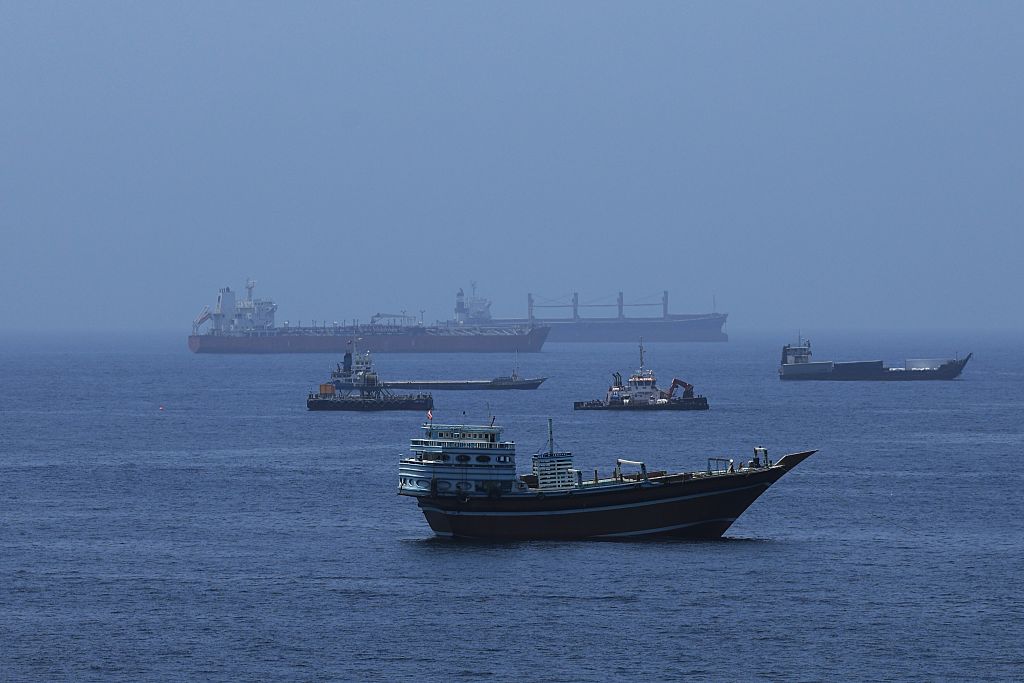
Oman has delivered a proposal to Iran envisaging regional management of the Strait of Hormuz and only voluntary fees for transit rather than Tehran’s vision of maintaining control of the waterway and charging for its use.
Control of the strait, the narrow waterway between the Gulf and the Indian Ocean that is the main route for about a fifth of world oil supplies and other vital goods, has been a main sticking point in efforts to resolve the U.S.-Iran war.
WHAT DO WE KNOW ABOUT OMAN’S NEW PROPOSAL?
A Gulf source and a Western diplomat have told Reuters the proposal was submitted to Iran over the weekend during talks in Tehran.
The proposal is for a joint regional mechanism to manage the strait with voluntary fees to help fund the cost of managing navigation, environmental protection, search and rescue and other services.
Oman’s plan is based on the existing arrangements for the Strait of Malacca linking the Indian Ocean to the Pacific, where Indonesia, Malaysia and Singapore ask ships to pay a voluntary contribution for services.
WHY HAS OMAN PROPOSED A NEW PLAN FOR HORMUZ?
Iran closed the strait, running between the Iranian and Omani coasts, as soon as the war began on February 28 with U.S. and Israeli strikes that killed its Supreme Leader Ayatollah Ali Khamenei.
As the conflict continued, it asserted what it calls a sovereign right to manage the strait and to collect fees for unspecified services alongside Oman.
An interim ceasefire deal that Iran and the United States agreed in June specifically gave Oman a role in determining arrangements for the strait.
That agreement said Iran would conduct a dialogue with Oman to define the future administration and maritime services in the strait, in discussion with other Gulf states and in line with international law.
However, while Oman had held dialogue with Iran on the issue, its only public intervention has been guidance issued in June for vessels transiting the strait through its waters that did not require fees.
WHAT DOES IRAN WANT?
Iran wants any permanent peace deal in the war to allow Tehran to demand fees for ships passing through the strait.
It has not specified how a fee structure would work, but an Iranian official told Reuters before June’s interim truce that it would depend on factors including the type and size of ship, its cargo and other unspecified conditions.
Iran regarded efforts by vessels to transit the strait near the Omani coastline during the ceasefire as a violation of the terms of the truce and fired on them.
It says all ships passing the strait must liaise with a new Persian Gulf Strait Authority that it has set up to administer transit.
Senior Iranian officials say that formalizing its control over the strait is now the most important goal for Tehran in its approach to the conflict.
DOES DONALD TRUMP STILL WANT TO CHARGE FEES FOR USING HORMUZ?
After the ceasefire broke down in July, U.S. President Donald Trump said Washington would charge for use of the Strait of Hormuz, seeking 20% of the value of all cargo shipped.
That declaration, made in a social media post, appeared to contradict his own earlier statements that Hormuz transit should be free, as well as those of other senior figures in his administration.
On June 25, U.S. Secretary of State Marco Rubio said “no country on Earth has the right to charge for the use of international waterways” and that fees for shipping would never be part of any peace deal.
Trump later said that nobody should charge a fee for using the strait, while adding that he thought it unfair the U.S. should have to pay for protecting the waterway.
WHAT WAS THE SITUATION BEFORE THE WAR AND IS IT LEGAL TO CHARGE FOR USING THE STRAIT?
The strait is made up of the territorial waters of Iran and Oman, with the maritime boundary running along the middle.
The United Nations Convention on the Law of the Sea says states bordering straits cannot demand payment simply for permission to pass through.
However, they can impose limited fees for specific services such as piloting, tugging or port services, though these may not be levied more heavily on vessels from any particular countries.
Neither Iran nor the United States is a signatory to UNCLOS, but it is widely regarded as international maritime law and Hormuz as an international strait.
In 1968, Iran and Oman agreed on a traffic scheme with the International Maritime Organization under which major vessels would use sea lanes along the middle of the strait. Iranian mine-laying during the war has now made such passage unsafe according to the IMO.
WOULD OTHER COUNTRIES ACCEPT TOLLS OR FEES?
No such unilateral move to demand fees to traverse a strait has been made in modern history, shipping industry officials said.
Gulf states, whose main access to the high seas for their vital energy exports lies through the strait, are particularly concerned about fees.
The Panama and Suez canals, which have been dug rather than occurring naturally, are treated differently than straits.
The Turkish Straits – the Bosphorus, Sea of Marmara and the Dardanelles between the Black Sea and Mediterranean – are governed by the 1936 Montreux Convention guaranteeing free passage for merchant vessels in peacetime.
That convention allows Turkey to levy standardised charges to cover the cost of services but does not allow it to impose a general transit fee.
Singapore does not charge a fee to transit the Singapore Strait.
(Reuters)


