







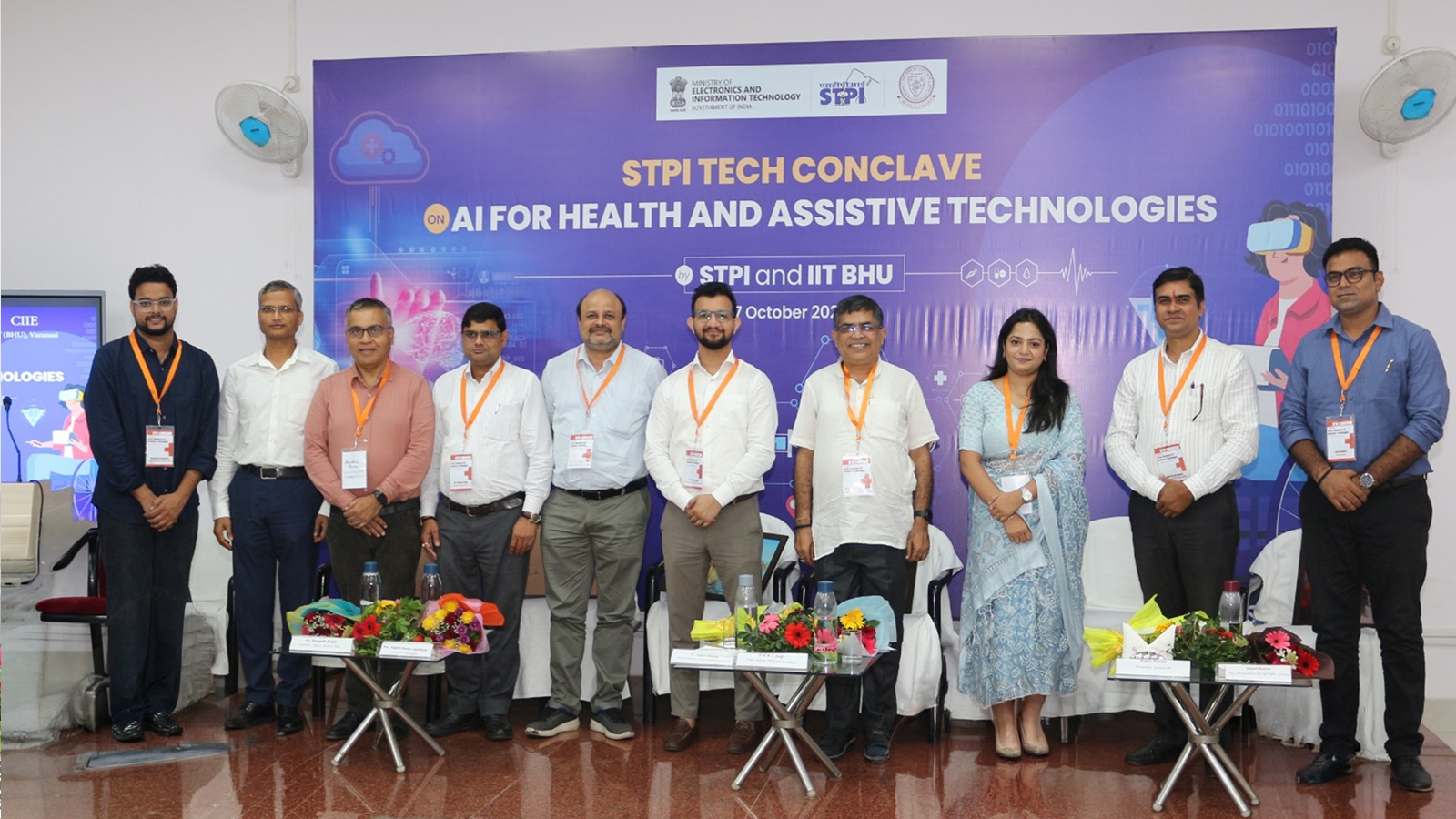
Artificial intelligence can improve healthcare access, clinical decision-making and service delivery, particularly for underserved communities, Electronics and Information Technology Secretary S. Krishnan said at a tech conclave in Varanasi.
The programme, titled “AI for Health & Assistive Technologies”, was organised at IIT BHU by Software Technology Parks of India (STPI) and the institute’s Centre for Innovation, Incubation and Entrepreneurship (CIIE). It brought together government representatives, academics, healthcare professionals and startups to examine practical applications of AI in health, accessibility and inclusion.
Delivering the keynote address, Krishnan highlighted applications including disease screening, medical diagnostics, remote ICU monitoring and AI-assisted surgical planning. He said these technologies could help improve healthcare accessibility, affordability and quality.
He called for AI education across disciplines and closer collaboration among technology specialists, medical researchers, industry and startups to develop scalable healthcare and assistive solutions.
Krishnan also highlighted support available through the IndiaAI Mission and other MeitY initiatives, alongside STPI’s role in connecting startups with investors, venture capital networks and market opportunities.
STPI Director General Arvind Kumar said India had an opportunity to build on its IT and IT-enabled services experience to advance indigenous AI innovation and entrepreneurship.
Recalling STPI’s role in supporting the technology industry since 1991, Kumar said the startup ecosystem now enabled young innovators to become job creators. He highlighted the organisation’s industry connections and 27 Centres of Entrepreneurship, stressing the importance of translating research into products, creating intellectual property and securing market access.
He also called for stronger startup ecosystems beyond established technology hubs through partnerships among academic institutions, industry and government.
IIT BHU Director Professor Amit Patra outlined the institute’s efforts to support entrepreneurship through CIIE. He emphasised a structured framework to help students, faculty and aspiring innovators turn ideas into viable businesses, supported by access to multiple funding sources.
Uttar Pradesh Startup Mission CEO Sumit Mahajan and Professor Mallika Tiwari of the Department of Oncology at the Institute of Medical Sciences, BHU, also addressed the inaugural session. CIIE Faculty In-Charge Professor Manoj Kumar Meshram delivered the welcome remarks.
The conclave featured two panel discussions: “Empowering Citizens Through AI: Health, Inclusion & Well-being” and “From Innovation to Impact: Translating AI Research into Scalable Healthcare & Assistive Solutions”.
The first examined how multidisciplinary research and entrepreneurship could support accessible, inclusive healthcare. Participants included Meshram; IIT BHU faculty members Sanjay Kumar Singh, Avanish Singh Parmar, Shiru Sharma and Ruchi Chawla; Arkision AI founder Shahbaz Ahmad; and STPI Additional Director Amit Kumar Verma.
The second panel explored how promising research could progress towards practical deployment. It featured MeitY Director Rajeshwar Singh Jenwar, IMS-BHU’s Akash Mishra, BioNest BHU Scientific Officer Durgesh Narayan Singh, LeminAi founder Tripti Verma and Shyam Kumar, chief operating officer of STPI’s MedTech Centre of Entrepreneurship at SGPGIMS, Lucknow.
STPI Lucknow Additional Director and Officer-in-Charge Praveen Kumar Dwivedi delivered the vote of thanks.
STPI, an organisation under MeitY, promotes the IT and IT-enabled services industry, research, startups and product development across emerging technologies. The conclave emphasised sustained collaboration to develop responsible, scalable healthcare and assistive technologies addressing societal needs.


