







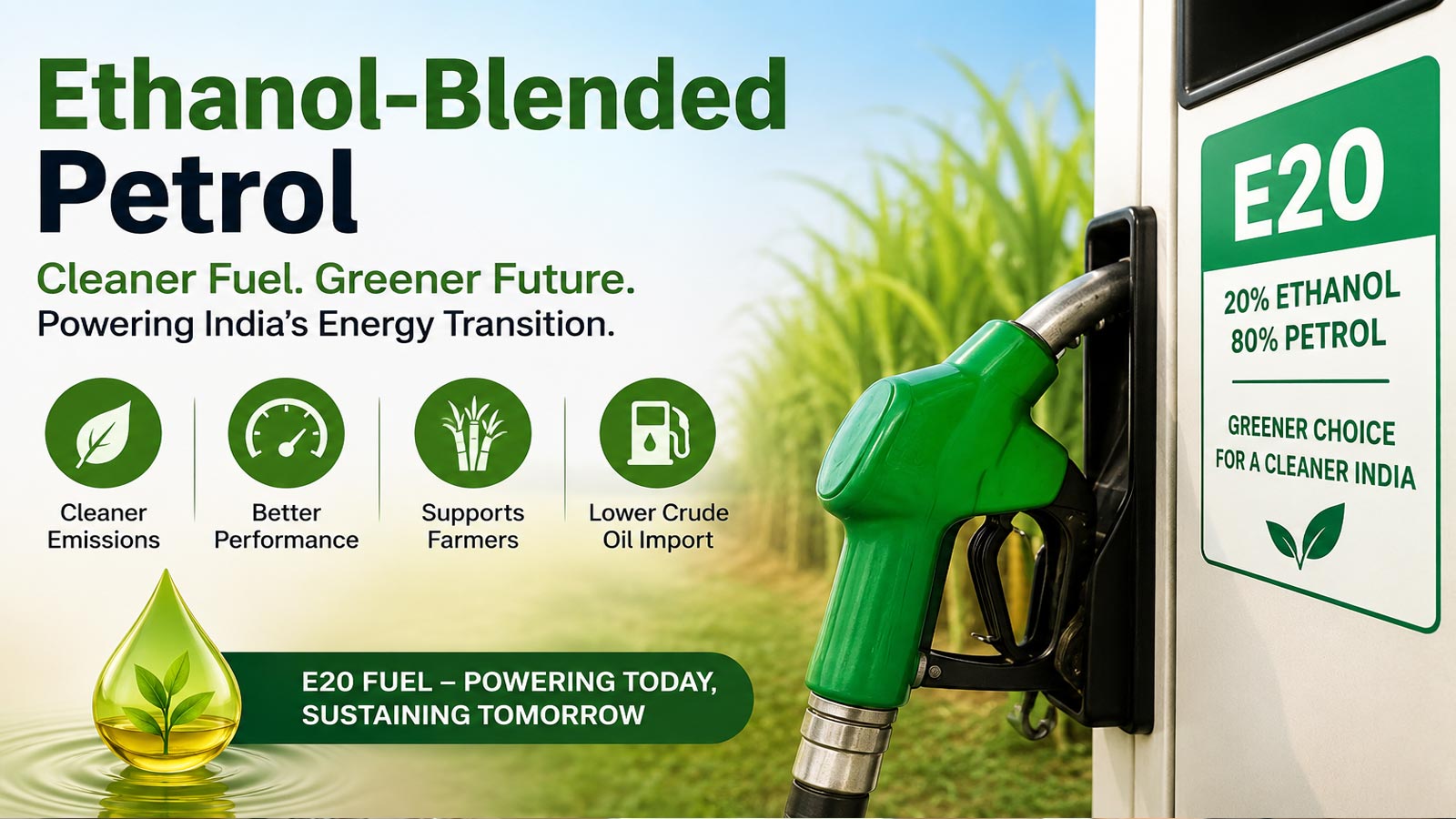
The Centre has issued a detailed clarification on the Ethanol Blended Petrol (EBP) Programme, rebutting what it described as misleading claims circulating in the media and on social media regarding the use of E20 fuel. The government said the programme is backed by extensive scientific validation, real-world operating experience, industry data and consultations with automobile manufacturers and technical institutions.
According to the Ministry of Petroleum & Natural Gas (MoPNG), the rollout of higher ethanol blends has been gradual and carefully calibrated, following years of laboratory testing, field trials and stakeholder consultations. It maintained that there is no verified evidence of widespread engine damage or vehicle failures caused by E20 fuel.
Gradual Rollout of Ethanol Blending
The Ministry highlighted that ethanol blending in petrol has steadily increased over the years after developing the necessary production capacity, infrastructure and regulatory framework. While the average blending level stood at around 1.53 per cent in 2013-14, it rose to about 8.1 per cent in 2020-21, 10 per cent in 2021-22, 12 per cent in 2022-23, 14.6 per cent in 2023-24 and 19.2 per cent in 2024-25. During the period from November 2025 to June 2026, the average blending reached 20 per cent.
The Ethanol Blended Petrol Programme itself began with a pilot project in 2001, followed by the introduction of E5 fuel in 2006. The Ministry noted that ethanol has been used globally for more than a century, with countries such as Brazil operating vehicles on even higher ethanol blends for decades.
No Evidence of Widespread Vehicle Damage
Responding to claims that vehicles manufactured before 2023 cannot safely operate on E20 petrol, the Ministry said E15-plus fuel has been in widespread use for more than three and a half years, while E19-E20 fuel has been available for over two and a half years.
During this period, India has not witnessed any verified cases of widespread engine failures or vehicle breakdowns attributable to ethanol blending. It argued that if E20 had been causing systemic damage, the country would have experienced large-scale warranty claims, service campaigns and consumer complaints, none of which have been reported.
The Ministry’s assessment is based on extensive field experience involving nearly eight crore vehicles visiting fuel retail outlets every day, of which around 80 per cent are petrol vehicles.
Manufacturer Data Supports E20 Compatibility
The clarification cites manufacturer service data as a key basis for its assessment. A leading automobile manufacturer serviced 2.84 crore vehicles during FY 2025-26, including nearly 1.5 crore vehicles that were not originally certified as E20-compatible, and reported no E20-related corrosion, abnormal wear or reduction in component life.
Another manufacturer tracked 1.4 crore vehicles operating on E20 fuel over an extended period and similarly found no evidence of ethanol-induced corrosion. A leading two-wheeler manufacturer also reported comparable field experience.
The Ministry said manufacturers continue to honour vehicle warranties for E20 fuel, reflecting their confidence in the compatibility of the fuel with existing vehicles.
Scientific Evaluation Before Rollout
According to the Ministry, higher ethanol blends were introduced only after extensive consultations involving automobile manufacturers, the Society of Indian Automobile Manufacturers (SIAM), the Automotive Research Association of India (ARAI), component manufacturers, testing agencies and Oil Marketing Companies.
Material compatibility, engine calibration, drivability, durability, emissions, fuel systems and overall vehicle performance were scientifically evaluated before implementation. ARAI reaffirmed that E20-compatible vehicles undergo internationally accepted validation procedures before entering the market.
The Ministry also noted that Oil Marketing Companies conduct quality checks throughout the supply chain and carry out more than 30,000 retail outlet inspections to ensure fuel quality and prevent adulteration. Ethanol-blended petrol supplied in the country conforms to Bureau of Indian Standards (BIS) specifications.
MoPNG Rejects Claims That Older Vehicles Will Become Unusable
The Ministry also dismissed claims that nearly 30 crore vehicles would become unusable because of E20 fuel. It pointed out that more than 20 crore two-wheelers and over three crore petrol cars have already been operating on E15-plus and E20 fuels without any verified evidence of widespread failures linked to ethanol blending.
It maintained that if E20 rendered vehicles unusable, India would have witnessed millions of breakdowns, large-scale warranty claims and extensive service campaigns, none of which have occurred.
Automobile Industry Reaffirms Support
The clarification referred to a joint press conference held on July 4, 2026 by the Ministries of Petroleum and Natural Gas, Heavy Industries and Road Transport and Highways, during which senior executives from Toyota Kirloskar, Maruti Suzuki, Hero MotoCorp, Hyundai Motor India, TVS Motor Company and Bajaj Auto addressed concerns related to E20.
According to the Ministry, the automobile manufacturers unanimously stated that E20 was introduced only after rigorous testing and scientific validation.
Toyota Kirloskar described ethanol as a clean, high-performance fuel that has been used globally for decades and said testing followed internationally recognised UNECE standards. Maruti Suzuki said its analysis of 2.84 crore serviced vehicles showed no evidence of E20-related corrosion, abnormal wear or reduction in component life, including in older vehicles. Hero MotoCorp similarly stated that its service data revealed no higher incidence of damage in two-wheelers operating on E20 fuel.
Hyundai Motor India, TVS Motor Company and Bajaj Auto also reiterated their confidence in the E20 programme and reaffirmed their commitment to addressing consumer concerns transparently.
Mileage Impact Limited
Addressing concerns over fuel economy, the Ministry said vehicle mileage depends on several factors, including driving habits, traffic conditions, tyre pressure, maintenance and air-conditioner usage.
For certain older vehicles originally designed for E10 fuel, any reduction in fuel economy is generally limited to around 3 to 5 per cent, significantly lower than claims circulating on social media.
The Ministry added that E20 fuel offers several advantages, including a higher octane rating, improved anti-knock characteristics, cleaner combustion, smoother engine performance, and better acceleration and ride quality.
Manufacturers Not Under Pressure
Rejecting allegations that automobile companies are being compelled to support E20, the Ministry said manufacturers are independent listed companies with legal and regulatory obligations towards consumers.
It said that companies could not conceal widespread vehicle defects without exposing themselves to warranty claims, regulatory action, product liability and reputational damage. The continued honouring of warranty claims for vehicles using specification-compliant E20 fuel, it said, reflects engineering validation and extensive field experience rather than any external pressure.
The Ministry reiterated that its assessment is based on more than 25 years of phased implementation, scientific studies, consultations with industry stakeholders, manufacturer service records, continuous quality monitoring and operational experience across crores of vehicles. It added that claims circulating on social media are routinely examined in consultation with manufacturers and technical agencies, and many have been found to be exaggerated, misleading or unsupported by technical evidence.


