







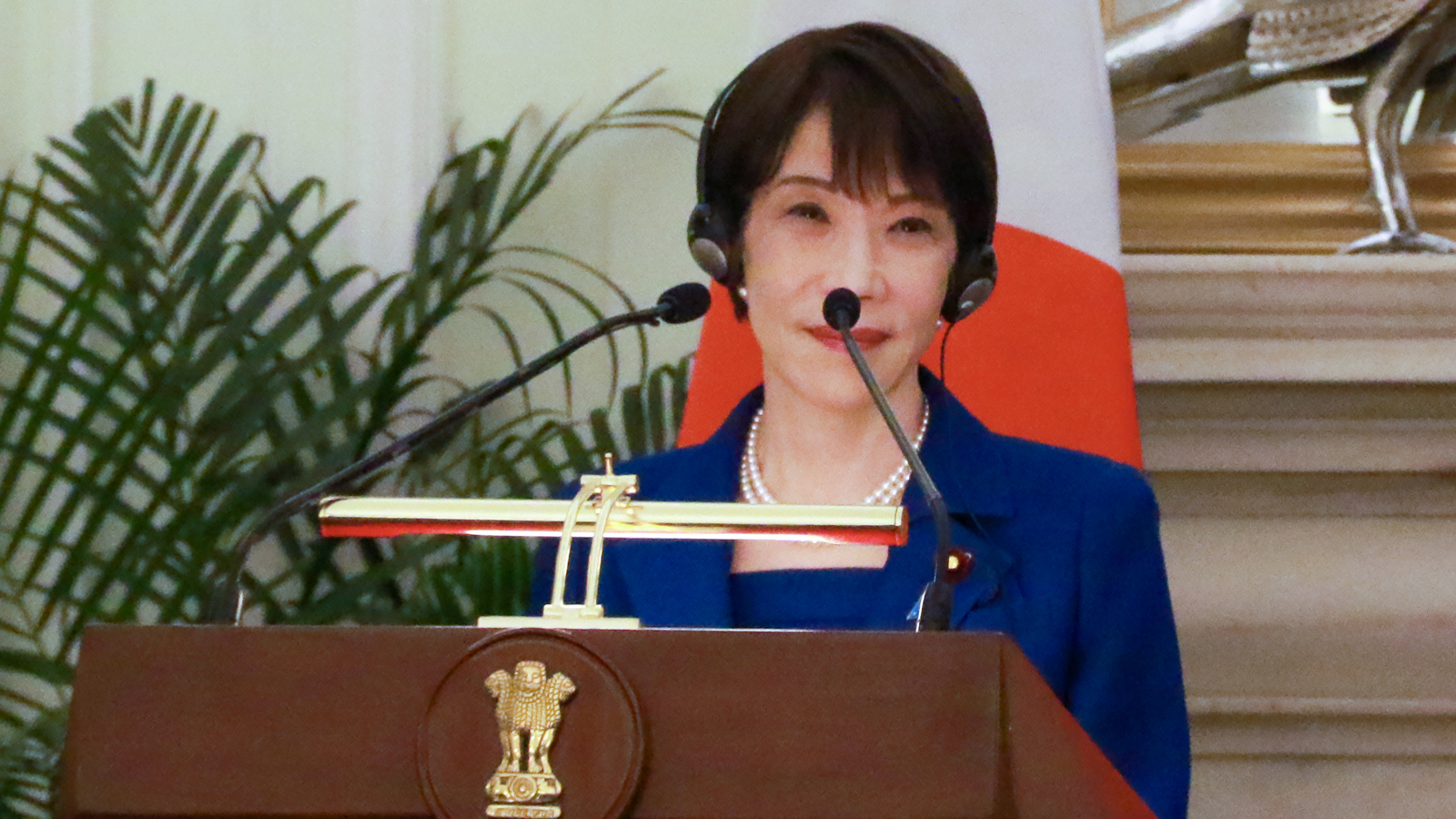
Japanese Prime Minister Sanae Takaichi on Thursday underscored the importance of deepening strategic cooperation with India, saying that a “free, prosperous, and rules-based Indo-Pacific” remains a shared priority for both countries. She also said that Prime Minister Narendra Modi’s MAHASAGAR initiative is closely aligned with Japan’s updated Free and Open Indo-Pacific (FOIP) policy.
Addressing a joint press statement with PM Modi after the 16th India-Japan Annual Summit in New Delhi, Takaichi said, “Today, both India and Japan are among the world’s largest economies. A free, prosperous, and rules-based Indo-Pacific is our shared priority. As the region’s largest democratic and market economies, we have undertaken several significant initiatives today. Together, these will pave the way for peace, stability, and progress across the entire region.”
Referring to PM Modi’s warm remarks during the summit, Takaichi said the two leaders had reaffirmed their close personal rapport and shared strategic outlook.
“You called me a beautiful younger sister, Prime Minister Modi. But at the small meeting before the big meeting, we confirmed that we are on the same page and develop this relationship as brother and sister. Japan and India must leverage our respective strengths to become stronger and more prosperous together in the midst of international affairs in disarray. The establishment of such inter-complementary cooperative relationship has become ever more important,” she said.
Highlighting maritime cooperation, Takaichi said India’s MAHASAGAR (Mutual and Holistic Advancement for Security and Growth Across Regions) initiative complements Japan’s updated FOIP vision.
“Prime Minister Modi positions the ocean as a shared space that supports regional stability and growth and is promoting the MAHASAGAR, the Great Ocean Initiative for countries across the Indian Ocean to defend their sovereignty and the sea through their own efforts, is perfectly aligned with FOIP (Free and Open Indo-Pacific policy). Thus, we agreed to deepen the strategic cooperation between Japan and India to achieve such common goals. Expansion of maritime security cooperation is especially important for regional peace and stability,” she said.
Takaichi said the two leaders agreed to place three priorities at the centre of bilateral cooperation, beginning with strengthening strategic and security ties.
“From such perspective, as Prime Minister Modi and I engaged in discussions over diverse issues, we again were reminded of the many goals we share. And we confirmed to place the following three points at the center of our cooperation. First, to deepen the strategic cooperation between Japan and India. Our two countries share their vision on the profile of international order we should establish under the current international situation. I recently announced the updated FOIP, Free and Open Indo-Pacific, which focuses on self-reliance and resilience to realize FOIP,” she said.
On defence cooperation, the Japanese Prime Minister announced plans to expand military engagement and institutional dialogue.
“Taking the opportunity of our visit, a destroyer of Japan’s Maritime Self-Defense Force and an Indian Navy vessel are planning to engage in a joint exercise. We will enhance exercises in the Indian Ocean, promote naval maintenance, repair and overhaul cooperation, and strengthen equipment cooperation under the Make in India framework. In order to deepen such cooperation, I have instructed the relevant departments to hold discussions and to organize the next Japan-India 2+2 before the end of the year,” she said.
Takaichi also highlighted the growing importance of economic security and resilient supply chains amid global uncertainties.
“Second, promotion of Japan-India cooperation in the area of economic security and energy security. As both countries face challenges such as economic weaponization and non-market practices, we need to urgently build resilience in our critical minerals supply chains,” she said.
“Further, in the area of energy security impacted by the Middle East situation, both Japan and India bear the responsibility to provide for region-wide energy security, as I presented in Power Asia. That is why we have released a document for public and private sectors, joint statement to engage in concrete action for economic security cooperation,” Takaichi added.
Speaking about clean energy cooperation, the Japanese PM announced a new bilateral initiative to support India’s renewable energy ambitions.
“Under the Power Asia initiative, we will launch a bilateral dialogue to strengthen India’s petroleum stockpiling system. Japan also supports India’s membership of the IEA. In the area of energy transition, India has set a goal of leveraging cooperatives to secure energy from cow faeces to build 1,000 biogas plants. In order to contribute to its achievement, we are launching the Japan-India Cooperative Biogas for Growth, or CBG, that was introduced by Prime Minister Modi,” she said.
Focusing on investment and innovation, Takaichi said both countries share the vision of building stronger economies through future-oriented investments.
“The third is co-creation of economic growth of both India and Japan through investment and innovation collaboration. This is economic growth. I am committed to realizing a strong economy and aiming to enhance Japan’s supply capability and technological capabilities through investment in 17 strategic areas. Prime Minister Modi launched Viksit Bharat, a national goal to become a developed nation by 2047, and it’s strongly driving India’s growth. In this way, we share the goal of making our countries strong and prosperous through investments in the future,” she said.
She noted that Japanese businesses are making substantial investments in India and expressed confidence that public-private collaboration would further strengthen bilateral economic ties.
“Strongly supporting our two countries to achieve such common goals are the business community representatives who are participating in the delegation from Japan. During this visit, around 120 cooperation documents between Indian and Japanese companies, including 2 trillion-yen scale investment, were announced. It is a desire to forge a path for future in India and Japan through unified efforts of public and private sectors,” Takaichi said.
Looking ahead to the 75th anniversary of diplomatic relations next year, she said both countries would further deepen people-to-people ties under their Special Strategic and Global Partnership.
“Next year marks the 75th anniversary of diplomatic relations and would like to seize this opportunity to further bring closer together the people of our two countries. Under the India-Japan Special Strategic Global Partnership, as trusted partners that share strategic direction, together with my bigger brother, Prime Minister Modi, I will lead the India-Japan relations going forward to a new phase. I look forward to welcoming Prime Minister Modi in Japan next time,” Takaichi said.
In a post on X, Ministry of External Affairs (MEA) spokesperson Randhir Jaiswal said that PM Modi and Takaichi held wide-ranging talks covering trade and investment, economic security, energy, emerging technologies, defence and people-to-people exchanges. The two leaders also exchanged views on regional and global developments of mutual interest.
Following the summit, the two countries adopted three landmark documents – a Joint Declaration on Economic Security, a Joint Statement on Cooperation in the field of Artificial Intelligence, and a Joint Statement on Energy Resilience. The leaders also witnessed the exchange of several memoranda of understanding and agreements spanning economic security, clean energy, critical technologies, research and development, while agreeing on a roadmap of activities to mark the 75th anniversary of India-Japan diplomatic relations next year.
(With ANI inputs)


