







India’s toy industry is undergoing a remarkable transformation, evolving from a sector rooted in centuries-old craftsmanship into a globally competitive manufacturing ecosystem driven by innovation, exports and policy support.
Blending traditional artistry with modern technology, the industry is steadily emerging as an important contributor to manufacturing, employment and exports, supported by a series of government initiatives aimed at promoting indigenous production, improving quality standards and expanding global market access.
With a rich heritage dating back nearly 5,000 years, India’s toy-making tradition traces its origins to the Indus Valley Civilisation, where excavations at Harappa and Mohenjo-Daro unearthed clay carts, figurines and handcrafted toys that reflected the creativity and ingenuity of ancient Indian artisans. Over the centuries, wooden figurines, dolls inspired by the Ramayana and Mahabharata, and handcrafted toys became an integral part of India’s cultural landscape, preserving traditions while supporting artisan communities across the country.
Today, that legacy is being complemented by advances in design, manufacturing and digital technology, positioning India as an emerging global hub for quality toys.
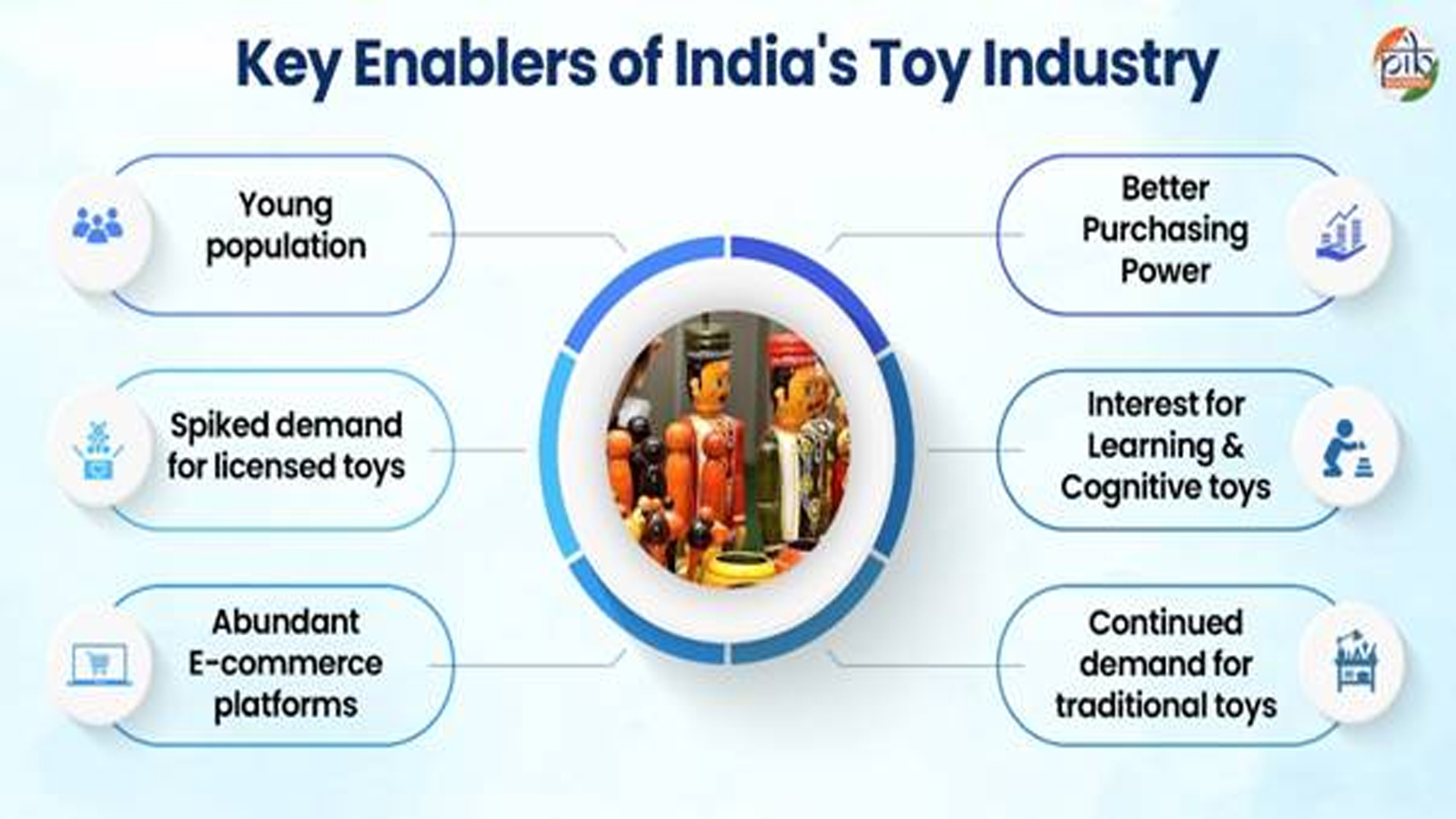
The sector is benefiting from strong domestic demand driven by India’s young population, rising disposable incomes and increasing preference for educational and skill-development toys. Parents are increasingly opting for STEM (Science, Technology, Engineering and Mathematics)-based products that promote creativity, problem-solving and cognitive development, while rapid urbanisation and changing lifestyles have expanded demand for innovative and licensed toys.
Technology is also reshaping the industry, with manufacturers increasingly exploring smart toys incorporating artificial intelligence, augmented reality and virtual reality to cater to evolving consumer preferences.
Government policy interventions have played a key role in accelerating the sector’s growth. The National Action Plan for Toys (NAPT), launched in 2020, seeks to promote toys based on Indian culture, values and history while encouraging their use as learning tools. The initiative also supports indigenous toy clusters, strengthens local manufacturing and promotes higher quality standards.
One of the major reforms under the policy was the introduction of the Quality Control Order (QCO) for toys, making Bureau of Indian Standards (BIS) certification mandatory for both domestic and imported toys. As of May 2026, BIS had granted 1,786 licences to domestic manufacturers and 56 licences to foreign manufacturers under Indian toy safety standards. The policy exempts products made by registered artisans and authorised users of Geographical Indication (GI)-tagged products, ensuring that traditional crafts continue to flourish.
Alongside quality reforms, customs duties on imported toys were increased from 20 per cent to 60 per cent in 2020 and later to 70 per cent in 2023, while the tariff on parts of electronic toys was revised to 20 per cent in the Union Budget for 2025-26. These measures have reduced the price advantage of imported toys and encouraged greater domestic manufacturing.
The impact of these initiatives is reflected in India’s growing export performance.
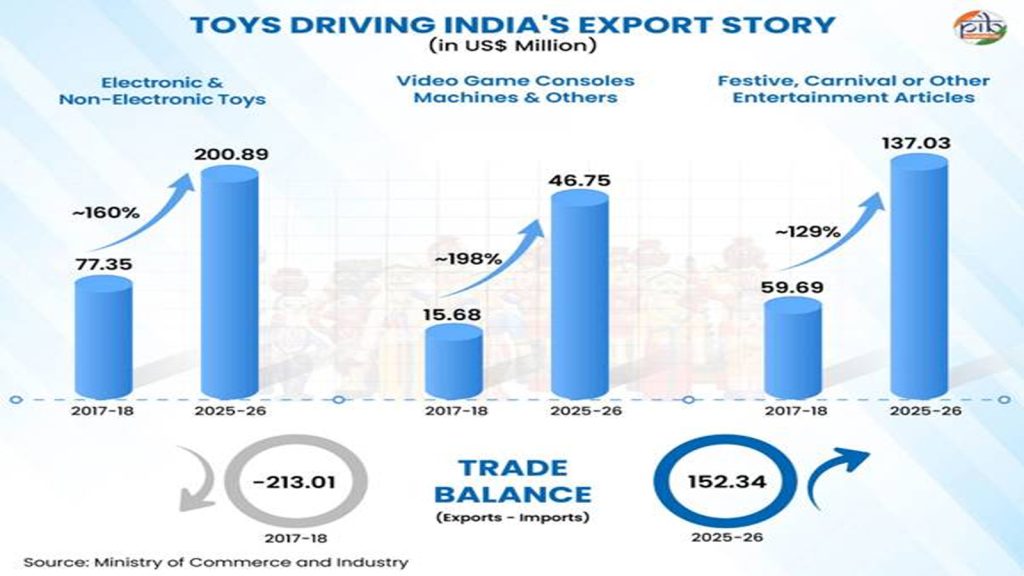
Overall toy exports across key categories (HSN 9503, 9504 and 9505) increased from US$152.7 million in 2017-18 to US$384.7 million in 2025-26, registering growth of more than 151.9 per cent.
Exports of electronic and non-electronic toys nearly tripled during the period, rising from US$77.35 million to US$200.89 million, with the United States emerging as the largest export destination. Other important markets include the United Kingdom, Poland, the Netherlands and Germany.
Exports of video game consoles and related products also recorded significant growth, increasing from US$15.68 million to US$46.75 million, while exports of festive and entertainment articles expanded from US$59.69 million to US$137.03 million.
At the same time, imports of traditional and educational toys declined sharply by 66 per cent, strengthening domestic manufacturing. India recorded a trade surplus of US$152 million in 2025-26 across major toy categories, marking a significant turnaround from the US$213.01 million trade deficit recorded in 2017-18.
The industry’s economic contribution extends beyond exports. Employment in the Games and Toys sector (NIC Code 324) more than doubled from 8,685 workers in 2018-19 to 17,693 in 2023-24, highlighting its growing role in supporting entrepreneurship, artisans, MSMEs and rural livelihoods.
Several government initiatives have further strengthened the ecosystem.
The annual Toy Biz International B2B Exhibition has emerged as one of the country’s largest platforms for connecting manufacturers with domestic and international buyers.
The Toycathon, launched in 2021, encourages students, designers, startups and educators to develop innovative toys inspired by Indian culture and heritage. Building on this initiative, the Government organised the first Electronic Toy Hackathon (e-Toycathon) in 2025 to promote indigenous electronic toy development.
To strengthen the electronic toy segment, the Ministry of Electronics and Information Technology established the e-Toys Lab at C-DAC, Noida, where young engineers receive specialised training in electronic toy design, prototype development and product testing.
Quality awareness has also been enhanced through initiatives such as Manak Manthan, organised by the Bureau of Indian Standards in April 2026 to promote adoption of updated Indian toy safety standards.
Traditional toys continue to receive institutional support through the One District One Product (ODOP) initiative, which promotes district-specific products by improving branding, packaging, technology adoption, exports and market access. Several indigenous toys have also received Geographical Indication (GI) status, including Channapatna toys and dolls from Karnataka, Leather Toys of Indore and the Thanjavur Doll of Tamil Nadu, helping preserve traditional craftsmanship while creating new economic opportunities for artisans.
Policy measures have also improved affordability and market access. The reduction of GST on toys from 12 per cent to 5 per cent has made toys more affordable while encouraging greater adoption of educational toys.
India’s expanding network of Free Trade Agreements, including agreements with the UAE, Australia, EFTA countries, New Zealand, Oman and the United Kingdom, now provides zero-duty market access for Indian toy exports in partner countries.
Additionally, the Districts as Export Hubs (DEH) initiative has identified more than ten districts with toy and doll export potential, helping strengthen local industries and expand export opportunities.
As India’s toy industry continues to blend traditional craftsmanship with modern innovation, it is steadily strengthening its position in global markets while preserving the country’s centuries-old legacy of play. Backed by sustained policy support, growing exports and rising domestic manufacturing, the sector is increasingly emerging as an important pillar of India’s manufacturing and export ecosystem.


