







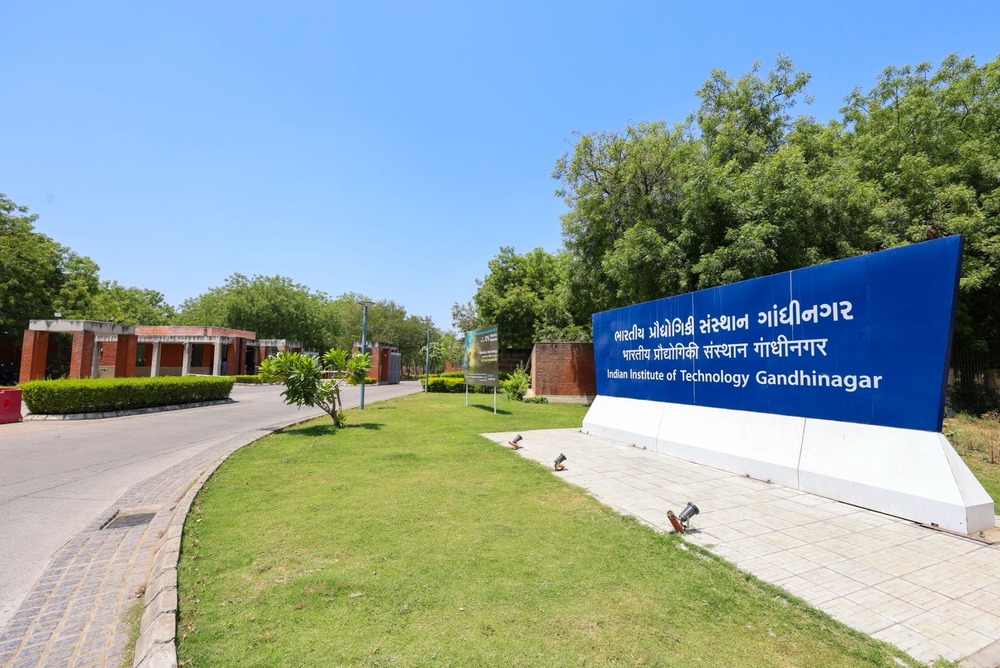
Gujarat is set to establish a dedicated semiconductor research and training centre at the Indian Institute of Technology (IIT) Gandhinagar with an investment of Rs 190 crore, as part of efforts to develop a skilled workforce for India’s expanding semiconductor industry.
The Silicon and Advanced Semiconductor Manufacturing Research and Training Hub (SAMARTH) is being funded by the Union Ministry of Electronics and Information Technology (MeitY), the Gujarat government’s Department of Science and Technology and IIT Gandhinagar. The facility is expected to become operational soon.
The centre will provide advanced research infrastructure and industry-oriented training for engineering students, faculty members and professionals, supporting India’s semiconductor manufacturing ambitions and strengthening Gujarat’s position as a key hub for the sector.
IIT Gandhinagar has initiated the procurement of equipment and the appointment of consultants for the construction of the facility and related infrastructure.
According to the state government, SAMARTH has been conceived to support the country’s goal of achieving self-reliance in semiconductor manufacturing through research, innovation and skill development.
The hub will focus on research and development while equipping engineering students with practical, industry-oriented training to make them “fab-ready” for employment in semiconductor fabrication facilities.
Faculty members and industry professionals will also have access to upskilling programmes, while outreach initiatives will introduce school and college students to opportunities in the semiconductor sector at an early stage.
The centre is expected to collaborate with national and international partners in research, training and workforce development. IIT Gandhinagar is also preparing to sign memorandums of understanding (MoUs) with engineering colleges across Gujarat to expand participation. Students from these institutions will be able to enrol in training programmes at nominal fees.
In addition to regular training, SAMARTH will offer specialised short-term certificate courses, summer schools and outreach programmes to familiarise students with semiconductor technologies and related career opportunities.
Over the next five years, the centre aims to train more than 10,000 individuals, including 5,600 undergraduate, postgraduate and doctoral students, 1,500 vocational and technical education trainees, 1,000 participants in certificate programmes, 230 faculty members and 230 industry professionals through upskilling initiatives. More than 2,700 school and college students are also expected to participate in summer schools and one-day exposure programmes.
The facility will house laboratories for nano-fabrication, CMOS process training, semiconductor process and device design, device modelling, integrated circuit (IC) design and prototyping. It will also include a device process characterisation laboratory for testing, inspection and quality assessment of electronic devices and semiconductor manufacturing processes.
Highlighting the broader vision for the sector, Prime Minister Narendra Modi had said, “Our goal is not limited to setting up just one factory, but to build an entire ecosystem. India is now focusing on the entire semiconductor value chain, from design engineers to machine manufacturers and logistics. The announcement of the ‘India Semiconductor Mission 2.0’ is a major step in this direction. As production increases, the demand for materials and components within India will also rise, creating the biggest opportunity for domestic industries.”
(With inputs from IANS)


