








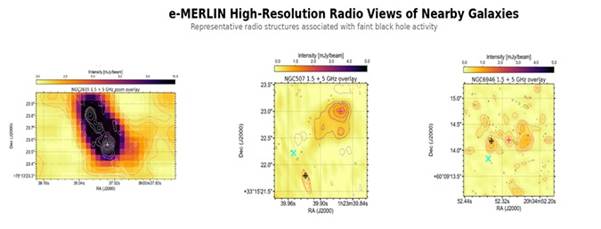
An international team of astronomers, including researchers from the Indian Institute of Astrophysics (IIA), has uncovered a hidden population of weakly active supermassive black holes in nearby galaxies using high-resolution radio observations, offering fresh insights into how galaxies evolve over time.
According to the Department of Science and Technology (DST), the findings are based on one of the first statistically complete high-resolution radio surveys capable of detecting faint black hole activity that has remained largely invisible in conventional observations.
The study, published in the Monthly Notices of the Royal Astronomical Society, involved observations of 280 nearby galaxies selected from the Palomar sample using the e-MERLIN radio array, a network of seven radio telescopes across the United Kingdom functioning as a single high-resolution interferometer.
The research team included Dr. Aru Beri of the Indian Institute of Astrophysics, an autonomous institute under the Department of Science and Technology.
According to the ministry, astronomers detected compact radio emissions from the centres of nearly one-quarter of the galaxies, indicating the presence of weakly accreting supermassive black holes that often escape detection through traditional observing techniques. While most of the detected sources appeared highly compact, some exhibited jet-like radio structures extending several parsecs from the galactic centre.
Scientists believe that almost every galaxy hosts a supermassive black hole at its core. However, many of these black holes remain extremely faint, making them difficult to identify despite their important role in influencing galaxy evolution.
The study notes that these hidden black holes inject energy into their surroundings through jets and outflows, affecting star formation rates and the long-term development of galaxies.
To validate the radio observations, researchers combined them with X-ray data from NASA’s Chandra X-ray Observatory. The multi-wavelength analysis confirmed that the detected emissions originated from actively accreting supermassive black holes rather than other astrophysical sources such as star-forming regions, supernova remnants or X-ray binary systems.
According to the researchers, the findings suggest that low-level black hole activity may be the dominant mode of black hole growth in the present-day Universe. The study also highlights the growing importance of high-resolution radio astronomy in uncovering a previously hidden population of faint active black holes.


