







India has highlighted the transformative role of artificial intelligence (AI) in global counter-terrorism efforts, stressing that the technology is rapidly reshaping both terrorist threats and the response mechanisms of governments.
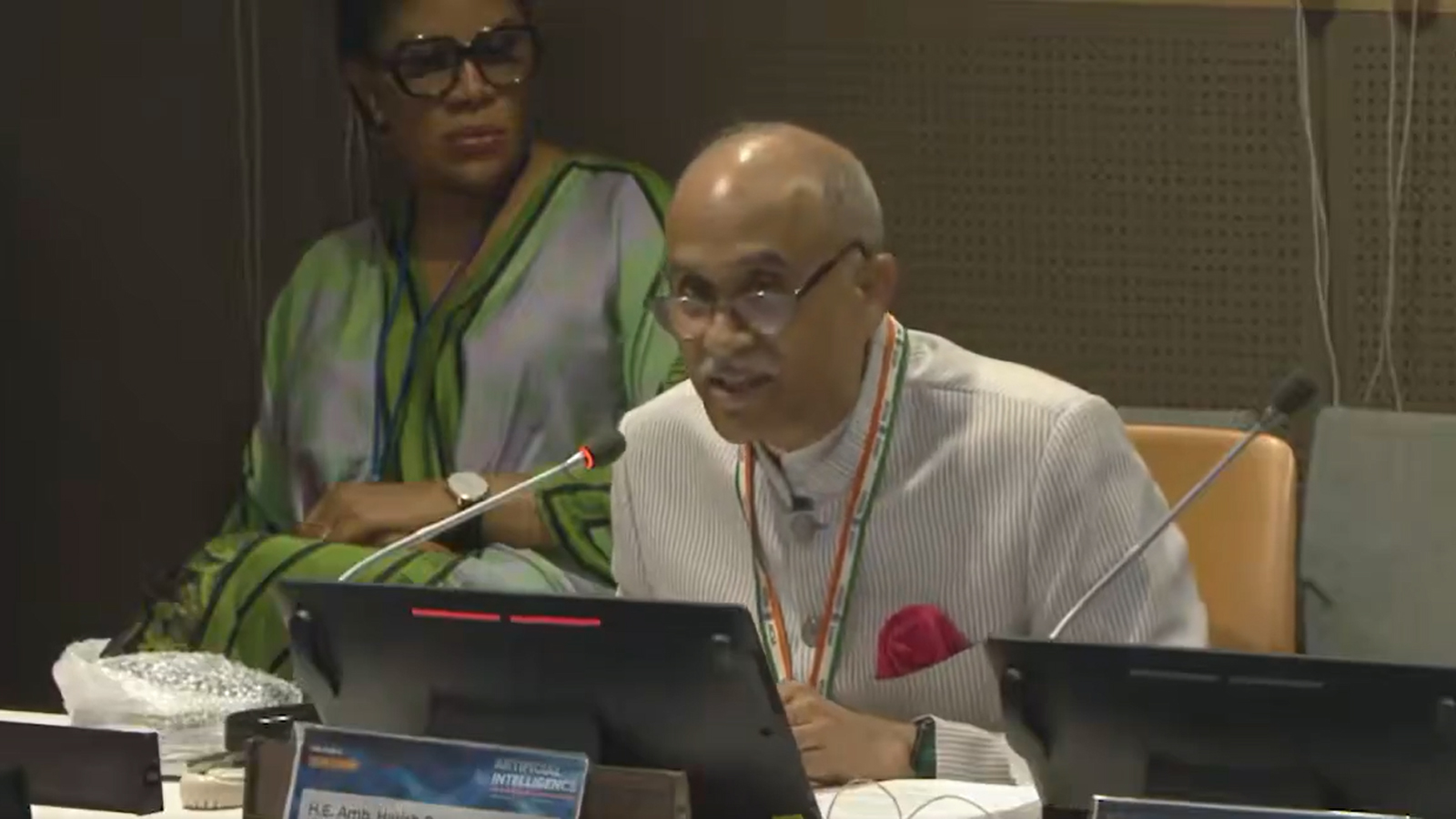
India’s Permanent Representative to the United Nations Ambassador Parvathaneni Harish on Wednesday addressed a side event titled “AI and the Future of Counter-Terrorism: Reshaping Institutions and Operational Realities” during the UN Counter-Terrorism Week.
In a post on X, he said, “Pleased to cohost a side-event on AI and the Future of Counter-Terrorism with UAE Mission to the UN, Japanese Mission UN, EU at UN-NY, United Nations Office of Counter-Terrorism and UNICRI. Noted that AI has changed Counter Terrorism in just 6 months, from countering deepfake propaganda to predictive intel & smarter borders. It’s now a fight over data, speed, trust & governance. Disappointing the GCTS review couldn’t agree on this, but the Delhi Declaration on countering the use of new and emerging technologies for terrorist purposes points the way forward. Security can’t be an afterthought.”
Speaking at the event, Harish noted that while six months may appear to be a short period in conventional domains, it represents a significant span in the rapidly evolving field of artificial intelligence. He said the partnership on AI and counter-terrorism has expanded since the group’s previous meeting in December to include Japan, the European Union and other partners, reflecting the growing importance of the issue within the United Nations.
Referring to AI-generated analysis of developments over the past six months, Harish said the technology has changed the operating assumptions of counter-terrorism agencies, which now view AI both as a threat multiplier for terrorists and a capability multiplier for states.
He said generative AI is enabling extremist groups to produce propaganda at scale, create deepfakes, tailor recruitment material, spread misinformation, translate content across languages and accelerate online radicalisation. At the same time, AI is making counter-terrorism efforts more predictive and data-driven by enabling machine-assisted pattern detection, while also supporting applications such as facial recognition, biometric identification, border screening, surveillance of public spaces, predictive policing and the protection of critical infrastructure.
The ambassador highlighted that AI is transforming counter-terrorism from “a contest over networks and narratives into a contest over data, speed, trust and governance,” adding that the challenge for security agencies will continue to grow as terrorist groups increasingly adopt and exploit emerging technologies.
Harish also expressed disappointment that the Ninth Review of the United Nations Global Counter-Terrorism Strategy (GCTS) failed to reach consensus on language relating to AI, resulting in what he described as a technical rollover of the strategy.
He, however, pointed to the Delhi Declaration on countering the use of new and emerging technologies for terrorist purposes as a key framework guiding future international efforts. He noted that two pillars of the declaration have already been taken forward by the UAE and Algeria, while India hopes to operationalise the third pillar when it joins the UN Security Council.
Concluding his address, Harish reiterated Prime Minister Narendra Modi’s message on global security, stating, “In today’s interconnected world, security cannot be an afterthought. It has to be at the core of our decision making.”


