







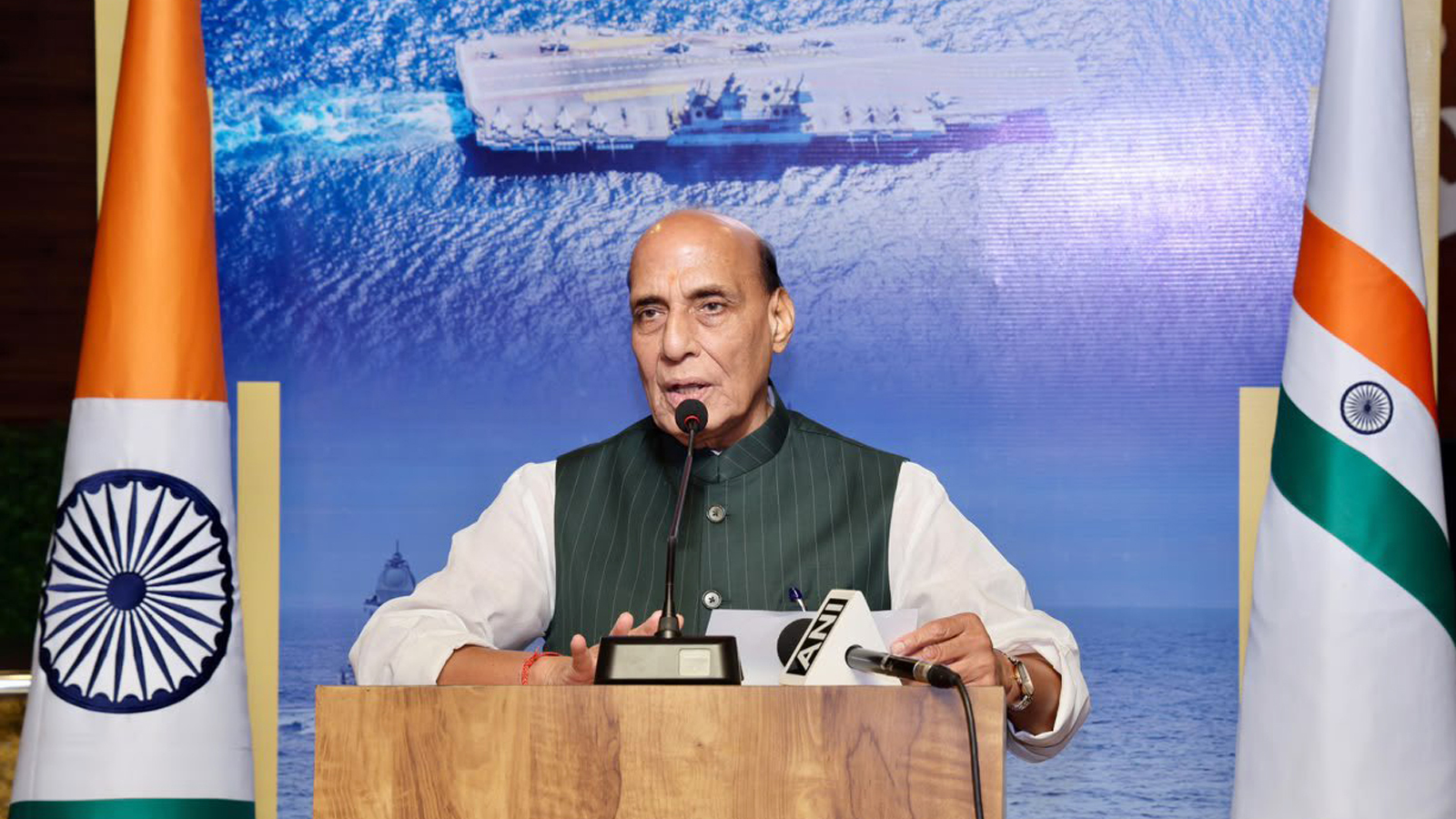
Defence Minister Rajnath Singh on Friday asserted that India has emerged as the primary guarantor of peace and stability in the Indian Ocean Region (IOR), highlighting the Indian Navy’s pivotal role in safeguarding the country’s maritime interests amid an increasingly complex global security environment.
Addressing naval personnel during a Barakhana in Visakhapatnam on the eve of the commissioning of INS Mahendragiri, the sixth indigenous Project 17A stealth frigate, Singh praised the Navy for protecting India’s maritime borders, securing vital sea lanes, and upholding the Tricolour across the region.
Emphasising the strategic importance of the Indian Ocean Region, the Defence Minister noted that more than 90 per cent of India’s trade by volume is conducted through maritime routes. He said the country’s energy security, Exclusive Economic Zone (EEZ), and island territories make maritime security central to India’s economic growth and national interests.
Singh observed that rising geopolitical competition and the increasing presence of extra-regional powers have heightened the need for greater maritime vigilance.
“India stands as the primary guarantor of peace and stability in the Indian Ocean Region. The Indian Navy is protecting India’s maritime borders, securing vital sea lanes, and safeguarding the nation’s interests across the region,” he said.
Describing India as the largest and most responsible stakeholder in the Indian Ocean Region, the Defence Minister reaffirmed the country’s commitment to maintaining peace, stability, and a secure maritime environment. “The region is our courtyard, and securing the courtyard is our responsibility,” he said.
Singh also highlighted India’s progress towards self-reliance in defence manufacturing, describing the commissioning of INS Mahendragiri as another milestone in the country’s indigenous defence capabilities.
Crediting the armed forces for their courage, commitment, and patriotism in safeguarding the nation, he urged military personnel to continuously enhance their skills, embrace cutting-edge technologies, and prepare for the changing nature of warfare.
Singh cautioned that future conflicts may emerge in unpredictable forms, requiring the armed forces to remain physically and mentally prepared.
“There are conflicts that are fought without a formal declaration of war. The adversary of tomorrow may not resemble the adversary of the past,” he said, stressing the need for constant adaptation to emerging technologies and evolving security challenges.
Reiterating the government’s commitment to strengthening the armed forces, Singh assured the personnel that every effort would be made to equip them with world-class weapons, advanced technologies, and modern resources.
“The Government will leave no stone unturned to provide our soldiers with the world’s best weaponry, technology and resources. But weapons alone do not win wars; it is the people who wield them that do,” he said.
Chief of the Naval Staff Admiral Krishna Swaminathan, Flag Officer Commanding-in-Chief of the Eastern Naval Command Vice Admiral Sanjay Bhalla, and other senior Indian Navy officers were present on the occasion.


